Get Full Government Meeting Transcripts, Videos, & Alerts Forever!
Get email alerts on the Mscp Subarea Plan topic
No spam. Unsubscribe anytime.
Santee council reviews draft MSCP Subarea Plan in workshop focused on long-term habitat, river maintenance and permitting certainty
Summary
City staff and consultants presented a draft Multiple Species Conservation Program (MSCP) Subarea Plan that would create a 35‑year permitting framework, a 2,263‑acre managed preserve at buildout and new staffing needs; council members pressed staff for clearer cost examples and timelines for river projects and maintenance.
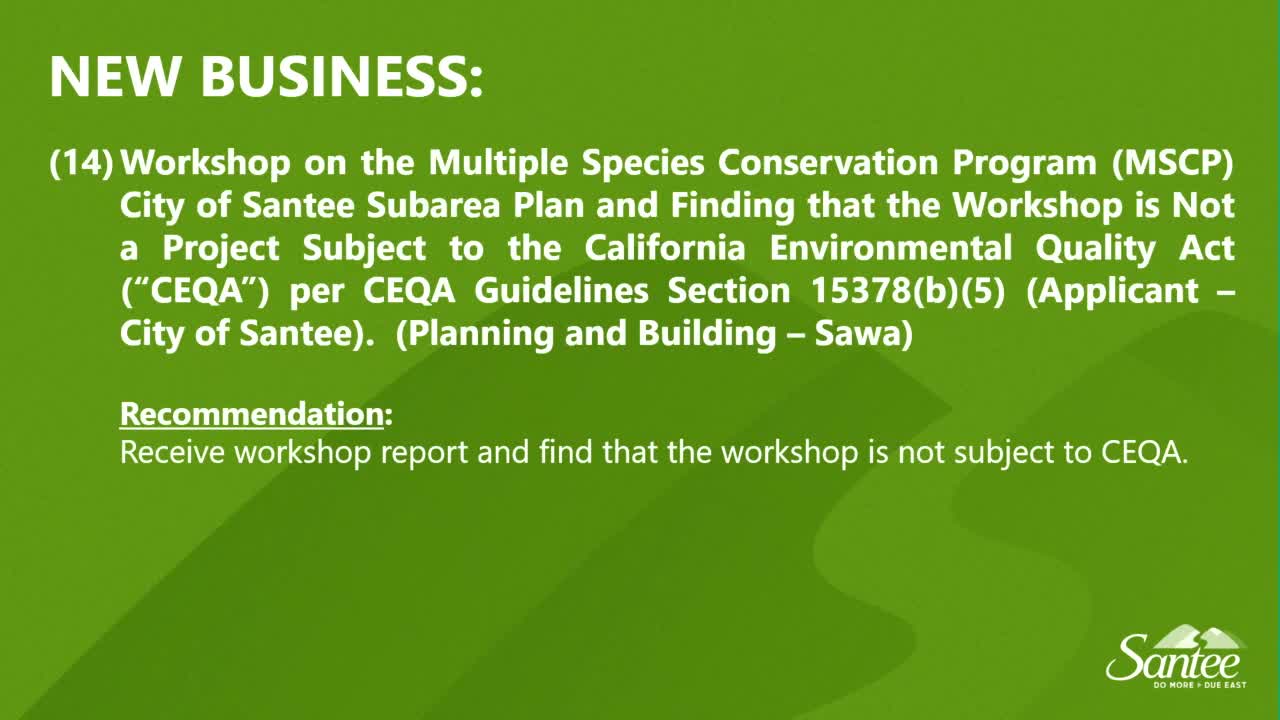
City planning staff and consultants gave a workshop Aug. 13 on the draft Multiple Species Conservation Program Subarea Plan, a framework intended to give the City of Santee long‑term regulatory certainty for species protection and to streamline approvals for maintenance and development projects. The session included a 45‑minute presentation and a public comment period, followed by council questions about cost, timing and local control.
The draft plan, presented by Marnie Borg, principal environmental planner, and Sean Skaggs of consultant firm Evan Mosher & Skaggs, would assemble a managed preserve and conservation strategy covering plants and animals of regional concern, provide federal and state “take” authorization for covered activities, and create criteria to distinguish “hard‑line” projects (with known footprints) from future development. The consultants said the draft would result in about 2,263 acres of managed preserve at full general‑plan buildout and includes habitat restoration commitments tied to specific development projects.
Staff emphasized three types of benefits: ecological protection of coastal sage scrub, chaparral, grasslands, riparian habitat and vernal pools; economic and procedural savings by reducing repetitive project‑by‑project permitting with federal and state agencies; and community benefits such as more predictable trails, defensible‑space work and stormwater projects. The presentation also outlined proposed new staff (a plan coordinator, preserve steward and part‑time preserve manager) and baseline survey and resource‑management costs. Borg said some costs could be pursued through state and federal grants.
During public comment, speaker objections focused on the plan’s long timeline and cost. A frequent commenter — identified in the record as "Truth" — questioned why the plan was returning now after decades and asked why non‑listed “sensitive” species were included and whether federal and county funding aims would centralize land ownership. Other public speakers raised questions about vernal pool reintroduction and whether the plan would limit river access or create unintended rules for routine maintenance.
Council members sought clearer, project‑level examples of the plan’s cost and time savings. Councilmember Hall asked for concrete instances showing how the plan would accelerate or reduce costs for routine River and bridge maintenance; staff cited likely savings on repeated environmental surveys and on EIR costs for small repair projects that currently can cost $200,000–$400,000 per project. Councilmember Koval and others asked whether some of the proposed full‑time positions could be combined or funded by grants; staff said that possibility would be explored.
Staff described next steps as responding to public comments on the draft plan and program EIR, negotiating an implementing agreement with federal and state wildlife agencies, drafting an incidental‑take and habitat‑loss ordinance for local implementation, and returning to council for later public hearings and adoption. Several councilmembers requested a follow‑up briefing showing examples of past project delays and the dollars spent by both the city and project proponents under the current project‑by‑project permitting system.
No formal action was taken at the workshop; staff noted a target for final adoption in 2026, subject to public review and agency coordination. Borg and the consultants said the plan is intended to align Santee’s mobility and town‑center projects with long‑term habitat management and to make river maintenance and trail work less encumbered by repetitive state and federal reviews.