Get Full Government Meeting Transcripts, Videos, & Alerts Forever!
Get email alerts on the Gunshot Detection topic
No spam. Unsubscribe anytime.
Vallejo advisory board recommends city pursue Flock Raven gunshot‑detection system
Summary
After a July–September beta, the Surveillance Advisory Board voted to recommend the Vallejo City Council consider adopting Flock Raven. Police presenters cited faster scene location and investigative leads; board members raised coverage, confirmation rates and potential for self‑reinforcing deployments.
The Vallejo Surveillance Advisory Board voted to recommend that the City Council consider using Flock Raven, a gunshot‑audio detection system, after a presentation by police staff about a beta test of the technology.
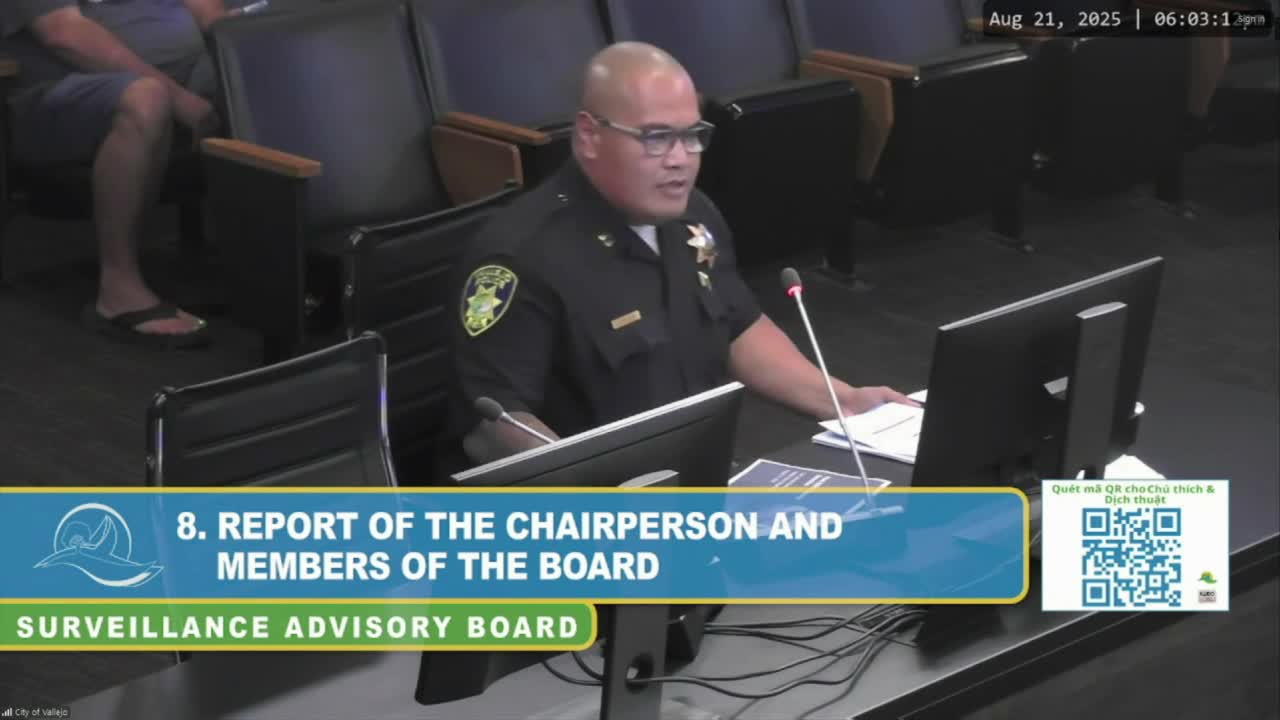
The board’s recommendation followed a presentation by Captain Bautista, who described Raven as “gunshot audio detection technology” and said the department ran training in June and September, began beta testing on Sept. 6 and implemented Raven with dispatch on Sept. 11. “My recommendation would be to move forward with the technology of, Flock Raven,” Bautista said.
Board members discussed the system’s operational benefits and limits. The department reported 1,003 Raven alerts from Sept. 6 through July 31 and 342 separate shots‑fired incidents during the same period. Combined, the department recorded 1,345 shooting alerts and incidents and said 99 investigative cases were generated from those data points — 26 traced to Raven alerts and 73 to caller‑reported shots. Police said 37 incidents had both a Raven alert and a 911 shots‑fired call; in 21 of those incidents officers located a scene within five minutes after a Raven alert, and in five cases Raven helped locate a scene after a gunshot‑wound victim walked into a hospital and could not give a location.
Police staff and dispatch staff described how Raven alerts are reviewed and entered into the city’s computer‑aided dispatch (CAD) system. The department said Raven is not integrated with CAD, and early in the beta not all Raven alerts were entered as separate 10‑75R shots‑fired incidents. Dispatchers receive Raven notifications on a separate console and, when possible, input an approximate location into dispatch. The department said priority and officer response depend on whether a 911 caller also reports shots; a confirmed 911 shots‑fired report will typically elevate the call to a priority‑1 response.
Presenters described the criteria the department uses to label an alert confirmed: a gunshot‑wound victim on scene, physical observation of shots, surveillance video, or physical evidence such as casings or strike marks. The department stressed that an alert labeled “unconfirmed” does not necessarily mean no gunfire occurred.
Board members pressed on data quality, coverage and placement. One board member warned that Raven sensors were not randomly sited but placed where police anticipated violence, a pattern the member said could be “self‑reinforcing” and resemble predictive policing. Police replied the beta used a limited number of sensors chosen from prior gunshot‑analysis and that additional sensors would be needed for citywide coverage. The department also said multiple Raven alerts can result from multiple volleys in a single incident and that triangulation of clustered sensors is used to locate events rather than counting a single gunshot as multiple independent events.
Members asked how often Raven alerts have directly solved homicides. Police staff said Raven alerts alone do not solve homicides but that Raven has supported investigations by identifying additional locations where casings were found, tracking movements of suspect vehicles and corroborating information from other agencies. Bautista said the department had “at least 50 confirmation stories” fitting the stated confirmation criteria and emphasized the operational time savings Raven produces for patrol.
A motion to recommend the City Council consider the use of Flock Raven was made and approved in a roll call vote; four board members voted yes and the chair recorded an abstention. City Attorney Reisner read the request as “that the Surveillance Advisory Board make a recommendation to the Vallejo City Council concerning the use of Flock and gunshot detection technology.”
The board’s recommendation will go to the City Council for a final decision. The department said further work is needed to expand coverage, improve CAD integration and refine dispatch handling and confirmation procedures.
Less critical details: the department presented heat maps showing high concentrations of Raven alerts in sections of North Vallejo — identified in the presentation as Country Club Crest and the Cimarron Hills — parts of central Vallejo west of Highway 80 and a southern area identified in the presentation as South Palleo. Police said the heat maps reflected alerts accumulated during the beta period rather than a fully citywide deployment and declined to share a citywide heat map publicly because it would reveal Raven locations.