
City engineer outlines traffic-impact analysis process; commission asks for clearer seasonal adjustments and executive summaries
Get AI-powered insights, summaries, and transcripts
Subscribe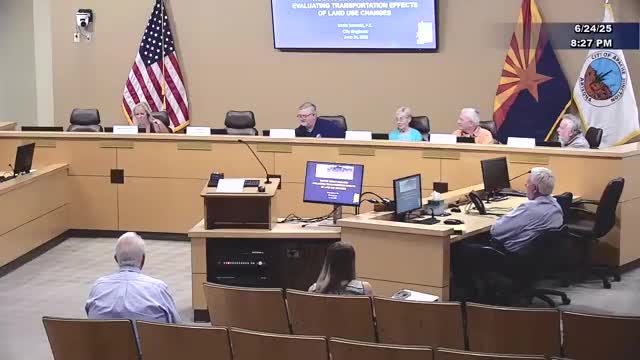
Summary
City Engineer Emil Schmidt told the Planning and Zoning Commission June 24 that traffic-impact analyses (TIAs) are used to assess how proposed developments affect roadway operations and to identify needed off-site improvements or mitigation.
Emil Schmidt, city engineer for Apache Junction, presented a primer on traffic-impact analyses (TIAs) to the Planning and Zoning Commission on June 24, explaining when the city requires TIAs, what they evaluate and how the studies inform mitigation and development conditions.
Schmidt said a TIA evaluates a proposed development’s effects on the surrounding roadway network—examining existing conditions, trip generation, trip distribution and assignment, capacity analysis, crash history and potential mitigation such as turn lanes, signal timing changes and access controls. He said thresholds for requiring a TIA are driven by project size and trip-generation estimates and noted ADOT requires a TIA for developments within a half-mile of state facilities; the Maricopa Association of Governments (MAG) also provides regional modeling inputs and counts.
Schmidt said TIA results are typically expressed as level-of-service grades (A–F) and that the reports identify off-site improvements or design changes needed to maintain safe, efficient traffic operations. He told the commission the city is updating engineering standards and will refine the specific TIA thresholds and submittal requirements so the expectations are clearer for both staff and applicants. He also said the public-works engineering division is recruiting for a traffic engineer to strengthen in-house review capacity.
Commissioners raised practical concerns about how TIAs present data. One commissioner said the Wolf Enterprise study, prepared “off season,” included a seasonal adjustment that was not obvious to readers; commissioners asked that future TIAs clearly document any seasonal adjustments and provide a short executive summary that highlights the key numbers and the study’s conclusions for non-specialists. Schmidt agreed to add clearer documentation of seasonal adjustments and to work with staff and consultants to provide more concise executive summaries in future TIA submissions.
Schmidt said traffic engineers adhere to nationally recognized methods and that TIAs are sealed by licensed engineers whose professional registration and reputation underwrites the analyses. He encouraged commissioners to bring project-specific questions to staff and noted that TIAs help the city identify conditions of approval such as turn lanes, signalization, access management and pedestrian/bicycle mitigations.