
Staff outlines guest-parking standard and rare use of parking reductions; commissioners ask for clearer trade-offs
Get AI-powered insights, summaries, and transcripts
Subscribe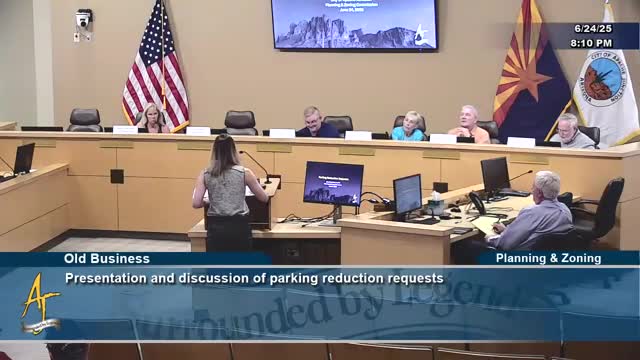
Summary
City planning staff told the Planning and Zoning Commission June 24 that a guest-parking requirement of 0.3 spaces per unit was added to the zoning code after 2023 and that parking reductions remain an infrequent, project-specific exception.
Kelsey Shatnik, a city planner, presented a briefing June 24 on parking-reduction requests and the city’s updated guest-parking standards.
Shatnik said the zoning ordinance did not have a separate guest-parking requirement before 2023; staff added a guest-parking standard of 0.3 spaces per unit after council direction and analysis of recent multifamily projects. She explained how multifamily parking is calculated by bedroom count (studio/efficiency = 1.0 space; one-bedroom = 1.5; two-plus bedrooms = 2.0) and that guest parking is intended to address short-term visitor demand. Administrative reductions of up to 10% are possible if applicants provide technical evidence—such as empirical parking-demand studies—or if public parking within 100 feet can accommodate required spaces.
Shatnik told commissioners parking-reduction requests are infrequent (two formal requests in the past ten years) and are reviewed case-by-case. Commissioners asked staff to make the public record clearer when reductions are approved: identify what the community is “getting back” for fewer parking spaces—for example, on-site amenities, affordable units, or public benefits—and to include those trade-offs in staff reports so the public can evaluate the value of a concession.
Staff said each request is evaluated for context, such as on-street parking availability and neighborhood impacts, and that developers must provide technical evidence to justify a reduction. The commission did not act on any ordinance changes; the presentation was informational.