
Committee clarifies fee categories; legal says development impact fees cannot be waived, but council may authorize city payment
Get AI-powered insights, summaries, and transcripts
Subscribe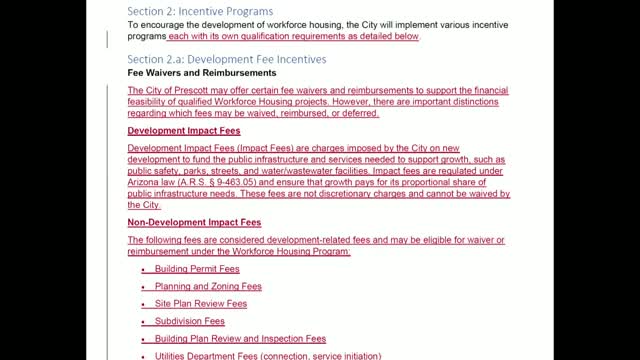
Summary
The draft policy separates non-development fees (eligible for waivers/reimbursements on a sliding scale) from development impact fees (restricted by Arizona law). Legal language included in the draft states impact fees "cannot be waived," though council could decide to have the city pay impact fees for qualifying projects using taxpayer funds.
The committee reviewed a revised policy section that separates development-related fees into distinct categories and explains which fees the city can waive, reimburse, defer, or pay. Amber said the red-line edits aim to clarify the difference between "fee waivers and reimbursements," "development impact fees," and "non-development impact fees." She explained that non-development fees could be waived or reimbursed on a sliding scale tied to the percentage of workforce units; committee members supported matching waiver percentage to the percentage of workforce units (for example, 25% workforce units → 25% non-impact fee waiver). On development impact fees, Amber read legal guidance incorporated into the draft: "These fees are not discretionary charges and cannot be waived by the city." She told the committee that while the city cannot legally waive impact fees, council could authorize the city to pay or defer impact fees for a qualifying project using taxpayer funds or via a council-approved development agreement. Developers and committee members discussed practical differences between waivers and reimbursements. One attendee said a waiver means a developer does not pay upfront, while reimbursement requires the developer to finance fees and wait for a later payment, which can increase project carrying costs. Amber said the draft includes two options—waiver (for demonstrated financial need) or reimbursement (for projects that commit to completing the housing)—and the committee can simplify the approach. Members asked staff to bring legal to the next meeting for a deeper discussion of the city’s options, including whether the city could provide grants in lieu of waivers or reimbursements, or otherwise structure reimbursements to protect taxpayers and lenders.