Board adopts new instructional materials policy after hours of public comment and legal warnings
Summary
After extended public comment and legal testimony, the Grants Pass School District 7 board adopted the second and final reading of policy IIA (instructional materials). The meeting featured objections from parents and educators, an attorney's legal analysis, and a split vote that approved the policy 4–3.
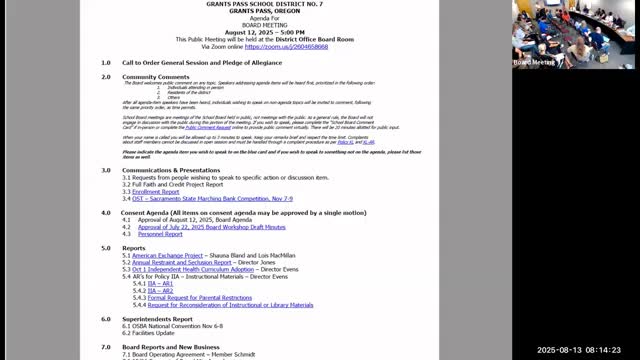
Grants Pass School District 7 adopted the second and final reading of Policy IIA, the district's instructional materials policy, after public comment and a lengthened board discussion. The motion to adopt, which included direction for the superintendent to notify staff and update district guidance, passed on a 4–3 vote.
Supporters of leaving library and classroom materials available urged the board not to remove books. Parents, teachers and union representatives said removing books would limit students' access to diverse perspectives and academic freedom. Laura Latham, a middle school teacher and president of the Phoenix Talent Education Association, said the board should “trust educators to do their jobs” and opposed any policy that she described as book banning. Nicole Jensen, a parent and substitute in the district, told the board: “Please vote no on any book bans. Books don't harm children; closing their minds do.”
Legal counsel for educators warned the board that the policy, as drafted, risked violating federal and state law. Andrew Noland, an attorney representing teachers and local associations, told the board that the policy “places school library materials and classroom library materials under the same umbrella,” then cited U.S. Supreme Court language recognizing special First Amendment protections for school libraries and said Oregon administrative rules and recent state law distinguish library materials from adopted instructional materials.
Board members debated a 25‑day public review period included in the policy's administrative regulation. Supporters said the review period provides transparency and mirrors how core curriculum is handled; opponents said it risked delaying access and created a two‑tier reconsideration process that could be confusing. Several board members said the accompanying administrative regulations (ARs) clarify procedures; others asked for those ARs to be reviewed in policy committee before final implementation.
Chair Smith called for a roll call after discussion. The minutes record four yes votes and three no votes and the motion carried. The board directed the superintendent to make notifications and update applicable district guidance and staff documents as the policy takes effect.
The action follows several weeks of public attention after statewide changes to law were mentioned repeatedly in testimony; speakers referenced the recently passed Oregon legislation described in testimony as the Oregon Freedom of Read Act (referred to in the meeting as “Senate Bill 10 98”) and state administrative rules cited in the board discussion.