Get email alerts on the Traffic Safety topic
No spam. Unsubscribe anytime.
Gilbert officials review traffic-safety data; staff to collect more information on cameras, staffing and crossings
Summary
Town staff and the Gilbert Police Department presented crash and enforcement data and discussed engineering, education and enforcement strategies. Council asked for more data on motorcycle crashes, automated enforcement and staffing; staff were directed to follow up.
Town of Gilbert traffic engineers and the Gilbert Police Department briefed the Town Council at a study session Tuesday on local crash trends, enforcement activity and engineering measures to reduce serious injuries and fatalities on the town’s roadways.
“Keeping the community safe and efficiently moving through our community is one of our whys,” Traffic Engineer Susanna said during the presentation, summarizing the town’s approach to traffic safety.
The briefing covered the “4 E’s” of traffic safety — evaluation, education, enforcement and engineering — and included multi-year crash and enforcement data. Town staff said Gilbert’s crash rate per capita is lower than the broader MAG region (the Maricopa Association of Governments) and that, overall, Gilbert’s fatality rate is roughly 60% lower than the rest of the region, but that the town remains concerned about intersection crashes and motorcycle fatalities.
Gilbert’s traffic data presented to the council included these takeaways: crashes are concentrated at or immediately adjacent to intersections (about 80% of crashes since 2021); intersection-related fatalities are predominantly linked to speed and failure to yield; crash rates in Gilbert have remained generally stable since 2021; and Gilbert’s total crashes per 100,000 residents are about 42% lower than the MAG regional average. Staff cautioned that some MAG 2024 figures are still unofficial.
Rob Frost, commander with the Gilbert Police Department, told the council the department’s top contributing factors to crashes in 2024 are “speed too fast for conditions, failing to yield the right of way, drivers making unsafe lane changes, and . . . disregarded traffic signals.” Frost said motorcycle crashes in Gilbert have increased about 40% since February 2021, while motorcycle registrations in Arizona rose about 33% over a comparable period; Gilbert’s motorcycle crash rate remains below the MAG-region average.
On enforcement, staff said the traffic unit currently consists of nine daytime traffic officers and one sergeant, three nightlife traffic officers and one night sergeant focused on impaired driving, and three civilian patrol technicians who assist with clearing minor crashes. Departmentwide last year, officers issued more than 9,500 citations and about 26,500 warnings. A targeted enforcement operation on Val Vista Road in August–September resulted in 1,105 traffic stops and 713 citations; the most frequent citations were for unreasonable/unsafe speed (373) and use of a mobile device while driving (109).
Police leadership and town staff stressed a mix of approaches. “We can’t enforce our way out of the problem,” the Police Chief said, urging a balance of enforcement, engineering changes and public education. Engineering measures discussed included safety audits, signing and striping reviews, signal retiming (the town standardized signal clearance intervals in 2022), addition of turn lanes where appropriate, trail-crossing signalization and pilot traffic-analytics software (an ATSBM analytics tool was described as the leading pilot project). Staff said they are pursuing grants and will add funds for preemptive cameras in some locations.
Council members asked staff to gather additional information. Council member Chuck Bongiovanni pressed for what the council could provide to improve safety, citing personal bike-riding close calls and asking, “What do you guys need from us to make the streets safer from drivers?” The chief and traffic staff cited staffing shortages (roughly half the traffic unit positions are vacant because of retirements) and asked for council consideration of additional officers and civilian traffic technicians. Council member Monte Lyons and others requested a staffing analysis and a peer comparison to identify an “optimal” traffic-unit size for a community Gilbert’s size.
Automated enforcement — red‑light and photo‑based speed enforcement — drew sustained discussion. The Police Chief noted the valleywide data generally show red‑light cameras reduce red‑light running; Tempe and Phoenix were cited as nearby cities using or returning to those tools. Council members raised typical concerns: cost, privacy, program administration and whether camera programs pay for themselves over time. Several council members asked staff to monitor Tempe’s new program and to bring back data and cost estimates before making any recommendation.
Motorcycle lane‑splitting and the recent state change allowing certain lane‑splitting practices also drew questions. Council members asked staff to contact state and regional partners for comparative data on whether lane splitting correlates to recent increases in motorcycle fatalities. Commander Frost said anecdotal crash reports sometimes indicate motorcycles accelerate from the front of the queue and are involved in high‑speed collisions after the light turns green; staff said they do not yet have conclusive multi‑city data on the issue.
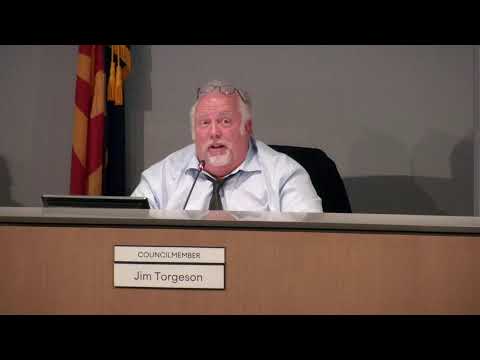
Several council members proposed low‑cost campaigns and temporary signage to test behavioral change. Council member Jim Torgerson offered, on the record, “I will contribute out of my pocket 40 signs, and let’s see if that works,” and other members suggested working with the town’s Parks & Recreation Foundation and existing bike‑safety funds to support education and low‑cost engineering (for example, green bike lane paint and temporary large signs). Staff noted the town’s sign code and right‑of‑way rules would govern any temporary signage and said Legal and Planning would help structure any pilot.
On trail crossings, staff said designs for five or six additional signalized or lighted trail crossings are in progress; design challenges include aligning trail crossings with existing intersections and right‑of‑way constraints.
No policy or ordinance was adopted at the study session. The formal action near the session’s end was a motion to adjourn the study session, which the council approved and the body recessed to prepare for the regular council meeting. Council and staff left the meeting with explicit follow-up assignments: produce a staffing needs analysis and peer comparisons for traffic staffing; gather data and cost estimates on automated enforcement and report on Tempe’s initial results; request comparative data from state and regional partners on motorcycle crash patterns since the lane‑splitting change; and provide updates on planned trail‑crossing signals and pilot analytics software.
The council asked staff to return with the requested data and cost estimates for further discussion at a future meeting.