
San Angelo council authorizes application to NRCS emergency watershed program for floodway armoring and voluntary buyouts
Get AI-powered insights, summaries, and transcripts
Subscribe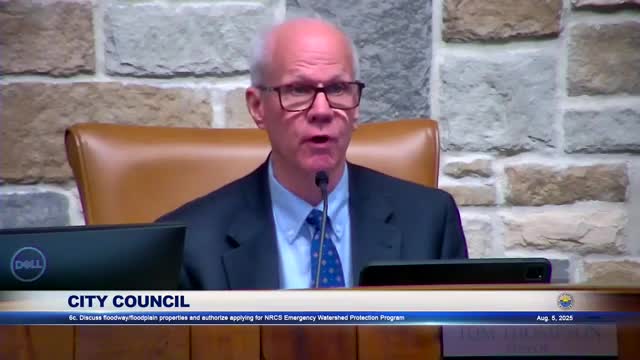
Summary
The council unanimously authorized staff to apply to the U.S. Department of AgricultureNatural Resources Conservation Service Emergency Watershed Protection (EWP) program to seek 75/25 cost-shared funding for infrastructure armoring and voluntary buyouts of flood-prone properties after the July 4 flood.
The San Angelo City Council on Aug. 5 authorized city staff to apply to the U.S. Department of Agriculture Natural Resources Conservation Service Emergency Watershed Protection Program to pursue cost-shared armoring of public infrastructure and voluntary buyouts of properties at imminent flood risk. The council voted 6-0 to permit staff to submit a letter of request to NRCS and begin the application process.
The authorization lets the city propose two types of projects under NRCSEWP: armoring projects to protect roads, outfalls and other infrastructure from erosion and flood damage, and voluntary buyouts of privately owned properties that are at imminent risk of future flooding, drought or erosion. Operations Director Patrick Frerich said the NRCS program pays 75% of approved project costs and requires a 25% local match. "The only obligation I need from y'all today is this action item that says authorization to apply to this program. That gets the ball rolling," Frerich told the council.
Why it matters: council members and staff said the July 4 inundation revealed long-standing, concentrated flood risk south of the loop and along the East Angelo draw. Staff identified a cluster of roughly 110 properties in the most impacted south-of-loop area touching the FEMA-designated floodway; those parcels have a combined pre-flood CAD valuation of about $12,000,000. City staff noted many of the structures in the mapped floodway cannot be rehabilitated under local permitting and FEMA floodway rules, and are therefore candidates for voluntary acquisition.
City staff described armoring examples that could be proposed to NRCS: strengthening riprap and outfalls at Rio Concho Drive near the convention center, stabilizing eroded banks under bridges along Nineteenth Street, and grouting riprap at concrete crossings that have repeatedly failed. Frerich said NRCS provides engineering, design and a 75/25 funding split; the city would bid and construct approved projects and remain responsible for maintenance.
The buyout portion would be entirely voluntary. Frerich said each parcel proposed for buyout would require a separate, well-documented approval process with NRCS; property owners must sign an opt-in notification before negotiations can begin. Under program rules the city must own acquired properties in perpetuity and limit future uses (typically open space or passive recreation). Frerich said the EWP buyout also covers relocation and remediation costs when applicable.
Council members asked staff to limit requests to feasible sites and to return with financial options before spending local funds. Councilmember Daniel (first name used in meeting) and others noted the city lacks a dedicated revenue stream for large drainage or buyout programs; staff said some pre-application costs and required local match elements (real estate work, environmental studies, permitting) could be included as part of the citys 25% share. Frerich and city staff said no Council authorization to buy properties or spend matching dollars was being made at this time; only the application to NRCS was authorized.
Public commenters described personal flood damage and asked staff for individual assistance in evaluating options. Aaron Vannoy, director of planning and development services, explained that whether a damaged structure can be rebuilt depends on its location and the percentage of destruction; structures wholly in the FEMA floodway generally face strict limitations.
Next steps: staff will submit the NRCS letter within the programs 60-day submission window, work with NRCS to screen candidate sites, and return to council for approval before any local matching funds or property acquisitions are committed.