Get Full Government Meeting Transcripts, Videos, & Alerts Forever!
Get email alerts on the Transportation Infrastructure topic
No spam. Unsubscribe anytime.
Caltrans says SR‑94/125 auxiliary‑lanes design nearly finished; connector still unfunded
Summary
Caltrans presented a two‑phase update on the SR‑94/125 interchange: an 85 million‑dollar auxiliary‑lanes phase moving to construction in 2026 and a larger connector phase still seeking full construction funding.
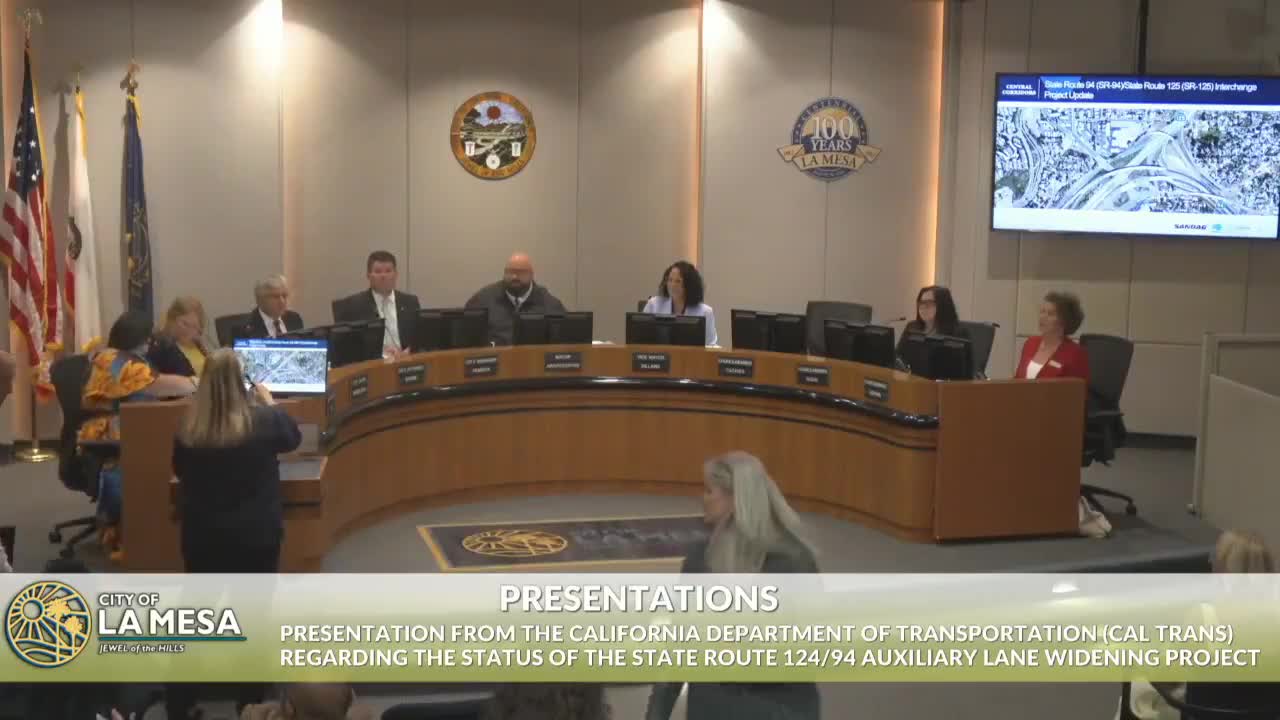
Caltrans project staff told the La Mesa City Council on Aug. 12 that design work on the first phase of the State Route 94/Interstate 125 interchange — the auxiliary‑lanes project — is nearly complete and is expected to reach the California Transportation Commission for funding allocation in December 2025. Construction is forecast to start in 2026 and take about two years.
Why it matters: The interchange, built in 1974 without a southbound‑to‑eastbound connector, has been cited by residents and local officials as a chronic bottleneck and a source of traffic spilling onto local streets. Caltrans said the two‑phase approach was chosen to deliver some improvements sooner while it resolves environmental and groundwater issues affecting the connector design.
Caltrans project director Karen Jewell and project manager Jake Stelton described the split approach. Stelton said the first phase — the auxiliary lanes project — includes two auxiliary lanes (one on southbound 125 and one on eastbound SR‑94), an added auxiliary lane on northbound 125 requested by the community, reconstruction of the Mariposa Street bridge to lengthen it for the lanes, some originally planned sound walls and retaining walls, and pedestrian and ADA upgrades on Mariposa Street and Bancroft Drive. Stelton said the auxiliary‑lanes phase is “fully funded through our State Transportation Improvement Program” administered by SANDAG and estimated construction capital and support at roughly $85,000,000.
Stelton told the council Caltrans is finishing design with the goal of getting that project to the December CTC meeting for allocation and opening it to traffic in “late spring, early summer 2028.” He said the second phase, the direct connector (the southbound‑to‑eastbound movement), is in environmental and design phases and is expected to cost about $140,000,000 for construction; however, “we are still searching for construction” funding for that connector.
Council members and public speakers pressed Caltrans on the project’s long history, alternatives and possible impacts. Vice Mayor Dillard asked whether the connector was the region’s top priority; Stelton replied, “It's the number 1 priority” for the regional program, but added that STIP funding is limited and Caltrans is pursuing federal grants and other sources. Public commenters raised concerns about groundwater contamination (selenium), project sequence and induced demand from widening freeway facilities. Mary Davis, a resident, asked for more detail on groundwater depth and whether pumping would be needed; Stelton said the groundwater issue prompted the split and that cost estimates (including the $140 million) depend on whether the connector will go over or under the freeway because “the water table and the water is an issue.”
Caltrans said the choice to build auxiliary lanes first was intended to relieve the immediate bottleneck under Mariposa by adding capacity for weaving and to reduce traffic using Spring Street as an unofficial connector. Stelton said the auxiliary‑lanes work was timed so that, if funds become available, connector construction could start immediately after phase one finishes.
No formal action or local funding commitment was taken by the council at the meeting; the presentation was informational and followed by public comment.