
Puyallup Tribe, state regulators outline terms of restated gaming-compact amendment
Get AI-powered insights, summaries, and transcripts
Subscribe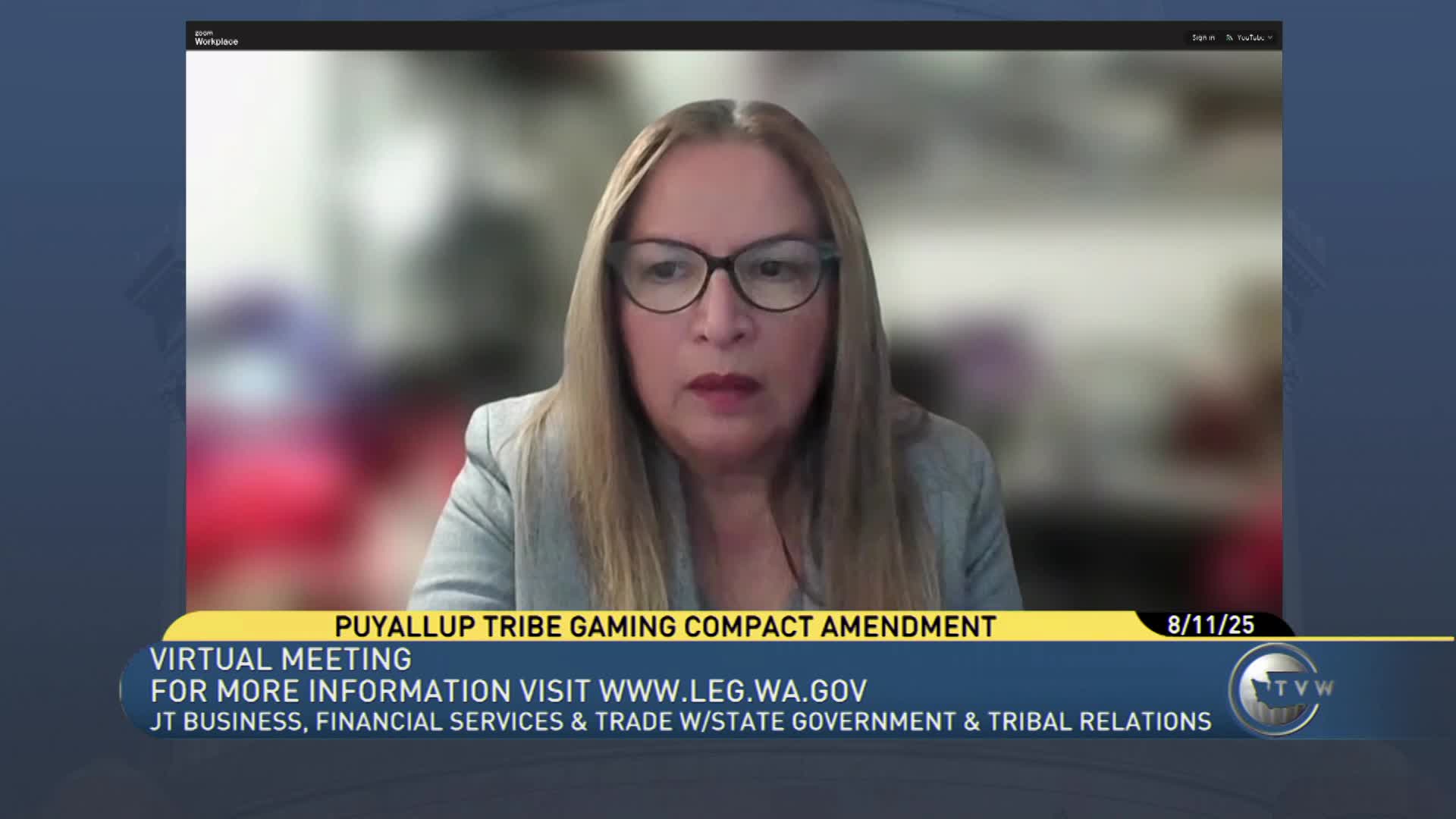
Summary
At a joint legislative hearing Aug. 11 in Olympia, Puyallup Tribe leaders and Washington State Gambling Commission staff presented a restated amendment to the Puyallup Tribe of Indians’ gaming compact, summarizing changes to electronic table games, player‑terminal limits, licensing responsibilities and responsible‑gaming measures.
At a joint legislative hearing Aug. 11 in Olympia, Puyallup Tribe leaders and Washington State Gambling Commission staff presented a restated amendment to the Puyallup Tribe of Indians’ gaming compact, summarizing changes to electronic table games, player-terminal limits, licensing responsibilities and responsible‑gaming measures. The hearing was held by the Senate Committee on Business, Financial Services & Trade and the House State Government & Tribal Relations committee.
The compact restatement seeks to incorporate prior amendments, clarify conflicting definitions and add appendices addressing electronic table games (ETGs), licensing/eligibility and a unified definitions section, Washington State Gambling Commission tribal liaison Julie Leese told the committee. Leese said several provisions mirror compacts the state has negotiated with other tribes but include specific options for the Puyallup Tribe’s allocation of gaming devices and wagering limits.
Why it matters: Tribal gaming revenues fund tribal government services and economic development, speakers said, and the compact changes would affect how the tribe operates its Emerald Queen Casino properties, allocates player terminals and structures high‑wager play and licensing oversight.
Key changes described
- Electronic table games and wagers: Leese said ETG provisions are included in 11 other tribal compacts in Washington. The restated agreement would allow ETG operation under an ETG appendix already used elsewhere in the state’s compacts.
- Removal of per‑facility limits and wager limits: The draft removes prior per‑facility limits on player terminals and is consistent with removing a $30 wager cap that other compacts have removed; Leese noted that removal of the $30 wager cap aligns with how the Washington State Lottery operates.
- High‑wager tables and prescreening: The restatement allows the tribe to operate higher‑wager tables (up to specified limits) for prescreened customers, subject to criteria for customer protection and privacy. Leese said earlier compacts limited higher‑wager seats to a percentage of the gaming floor; under the Puyallup draft the tribe can decide how many such tables to offer based on customer demand.
- Player‑terminal allocation and phased implementation: Leese described that the Puyallup Tribe has been operating roughly 4,000 player terminals, some leased from other tribes. Under the draft, the tribe could add up to 1,000 player terminals to its own allocation and—optionally—receive an incremental additional 500 after operating at the higher level for a transitional period; those steps are optional, she said.
- Licensing and registration appendix: The draft adds an appendix that distinguishes “eligibility” and “registration” pathways. Leese explained that under eligibility, the tribe assumes more licensing responsibility and employees licensed under that pathway would be restricted to Puyallup facilities rather than able to move between tribal facilities statewide.
- Unified definitions appendix: The restatement consolidates definitions so separate appendices and prior amendments use consistent terms, Leese said.
Tribal presentation: uses and benefits of gaming revenue
Puyallup Tribe officials described how gaming revenues have funded cultural preservation, housing, health services and economic diversification. Vice Chairwoman Sylvia Miller said gaming revenue finances a tribal headquarters building, a youth center, a funeral facility that keeps funerals out of school buildings, a K–12 school the tribe operates and elder services. She said the tribe operates a health authority that serves tribal members and nonmembers and cited addiction treatment and cancer support centers.
"We are blessed to have this revenue," Sylvia Miller said, describing programs that provide tuition assistance, housing initiatives and elder care. The tribe’s financial and economic development officer, Matt Wadhwani, said the tribe and its enterprises are among the region’s largest employers; he said tribal enterprises employ nearly 5,000 people and generate more than $1 billion in economic impact in Pierce County, according to his presentation.
Emerald Queen Casinos CEO Yael Rowe emphasized responsible‑gaming measures tied to the compact restatement. "It is our shared responsibility and obligation to help those who are unable to gamble responsibly," Rowe said, describing signage, self‑imposed limits, self‑exclusion processes and partnerships with the Evergreen Council on Problem Gambling. Rowe also said the tribe engaged consultant Dennis Amorine, formerly of the Nevada Gaming Control Board, to help build compliance and audit programs.
Process and next steps
Washington State Gambling Commission staff and committee members emphasized this legislative hearing is one step in a multi‑stage approval process. Leese and commission staff said the commission will hold a public hearing and take public comment at its Aug. 14 meeting, when four commissioners and four ex officio members (Sen. Conway, Sen. Holy, Rep. Clibborn/Clovis as listed in the transcript, and Rep. Waters) will vote to either send the restated compact forward to the governor or return it for further negotiation. Leese said the tribe signs the compact as part of its process, the governor reviews it, and the Department of the Interior’s Office of Indian Gaming has 45 days to act; the compact becomes effective upon publication in the Federal Register.
Committee members and staff acknowledged the tribe’s charitable giving and community partnerships. Chair Claudia Kauffman thanked tribal presenters for the overview and noted the committee’s required 30‑day review hearing timing.
Public comment and immediate outcomes
No members of the public signed up to testify at this legislative committee hearing, the committee clerk said. No formal legislative vote or approval occurred at the Aug. 11 session; the Washington State Gambling Commission’s public hearing and vote scheduled for Aug. 14 are the next formal actions described on the record.
Limitations and transcript notes
Committee staff and presenters clarified many details during the hearing; where the transcript contained inconsistent spellings or dates, the article uses the spelling and names provided by presenters on the record (for example, "Puyallup Tribe" and "Emerald Queen Casinos"). Specific numeric limits and implementation steps described by commission staff were summarized as presented; the commission and the tribe will publish final, machine‑readable compact language after negotiations conclude and the commission and governor act.
Ending
The joint committee closed the hearing after thanking the Puyallup Tribe delegation and Gambling Commission staff; committee members reiterated that the commission’s Aug. 14 meeting will accept public comment and then vote on whether to forward the restated compact to the governor or return it for more negotiation.