
Washington health officials warn HR 1 will shrink coverage, cut provider funding and raise verification burdens
Get AI-powered insights, summaries, and transcripts
Sign Up Free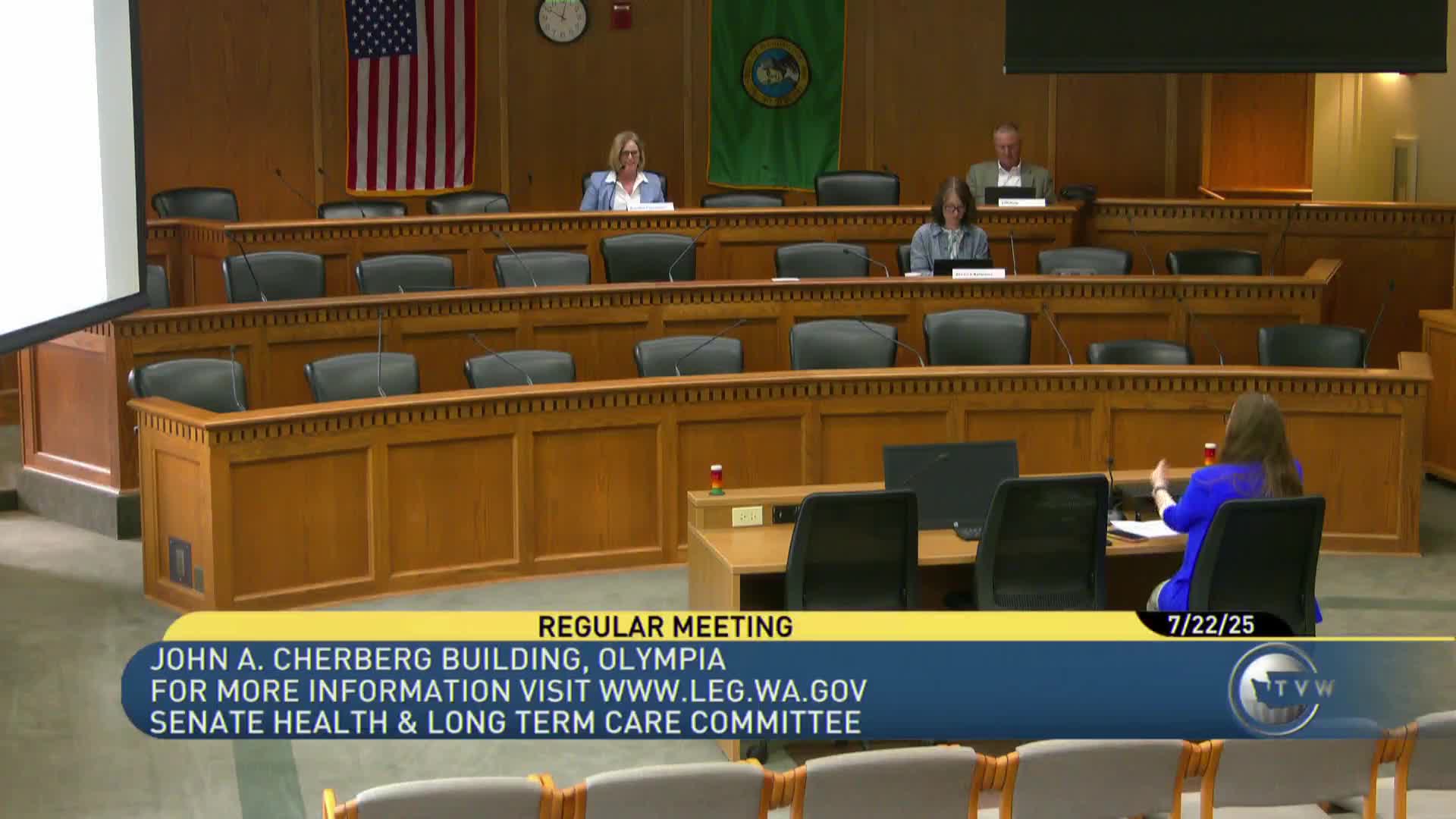
Summary
Caitlin Stafford, the governor’s senior health policy advisor, and Washington State Health Care Authority officials told the Senate Health and Long Term Care Committee on July 22 that the federal reconciliation bill HR 1 will cause coverage losses in the individual market starting in January and impose significant Medicaid funding, verification and administrative changes over the next several years.
Caitlin Stafford, the governor’s senior health policy advisor, and Washington State Health Care Authority officials told the Senate Health and Long Term Care Committee on July 22 that the federal budget and rule changes in HR 1 will likely cause immediate disruptions for the individual insurance market and substantial Medicaid funding and administrative changes over the next several years.
Why it matters: Committee members were told the combination of HR 1 provisions and potential expiration of enhanced premium tax credits could leave tens of thousands uninsured in January and reduce federal Medicaid dollars to the state by billions over a 10‑year window, forcing difficult budget and program choices for providers and counties.
State officials said HR 1’s provisions will produce losses in the individual marketplace beginning in January and that Medicaid impacts will follow. Caitlin Stafford said, “we're probably gonna start seeing at a minimum about 80,000 people not being able to afford coverage starting in January.” Dr. Sherissa Fotinos, Medicaid and behavioral health medical director at the Health Care Authority, summarized the wider effects: HR 1 shortens retroactive coverage, increases the frequency of eligibility checks, adds work and community‑engagement requirements for certain adults, restricts who can bill for some reproductive services, and caps state‑directed payments tied to Medicaid rates.
Officials outlined several concrete provisions and expected timing that will affect beneficiaries and providers. Dr. Fotinos listed measures in HR 1 that committee members should note: eligibility redeterminations every six months beginning December 2026; shortening retroactive coverage from three months to one month starting January 2027; new work or community‑engagement requirements effective December 2026 (with CMS rulemaking expected in mid‑2026); a federal cap that limits state‑directed payments to Medicare levels (with phased reductions beginning in 2028); a new federal allowance for cost sharing of up to $35 for some services in October 2028; and a removal of good‑faith waivers that could reduce federal financial participation if error rates exceed a 3% threshold beginning in 2029.
State response and uncertainty: Trinity Wilson, assistant director for Medicaid eligibility, and Dr. Fotinos described steps the state is taking. Washington has a mitigation plan with CMS to automate certain eligibility renewals for non‑MAGI populations by June 2027; officials plan to request waivers or extensions from CMS so implementation of some HR 1 requirements can occur after automated systems are ready. Dr. Fotinos said the administration will “apply for a waiver” to delay implementation of the work requirement while the state finishes technology and process changes.
Officials highlighted several numerical estimates discussed during the briefing. Caitlin Stafford and Dr. Fotinos said models vary, but provided working figures the state is using for planning: roughly 80,000 people in the individual market could lose coverage in January; multiple modeling approaches suggest more than 100,000 people could lose coverage over a 10‑year horizon; and the cap on state‑directed payments could reduce Washington’s leverage of federal funds by about $1.5 billion annually (staff noted the safety‑net assessment is about $1.3 billion and an additional $200 million is tied to the University of Washington). Dr. Fotinos also said Governor Jay Inslee’s office has committed to filling an immediate Planned Parenthood funding gap of about $11 million for the next year while legal challenges proceed.
Officials warned of operational burdens on beneficiaries and providers. The combination of increased verification frequency, new documentation requirements for work or community engagement, and short windows for proving eligibility could drive coverage losses through administrative churn. Trinity Wilson noted that some wage and work data can already be pulled from the Employment Security Department for quarterly wages, and state agencies are coordinating to reduce duplicate reporting across Medicaid, SNAP and TANF. Still, witnesses flagged particular risks for gig workers, seasonal workers and people with unstable addresses.
Rural hospital funding: HR 1 created a $10 billion annual rural health transformation fund, with applications due this year and awards at the secretary’s discretion. Committee members and presenters said the rural fund may help some providers but is unlikely to fully offset the longer‑term financial impacts from reduced state‑directed payments. Dr. Fotinos said the program is time‑limited and discretionary, and officials will apply but cannot guarantee award outcomes.
What was not settled: Presenters emphasized that modeling varies, federal rules and litigation remain active, and the state faces an “unpredictable” federal landscape. Dr. Fotinos noted several provisions that were removed or delayed in the final federal action, including a proposed FMAP reduction for some states and a prohibition on gender‑affirming care for minors; she warned those items may reappear in future rulemaking.
Where lawmakers may act: State officials said many policy and technical changes will require partnership with the legislature in the short 60‑day session and the 2027 regular session. They will supply timelines and more detailed impact estimates as agency analysis with the Office of Financial Management is completed.
Ending note: Committee members pressed for clear timelines and better predictability for providers and counties. Officials committed to producing a public timeline and continuing interagency and tribal consultation on application for federal funding and implementation steps.