
D11 reports rise in behavior incidents after new reporting and cell-phone enforcement; board backs planning for large bond
Get AI-powered insights, summaries, and transcripts
Subscribe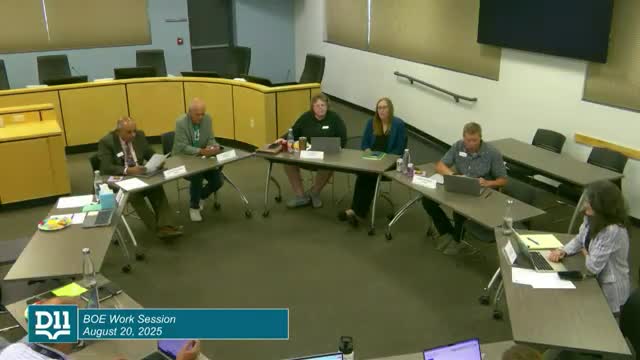
Summary
Colorado Springs School District 11 administrators told the Board of Education on Aug. 20 that reported student behavior incidents rose in 2024–25 after the district standardized reporting and enforced a cell-phone policy, but officials said better documentation — and a newly tracked "cell phone" category — explain much of the uptick.
Colorado Springs School District 11 administrators told the Board of Education on Aug. 20 that reported student behavior incidents rose in 2024–25 after the district standardized reporting and enforced a new cell-phone policy — but they said the increase largely reflects better documentation, not a sudden collapse in behavior.
Superintendent Gahl and interim accountability staff described training for principals and the district's migration to PowerSchool incident reporting, and they said the largest single driver of the increase was incidents coded to a new "cell phone" category that was not tracked in 2023–24. The district also reported wide variability across schools in how incidents were recorded and emphasized work to reduce an oversized "other" category in the data.
"Cell phones are sticking," Superintendent Gahl said, adding that improved reporting means some schools are recording many incidents they previously did not log. "The win has been cell phones is sticking. You'll see that in the numbers...we have lots of cell phone incidents. That's good because we're reporting that," Gahl said.
Dr. Schulte, who presented the accountability structure, told the board the district trained principals in the 2024–25 year to document every state-reportable incident in PowerSchool and to communicate with families about discipline. "Safety is the utmost importance for all of our schools," Dr. Schulte said. She described a three-year expectation: higher initial variability as the system normalizes, then steadier, actionable data in year three.
Central details presented to the board included:
- A districtwide increase in reported incidents from 2023–24 to 2024–25 driven in large part by the addition of a cell-phone category and by incidents recorded as "other," which administrators said needs better specificity for action.
- Elementary schools showed increases in categories labeled "unsafe behavior" and "other violations," though administrators noted cell phones were not a primary issue at the elementary level.
- Middle and high schools showed larger increases; administrators said middle schools had nearly doubled incident counts at some sites, and that the new cell-phone category was the largest subcategory in middle and high school "other" totals.
- The district reported a decline in behavior incidents at Coronado Elementary (40% decrease from 2023–24 to 2024–25) and steady or improved results at other schools (Edison, Russell and Jenkins cited for stable or improved measures), with school leaders attributing gains to clearer expectations, family communication and consistent enforcement.
Administrators explained that some of the apparent growth in incidents is a product of better reporting rather than worsening behavior. "We have had a noisy system for several years," said Chief Koligian, who described prior local spreadsheets and inconsistent practices that prevented district-level analysis. He said that as reporting becomes consistent, site-to-site variability should moderate.
Board members asked about definitions and consequences. When asked to define "unsafe behavior," administrators read the state reportable definition: "detrimental to the welfare or safety of other students or school personnel or that create a threat of physical harm to the student self or others." Board members asked whether teachers know how to log incidents; administrators said on-demand training and building-level briefings are available and that PowerSchool now supports a two-way dialogue between teacher and administrator about each incident.
Administrators also discussed expulsions and safety: expulsions in the district were primarily for assault and violence, and administrators said those cases typically involve law enforcement and possible court action. They reiterated that drug use and weapons on campus remain zero-tolerance priorities.
On the facilities side of the Aug. 20 work session, Superintendent Gahl and Chief Comfort briefed the board on facilities needs and polling on a potential bond. Gahl said the district's average building age is about 65 years and that many high schools have not had major renovations since construction in the 1970s.
Chief Comfort outlined an illustrative $750 million bonding concept to cover transformational investments in middle and high schools, completion of the Palmer High School master plan, repayment of current certificates of participation (COP) that are now funded from the mill levy override (MLO), and targeted elementary modernizations and sustainability upgrades. The administration recommended a community engagement process and polling ahead of any bond question and reported a spring poll that showed roughly 58% support under modeled packages — close to the 60% threshold the administration used as a guide to likely passage.
"We are 1 phone call away... from being in a position where we won't have the money to actually make the repair," Gahl said, urging the board to direct staff to prepare a community-engaged bond plan for consideration. Board members expressed support for moving forward with community engagement and asked that sustainability and energy-efficiency work be included in project scoping.
Actions and follow-ups the board asked administrators to pursue included tightening PowerSchool reporting rules to reduce the "other" category, producing a closure metric for incident follow-up, continuing principal training and teacher support for classroom management, and developing a detailed bond project list and public engagement timeline for a possible Nov. 2026 ballot measure.
The board did not vote on any of the items at the Aug. 20 meeting; it directed staff to return with refined data and a community-engagement plan to inform any future bond decision.