
Building trades urge safeguards for workers, apprenticeships as off‑site construction grows
Get AI-powered insights, summaries, and transcripts
Subscribe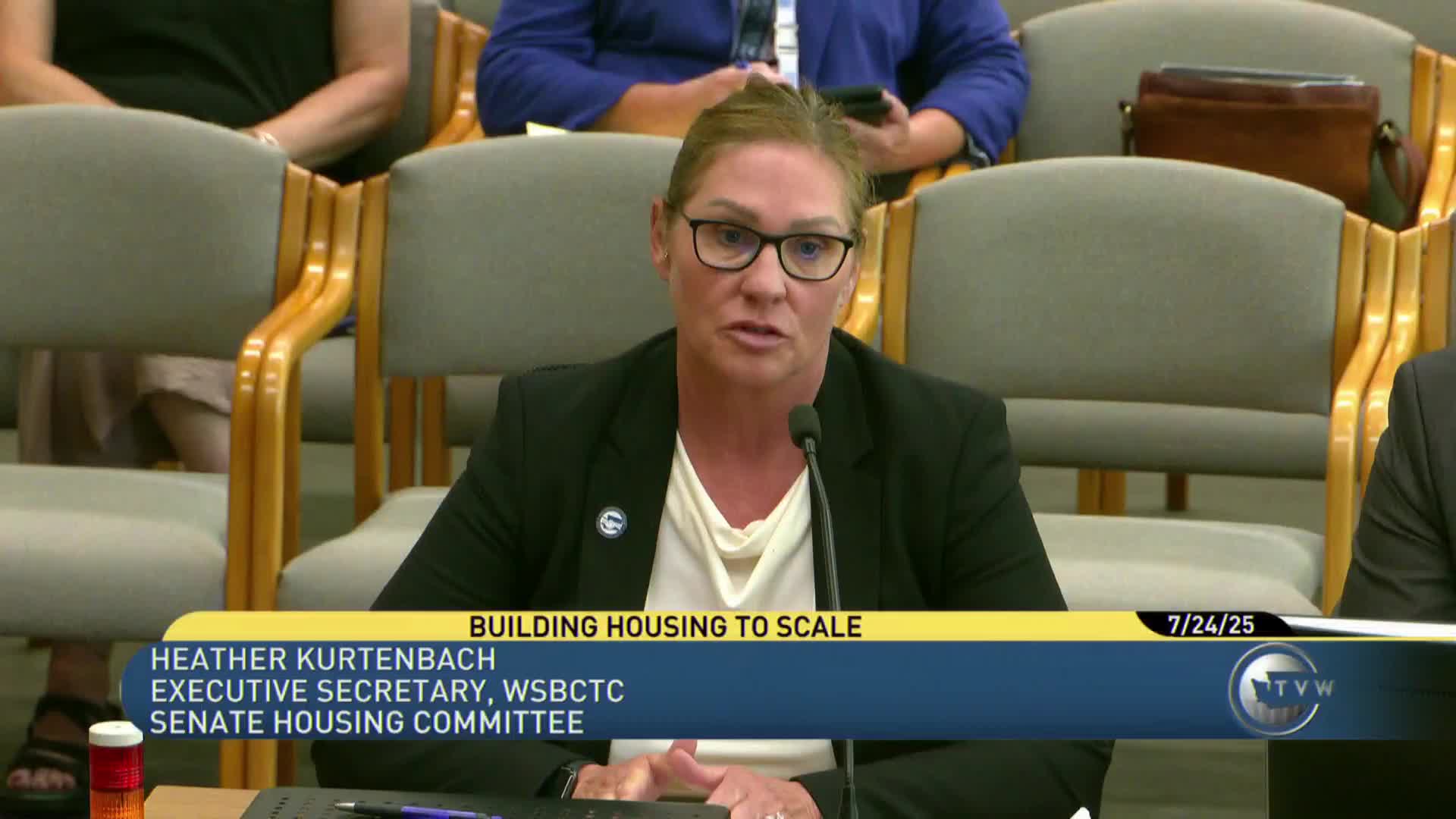
Summary
State building trades and the UA plumbers warned the committee that prefabrication and modular construction can speed housing delivery but must not undercut wages, apprenticeships or safety. They urged stronger contractor licensing, project labor agreements and enforcement when public funds are used.
Representatives of the Washington State Building and Construction Trades Council and the United Association plumbers’ union told the Senate Housing Committee on July 24 that prefabrication and modular housing present opportunities to increase supply but also raise labor, safety and enforcement concerns.
Heather Kurtenbach, executive secretary of the State Building Trades, said the trades support reducing permitting time and administrative burdens but warned against weakening safety or labor standards to speed housing production. “Prefabrication must not come at the expense of worker or consumer safety,” she said, and she urged measures to preserve apprenticeship opportunities and wages. Kurtenbach recommended community workforce or project labor agreements to guarantee skilled workers and limit labor disputes on projects that use public funds.
Neil Hartman, government affairs director for the Association of UA Plumbers and Pipefitters, supported trades engagement in the housing conversation and described compliance challenges in residential construction. He told the committee residential projects—particularly small, scattered or heavily subcontracted job sites—are difficult to monitor for violations such as worker misclassification and wage theft. As a preventive step, Hartman said the underground economy task force is exploring enhanced contractor licensing that would include minimal training requirements on the front end (he noted current licensing can be obtained with a bond and minimal prerequisites) so new entrants understand Washington’s labor and contracting rules before work begins.
Hartman also said modular factories should be subject to the same safety and code inspections as on‑site work and urged policies that favor in‑state manufacturing when public dollars are used so local economic benefits are maximized.
Why it matters: Labor’s input highlights the tension between accelerating housing production and maintaining wage standards, apprenticeship pipelines and enforcement. Several labor speakers said the state should require protections where public funds are spent and build front‑end education and licensing to reduce errors and noncompliance later in the process.
What’s next: Labor leaders asked to be consulted on legislative or program changes related to off‑site construction, enforcement and public funding rules; committee members invited continued engagement with labor and the underground economy task force.