
Civic Commons presents statewide starter-home production plan, seeks multi-site demonstration funding
Get AI-powered insights, summaries, and transcripts
Subscribe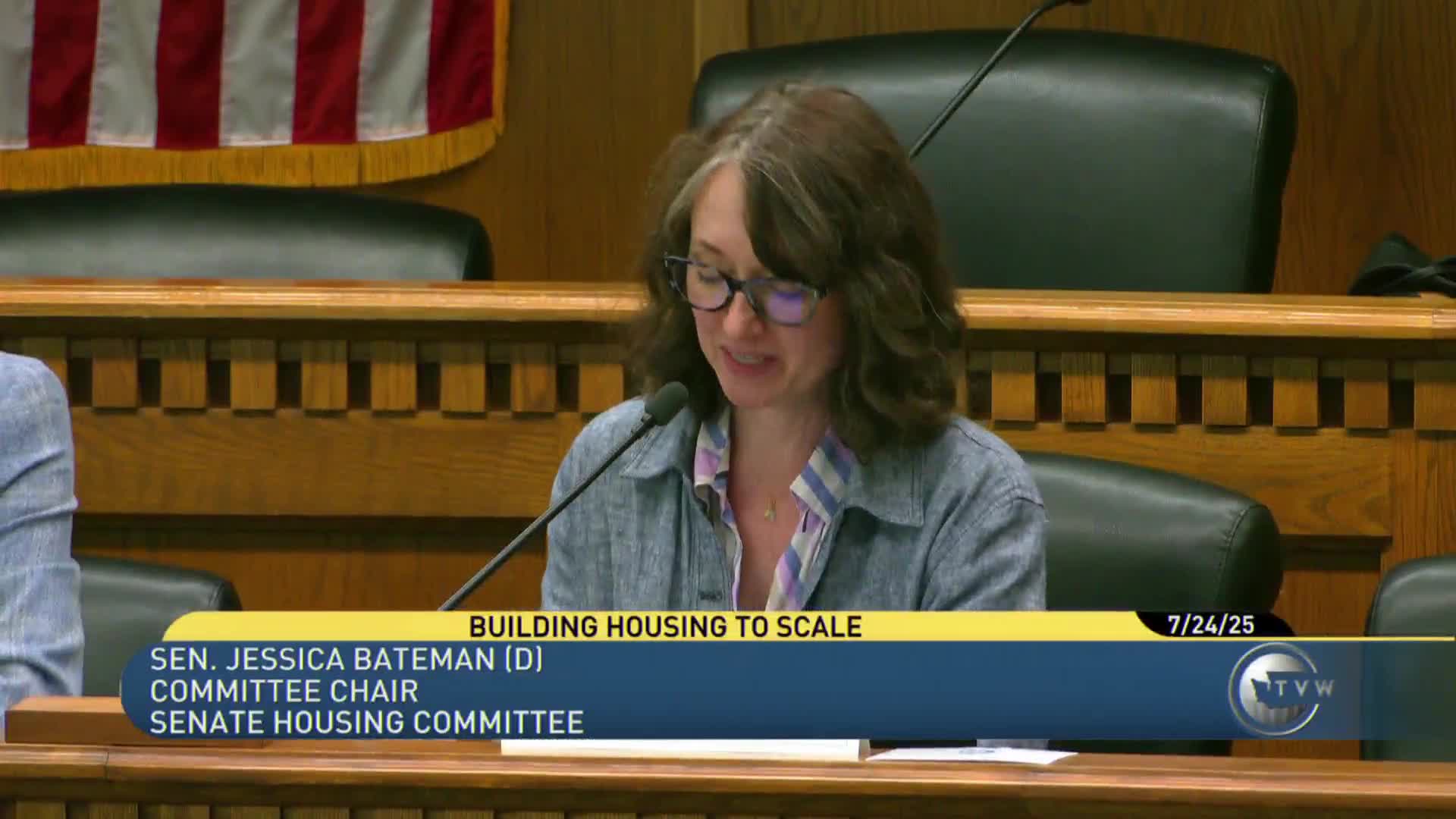
Summary
Civic Commons presented a three‑document starter‑home production plan to the Senate Housing Committee July 24, urging a temporary cross‑sector task force, standardized designs and a multi‑site demonstration to scale homes affordable to low‑ and moderate‑income buyers.
Civic Commons representatives outlined a statewide starter‑home production plan to the Senate Housing Committee on July 24, saying the plan is intended to increase supply of homes affordable to low‑ and moderate‑income buyers so Washington’s Covenant Homeownership Program can succeed.
Michael Brown, chief architect for Civic Commons, said housing prices in Washington have risen far faster than incomes: “Housing prices are up 172% since 02/2004, incomes up only 98%,” and only three of 39 counties currently have homes affordable at 100% of area median income (AMI). Brown and his colleagues presented the plan as a “comprehensive and scalable” blueprint covering single‑family homes, condominiums and cooperatives and tied to two implementation playbooks.
The plan’s core ideas are standardization and off‑site construction. Chris Hermans, project director for the starter‑home plan, described five principles underpinning the work: limiting unit size and complexity (they discussed homes under 1,500 square feet), standardizing design and delivery, aligning financing timelines with off‑site construction methods, centering multiple typologies (urban multunit, attached and detached, and rural forms), and making local context central to deployment. “We need to create efficiencies in order to drive down costs and create predictabilities around the timelines,” Hermans said.
Civic Commons presented four near‑term implementation actions it recommends: (1) a temporary cross‑sector crisis task force to implement the playbooks; (2) creation of a developer network and statewide training to grow off‑site manufacturing capacity and lift underrepresented developers; (3) new financing that reduces developer and manufacturer risk and uses public seed funding to attract private capital; and (4) a multi‑site demonstration program to compare off‑site methods to traditional construction and publish open‑book results for replication.
Martie Koistra, identified in the presentation as Network Weaver for the Black Home Initiative, described a project management collaborative that would oversee four cross‑sector networks, track progress with transparent data, and serve as a bridge to the governor’s office and any future Department of Housing. Civic Commons projected the project management collaborative would cost about $1,400,000 and said about $850,000 in private commitments had been secured. The group said a demonstration program has $1,700,000 allocated “through Senator Trudeau’s leadership” to help kick the demonstration into gear and that the Housing Finance Commission is “fully committed” to supporting implementation.
Committee Chair Senator Bateman thanked the presenters and said she had recently toured an off‑site factory and found the presentation’s description of permitting and timeline barriers consistent with that visit. Members of the committee raised questions about where the plan would be most effective, whether the plan targets households below 80% AMI or also includes 80–120% AMI, and whether the team had assessed why prior modular efforts struggled. Civic Commons replied that the plan intentionally addresses both below‑80% AMI production (via nonprofit models and community land trusts) and market support for 80–120% AMI starter homes to unlock scale with private‑sector participation.
Civic Commons emphasized the plan’s emphasis on testing: the demonstration projects would include standardized designs, pre‑approved plans, multi‑party contracts that allocate risk more clearly, head‑to‑head testing of off‑site versus traditional building on the same sites, and “open‑book transparency” so other jurisdictions can replicate the results.
Why it matters: Civic Commons framed the plan as an operational blueprint, not another study, that aims to unlock production at scale by combining design standardization, off‑site manufacturing, financing innovations and a time‑limited implementation body. The committee did not take a vote; presenters asked the Legislature and executive branch to consider enabling resources and statutory or budget support to implement and scale the demonstration and follow‑on phases.
What’s next: Civic Commons said the starter‑home plan, playbooks and an implementation roadmap are going to the Housing Finance Commission for review and will be released publicly following that meeting. The group asked for legislative and executive cooperation to support a temporary implementation body and demonstration funding.