Get Full Government Meeting Transcripts, Videos, & Alerts Forever!
Get email alerts on the State Budget topic
No spam. Unsubscribe anytime.
Arizona House approves $17.5 billion budget after hours of amendment fights and roll-call votes
Summary
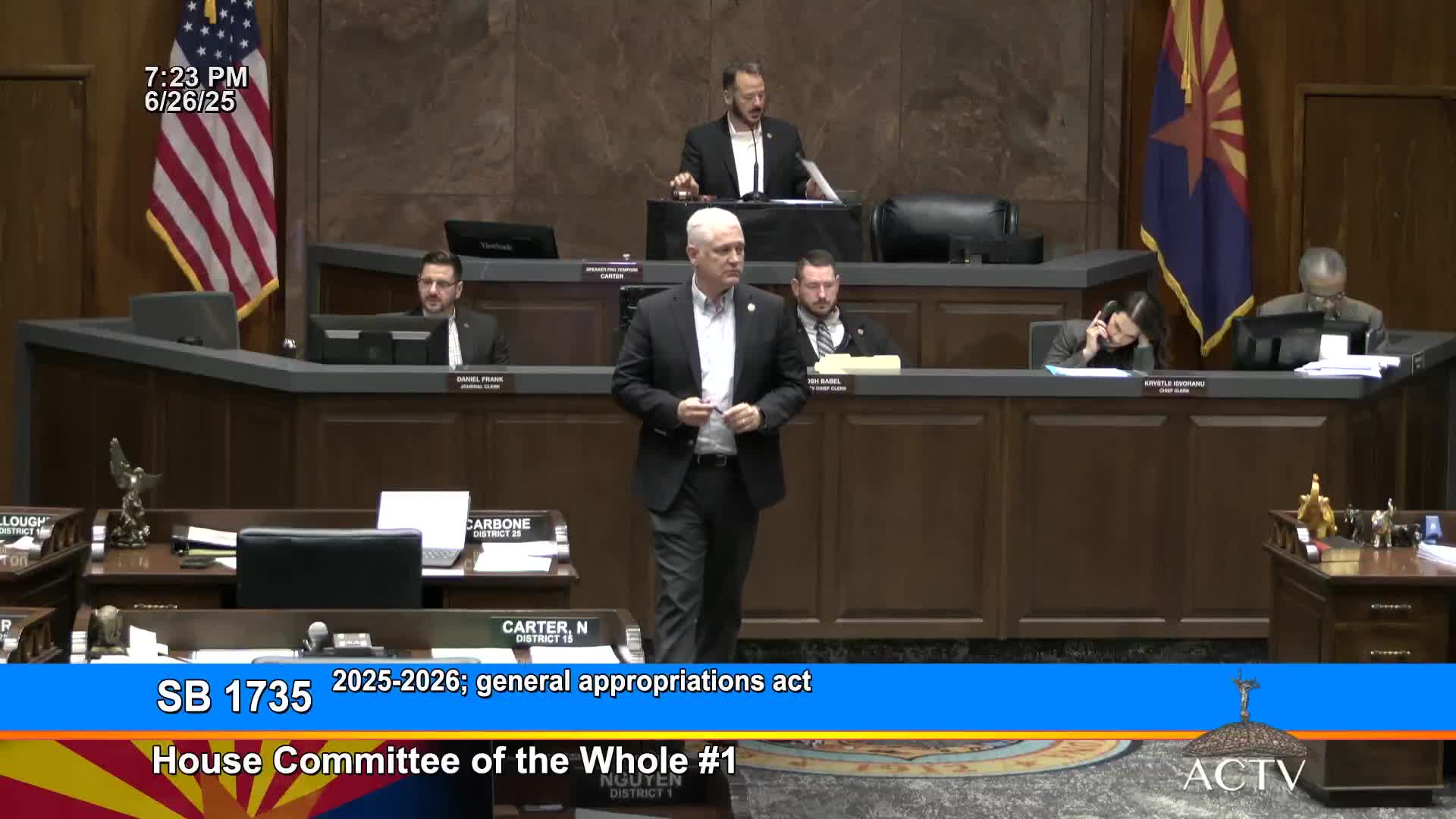
After extensive committee and floor debate, the Arizona House passed the General Appropriations Act (Senate Bill 17-35) late Thursday, approving the state's 2025'26 spending plan amid multiple amendments, roll-call appeals and vocal floor explanations from members on both sides of the aisle.
The Arizona House passed the General Appropriations Act (Senate Bill 17-35) late Thursday after extended committee work and floor debate that included multiple floor amendments, attempts to add committee-report amendments and a series of roll-call challenges.
Representative Kevin Diaz, speaking in committee, moved that the bill receive a "due pass" recommendation; the committee later reported the bill to the full House as amended. The House approved the measure on third reading with the clerk recording 40 ayes, 16 nays and 4 not voting.
Why it matters: SB 17-35 is the state's primary operating budget for fiscal 2025'26. It funds K-12 and higher education, health and human services, public safety pay increases, and a mix of targeted one-time and ongoing appropriations that members said were intended to hold agencies while the Legislature settles long-term policy.
Most consequential debate focused on program funding and policy guardrails. Representative Sandoval, explaining her no vote on the final passage, said the state had committed "almost a billion dollars" to an expanded universal voucher program and warned that public schools serving 90% of Arizona's students were being left behind. "Our budget is our moral document," she said on the floor.
Several members pressed for more stringent fiscal constraints and transparency. Representative Olsen argued that federal fiscal risks require caution: "We have a $37 trillion national debt," Olsen said during floor debate, urging the House to avoid structural commitments that might be unsustainable if federal funding changed. Opponents of cuts warned that removing targeted appropriations would harm rural schools and services for vulnerable populations.
Committee amendments and floor motions were numerous. Representative Collin offered several floor amendments during committee consideration that touched on grant distributions, department allocations and election-administration provisions; a later motion to amend the committee report to include several Collin floor amendments failed on a roll call. Representative Olson and others offered amendments aimed at savings and program controls; some passed and others did not.
Votes and procedure: Multiple procedural motions and roll-call votes punctuated final action. Members called for roll calls to attempt to add floor amendments to the committee report; the motion to amend the report to include several Collin amendments failed by a recorded vote. On final passage, the clerk recorded the vote at 40 ayes, 16 nays and 4 not voting; the House ordered the bill engrossed and directed the clerk to transmit the bill to the Senate.
Context and outlook: Supporters said the budget balances competing priorities in a divided government and funds pay raises for public safety personnel and a range of one-time investments. Opponents, including some long-serving members, said the package over-invests in private school vouchers and fails to restore K-12 funding cut during past recessions. Several members signaled they will press the Senate and the governor on specific items and control language in conference.
Representative Sandoval, one of those voting no, emphasized concerns about the voucher expansion and rural funding shortfalls. Representative Alma Hernandez and Representative Consuelo Hernandez both said they could not support the budget because of language they said would increase immigration enforcement activity funded by the state. Those objections were recorded during floor explanations of vote.
Ending: The House recessed after taking the final vote and instructed the clerk to convey the engrossed budget to the Senate. Members were told additional committee and floor business could follow once the Senate returns bills; the chamber scheduled return business for the next day.