Get Full Government Meeting Transcripts, Videos, & Alerts Forever!
Get email alerts on the Education Policy topic
No spam. Unsubscribe anytime.
Auditor General presses ADE on risk‑based ESA audits; Department says staffing, handbook delayed consultation
Summary
The Auditor General said the Arizona Department of Education has not completed required consultation to develop risk‑based audit procedures for the Empowerment Scholarship Account (ESA) program; ADE said it delayed meetings while finalizing an ESA parent handbook and that the program’s rapid growth strains a small staff.
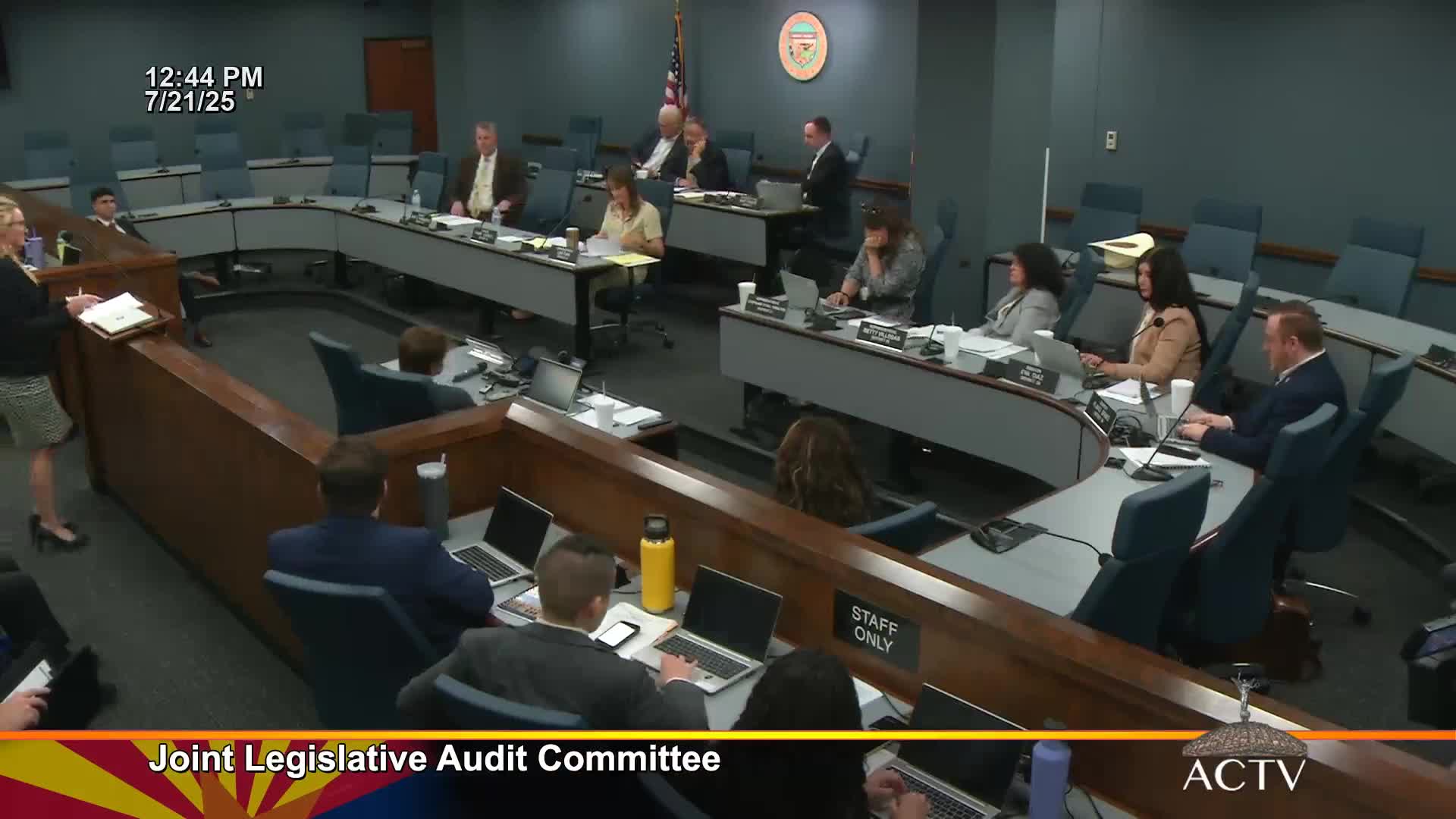
The Joint Legislative Audit Committee heard sharply different accounts about the status of risk‑based auditing for Arizona’s Empowerment Scholarship Account program.
Auditor General Lindsey Perry told the committee she had repeatedly sought a meeting with the Department of Education to complete procedures required by a 2024 law. “Since January 2025, my office has called and emailed the department on multiple occasions to request a meeting about risk based auditing procedures for E.S.A.s,” Perry said, and she told lawmakers the department had not completed consultation or provided required documentation as of the committee packet date.
John Ward, director of the Department’s ESA program, disputed a suggestion his agency had ignored the Auditor General. The department’s record, he said, shows it had met the Auditor General’s staff on other ESA audits and single‑audit matters; Ward told the committee the department did not open a separate consultation in January because staff were finalizing the ESA parent handbook, which he said required priority focus. Ward outlined the program’s size and staffing constraints: the ESA program has about 86,400 current enrollees (Ward said another roughly 4,000 applications were pending) and “40 staff” total in the ESA office, with a smaller number assigned to purchase and application review operations.
Ward told JLAC the department changed its purchase‑review approach in late 2024 to reduce a queue of tens of thousands of orders: orders above $2,000 continue to be prospectively reviewed; purchases below $2,000 are subject to risk‑based auditing and sampling. He said the department and its payment‑platform vendor, Class Wallet, are working to develop anomaly‑detection tools that use standardized commodity codes and machine‑learning models to flag suspect activity, but Ward said the state had not yet purchased an external contractor to implement additional independent auditing and that the program lacked extra legislative funding for such a vendor.
Perry said the statutory change requiring consultation became effective Sept. 14, 2024, and that the department’s risk‑based procedures had been reported publicly in late 2024 without completing the office’s consultation. She asked JLAC to formally direct her office to work with the department to close the gap and to ensure statutory compliance.
Ending — JLAC asked Department of Education and Auditor General staff to meet promptly; several committee members pressed for an early, documented consultation and for ADE to provide analytics (including balances in dormant accounts by eligibility category) and documentation of the $2,000 threshold implementation. The committee set an expectation for an early meeting between the Auditor General and ADE to produce a plan for risk‑based auditing and a timeline for any additional resources that would be required to implement it.