Get Full Government Meeting Transcripts, Videos, & Alerts Forever!
Get email alerts on the School Finance topic
No spam. Unsubscribe anytime.
Tolleson Union High School District defends $25M lease‑leaseback, land deals and large cash reserves amid criticism
Summary
Tolleson Union High School District Superintendent Jeremy Kais defended a series of multi‑million dollar real‑estate and lending transactions, saying they protect services and produce revenue, while lawmakers and community members raised questions about transparency and appropriate use of district funds.
Tolleson Union High School District Superintendent Jeremy Kais told the Joint Legislative Audit Committee that the district has deliberately built large cash reserves and pursued real‑estate transactions — including a controversial $25 million lease‑leaseback with the Isaac School District — to preserve services and finance capital projects while state and federal funding remains uncertain.
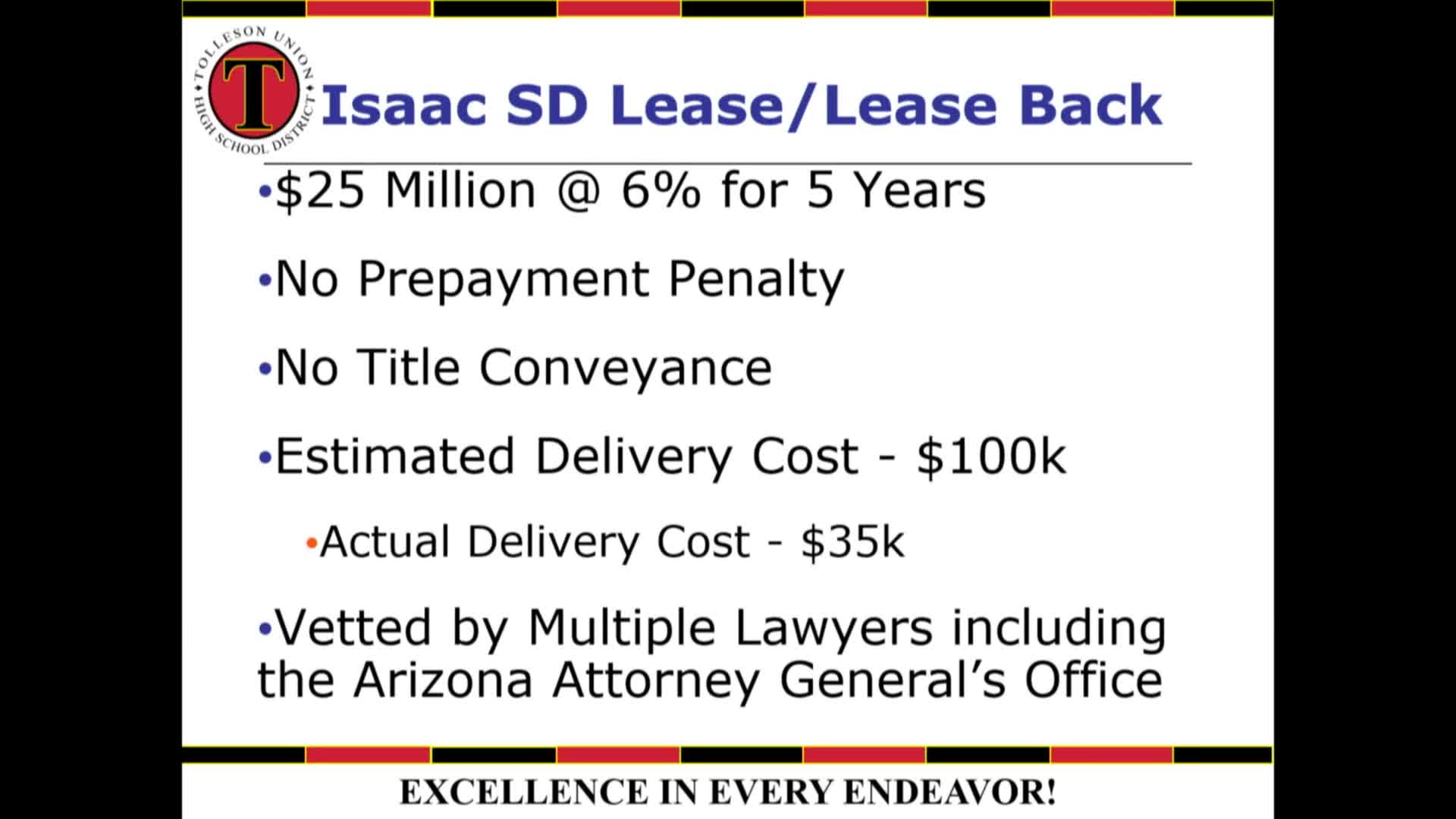
Kais described the Isaac transaction to the committee as a $25 million, five‑year lease‑leaseback at 6% interest, with no prepayment penalty and no title transfer. “If Isaac wanted to, they could go out to a bank today, talk to a bank within 6 weeks, they'd have a deal and they could pay Tolleson off in its entirety,” Kais said, adding the district and the receiver vetted the transaction with counsel. Kais said the structure was intended to deliver cash quickly to prevent Isaac from missing payroll while still allowing Isaac to refinance later.
Kais said the district used a portion of its cash carryforward to fund the transaction and described reserve and cash‑management reasons for maintaining large balances. He cited a $73 million budget balance carryforward (presented as the most recent figure) and told the committee the district estimated a projected return of about $7 million on the five‑year Isaac arrangement if it runs to term. He also said the district had no prepayment penalty so Isaac could refinance earlier.
Kais gave committee members a broad fiscal picture: credit ratings upgrades from Moody’s and Standard & Poor’s, a history of budget balances that rose over time, and a long‑term strategy to protect programs against state payment timing and federal funding freezes. He said teacher pay rises were central to district strategy to improve retention: he argued starting teacher pay is now roughly $64,009 and that Tolleson’s average and starting teacher pay are among the highest in Arizona. “We have the highest paid teacher in the state of Arizona. We have the highest average teacher salary in the state of Arizona, and we have the highest starting teacher pay in the state of Arizona,” Kais said.
Kais also described several property transactions tied to the district’s capital plan: a ground lease for about 12 acres intended for an affordable housing development (the district paid roughly $3 million for the parcel and Kais said the developer proposed an initial payment of $4 million and long‑term payments, including a 99‑year ground lease with buyout options); a near‑12‑acre site near the Loop 101 intended for a career and technical education campus (Kais said the parcel cost about $7.8 million and would host a 500‑student facility adjacent to West MEC); and a 6.96‑acre purchase intended for a new district office near the 101. Kais said bond proceeds and other voter‑approved debt earlier funded acquisition and campus work, and he asserted the purchases fit approved capital plans.
Committee members pressed Kais and raised multiple concerns. Representative Gress and others argued Tolleson used money that voters expected to be spent within the district and questioned whether the Isaac loan was an appropriate use of Tolleson funds. Representative Carbone and Representative Gruss pressed details about appraisal, whether the district used its cash balances to make the payment to Isaac, and the terms of the lease‑leaseback; Kais responded the district and counsel reviewed property valuations and the transaction structure and that the transaction produced immediate liquidity for Isaac while generating a return for Tolleson.
Lawmakers and several public speakers told the committee they were troubled by the size of Tolleson’s reserves, by the timing and notice of board votes and bond‑planning disclosures, and by perceived lack of transparency. Senator Diaz noted the district’s $125 million bond approved by voters in November 2024 and asked how the bond projects benefitted Tolleson students; Kais described a list of construction and campus priorities the bond would fund, including a new gym for Tolleson campus and a new building for University High. Kais said the bond proceeds would be fully expended on listed projects.
Ending — The committee did not vote on any action but repeatedly asked the district to provide documentation for the transactions and for attorneys’ analyses. Several members indicated they want closer review of whether district transactions conform to applicable statute and bond‑pamphlet disclosures. Kais said legal counsel and bond counsel reviewed deals and that district attorneys vetted the Isaac transaction before approval. JLAC members signaled they will request follow‑up documents and that some members may seek further audit work or legislative clarification about district real‑estate transactions.
(Attribution lock: quotes in this article come only from speakers listed in the "speakers" field.)