Get Full Government Meeting Transcripts, Videos, & Alerts Forever!
Get email alerts on the Wildfire Season Outlook topic
No spam. Unsubscribe anytime.
Arizona fire officials say season remains active as resources tighten
Summary
State fire managers told a July field hearing that Arizona’s 2025 fire season is not over, that most fires have been human-caused, and that resource drawdowns and national demand are constraining local suppression options.
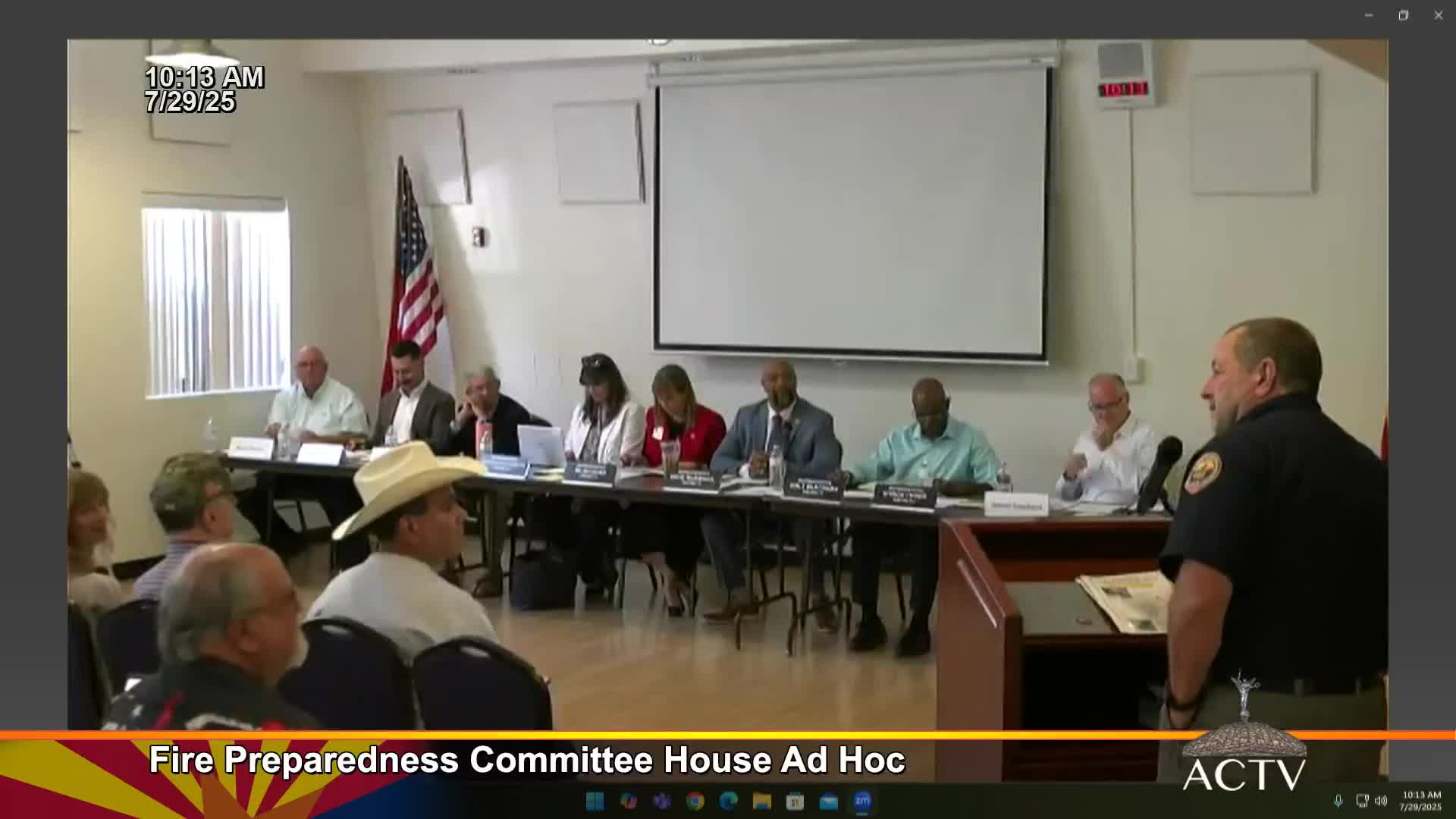
State fire managers told members of the Arizona House Ad Hoc Committee on Fire Preparedness on July 1 that the state remains in an active, high-risk fire season and that crews and equipment are being held in Arizona rather than sent to other Western states. John Truett, state fire management officer for the Department of Fire and Forestry Management, told legislators in Payson that the department has recorded 913 fires totaling roughly 122,000 acres on state and tribal lands so far this year and that most incidents are human-caused. Truett said national demand for wildfire assets is rising and that Arizona has limited its normal practice of exporting engines and crews in order to defend local ground. “Demands on resources are going to be pretty extreme in the next month or so,” he said. “So we can anticipate here at home that we have to hold some of our folks in ready reserve.” Truett described several active large fires that have been difficult to access, including the Dragon/Bravo incident, which he said experienced nearly 50,000 acres of growth in four days and in places produced pyro‑cumulus clouds. He said mixed‑conifer stands with no fire history can be impossible to safely put firefighters on and that weather, not tactics, often determines whether a fire can be fully suppressed: “You cannot put our firefighters in harm’s way,” he said. Committee members asked for plain‑English explanations of Preparedness Levels (PL 1–5), GACCs (geographic area coordinating groups), and national coordination. Truett said PLs are derived from scientific matrices that consider fuels, resource commitments and availability; as PL increases, so does the threshold for calling national assets. He explained that Arizona is in a state and regional posture that has required prepositioning and drawdown limits so local assets remain available. On staffing, Truett said DFFM employs approximately 75 permanent firefighters and roughly 120 seasonal workers during peak months; he and committee members discussed a white paper the agency is preparing that would recommend an additional 30–40 permanent positions and two additional crews (about 20–30 seasonals) over a multi‑year plan to keep pace with development in the wildland‑urban interface. Committee members and briefers emphasized firefighter safety and science‑based decision‑making. Truett said incident commanders on difficult ground weigh safety and strategic options closely; he asked legislators and the public to “trust what we’re doing on the ground.” The hearing produced no formal votes or policy actions; committee members requested further briefings and follow‑up data on PL metrics, regional resource sharing, and staffing white papers.