
County staff seek short-term wildlife mitigation guidance while state prioritization process proceeds
Get AI-powered insights, summaries, and transcripts
Subscribe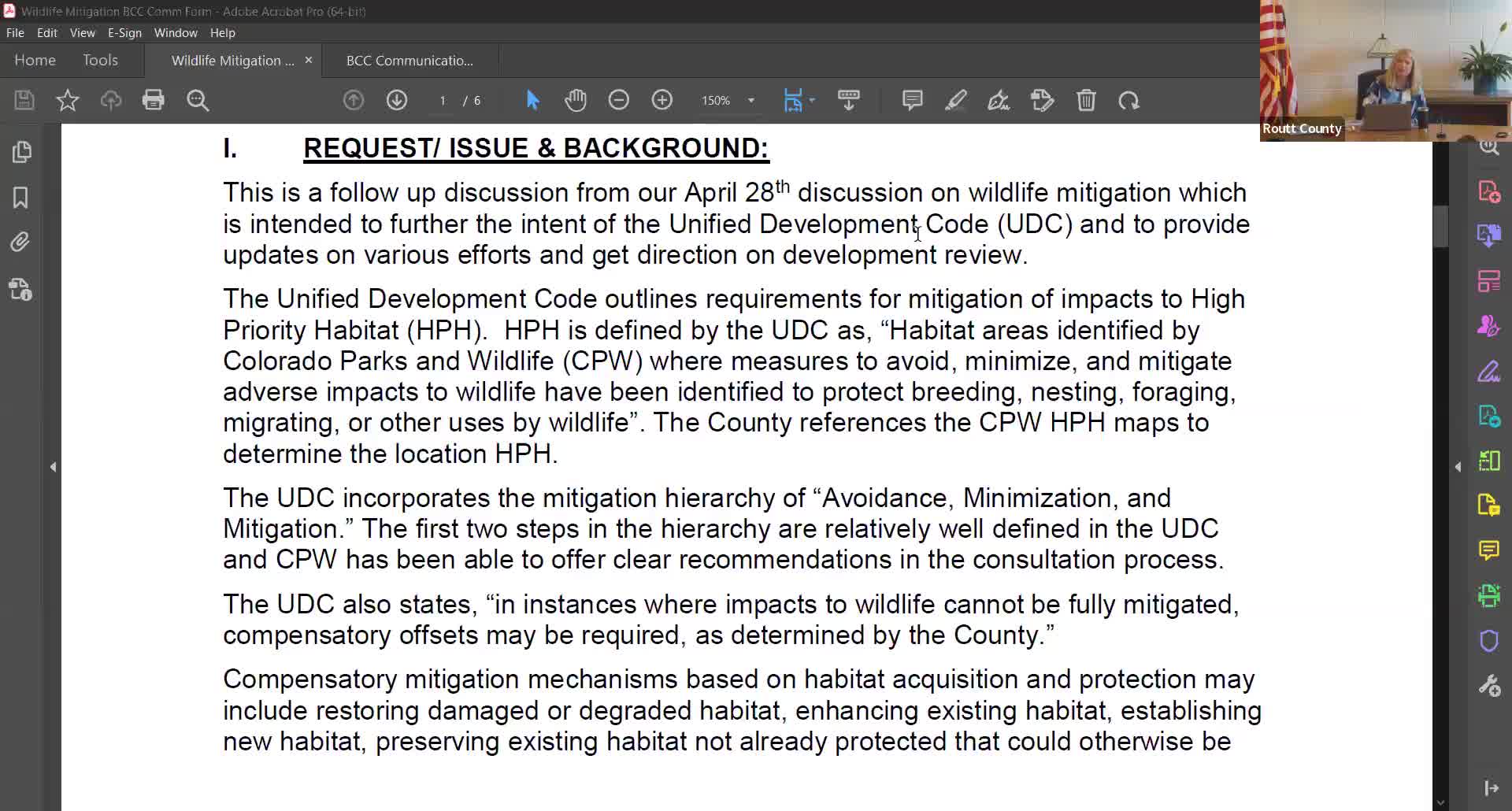
Summary
County planners and conservation partners urged commissioners to endorse short-term, narrowly scoped mitigation guidance for wildlife impacts while Colorado Parks & Wildlife completes a local habitat-prioritization map that would guide longer-term offsets and conservation investments.
Routt County planning staff and conservation partners asked the Board of County Commissioners to give short-term policy guidance on compensatory wildlife mitigation for development projects while state-led habitat-prioritization work continues.
Christy (planning staff) summarized that the Unified Development Code (UDC) requires a mitigation hierarchy of avoidance, minimization and mitigation but leaves room for interpretation about what kinds of compensatory offsets satisfy county standards. Tim Sullivan of the Yampa Valley Sustainability Council and online consultant Sally Ross briefed the board on an ongoing Colorado Parks and Wildlife (CPW) project to produce a local habitat- and connectivity-prioritization map for the Upper Yampa watershed. That map, they said, could help the county identify locations where mitigation investments would deliver the greatest ecological benefit.
Planning staff described three broadly accepted mitigation approaches: (1) proponent-responsible mitigation (project proponents protect, restore or otherwise secure habitat), (2) in-lieu-fee programs (developers pay into a fund that finances mitigation projects), and (3) mitigation/conservation banks (credits sold for pre-implemented habitat projects). Staff said each approach has trade-offs in Routt County's mixed landscapes and that the county has had conversations with local partners, including the county's PDR program and the ranching community, about potential additive conservation projects.
Commissioners and wildlife experts focused discussion on technical and procedural points: how to account for species' '2site fidelity' (some species rely on a very limited area), how to ensure mitigation is ecologically appropriate and near enough to the impact site to be effective, and how to build financial-assurance mechanisms (bonds, multi-year monitoring and adaptive management) into mitigation agreements so the county can require corrective work if projects fail. Alan (county wildlife/consultant) and others urged including adaptive-management plans and monitoring timelines as part of any mitigation approval; they also warned that in-lieu funds without a clear plan risk accumulating cash without meaningful on-the-ground outcomes.
Staff asked whether the board would support drafting short-term guidance to use for projects currently in the review pipeline (projects that cannot practicably meet on-site mitigation requirements). Commissioners expressed support for a narrowly tailored, temporary set of criteria limited to projects that have already advanced and lack feasible on-site mitigation options, and they asked staff to work with CPW and local conservation partners to refine criteria and identify priority mitigation projects.
No formal policy was adopted; staff were directed to draft short-term guidance, develop clear monitoring and financial-assurance language, and continue coordinating with CPW and the Upper Yampa prioritization effort so longer-term mitigation actions, including possible in-lieu-fee pooling or advanced mitigation banks, can be aligned with the state-prioritization map.