Dallas council reviews police station options, eyes value engineering and new financing route
Loading...
Summary
City staff and architects presented updated cost estimates for a proposed $17.2 million police station, compared single‑ and two‑story schemes, evaluated renovating the Itemizer Building as a temporary or partial solution, and discussed financing options including a public building fee and local option levy.
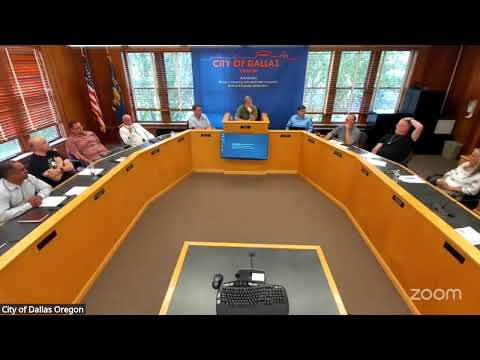
City of Dallas officials and outside architects spent Monday’s council work session reviewing updated cost estimates, alternative building options and financing plans for a proposed new police station that was rejected by voters in May.
Architects from Mackenzie presented a detailed cost breakdown for the two‑story design the city previously put before voters and a third‑party hard‑cost estimate. Jeff Humphreys, principal at Mackenzie, said the project was estimated as an essential facility with prevailing‑wage requirements and a CMGC (construction manager/general contractor) delivery, which carry premiums. “This is the best way to go,” Humphreys said of alternative delivery approaches given long lead times for equipment since the pandemic.
The presentation put the project’s planning total at about $17,200,000. A third‑party estimator, TAW Construction, produced a hard construction estimate of roughly $12,600,000 — inside the architect’s previously provided range. Mackenzie staff explained the spread between low and high estimates largely reflected contingencies for items not yet designed and escalation for inflation, and noted some cost lines (for example CMGC participation, general conditions and contractor overhead) vary by delivery method.
Councilors asked whether a single‑story building or moving to a different site would produce meaningful savings. Kathy Bowman, Mackenzie project manager, said site purchase price and unknown subsurface or foundation conditions can erase savings: the firm’s sample single‑story projects averaged roughly $900 per square foot, similar to the two‑story estimate for the proposed downtown site. Bowman summarized the Itemizer Building retrofit option as “very high level preliminary numbers” and said the Itemizer is about 7,500 square feet and would not by itself meet the programmatic need (the team’s program target was about 12,528 square feet). She told the council the Itemizer has “significant structural deficiencies,” including unreinforced masonry and single‑pane windows, and would require seismic upgrades to meet essential‑facility criteria.
Architects and staff estimated a temporary retrofit using the Itemizer plus annex space would cost roughly $5.3 million to $7.0 million as a short‑term solution, but that type of renovation would carry higher contingencies and could be operationally inefficient if police functions were spread across several buildings. Mackenzie cautioned a seismic retrofit could be as time‑consuming as building new and might not extend building life comparable to a purpose‑built facility.
Finance Director Cecilia Ward outlined four financing scenarios discussed with the city’s financial adviser: a 30‑year general obligation bond at roughly $0.52 per $1,000 assessed value (the structure the city used previously), a 20‑year bond tied to a remodel amount, a 20‑year bond that leans on existing public safety fee revenue, and a local option levy that would shift some recreational and library costs to a separate 5‑year levy. Ward said the city’s current public safety fee generates a little more than $1.1 million per year; structuring a voter‑approved public building fee that bills to utility (sewer) accounts rather than assessed property could spread costs across more payers and lower per‑payer amounts while shortening the payback horizon compared with a long bond.
Council discussion focused on balancing cost, voter support and long‑term value. Several council members said they would favor additional value engineering to reduce the ask presented to voters and explore a public building fee as a financing vehicle. Multiple councilors characterized renovating the Itemizer as an expensive, short‑term “band‑aid” that they did not want to pursue as the primary path forward.
Staff outlined next steps: pursue a value‑engineering exercise, engage a CMGC or contractor early to refine delivery and pricing, and return with refined cost and financing options suitable for a May 2026 ballot if the council decides to proceed. No formal motion or vote occurred at the work session.
The session included technical clarity about state and code drivers (prevailing‑wage rules, essential‑facility seismic requirements and a state green‑energy requirement that the team assumed would be photovoltaic panels at about 1.5% of construction cost) and several specific budget figures and contingencies for council review.
Councilors and staff emphasized outreach and presentation strategy ahead of any election, noting past voter returns and urging more outreach and value engineering to make the next finance request more likely to succeed.