
City Council adopts Mill Site Area Redevelopment Plan to guide South Dallas redevelopment
Get AI-powered insights, summaries, and transcripts
Subscribe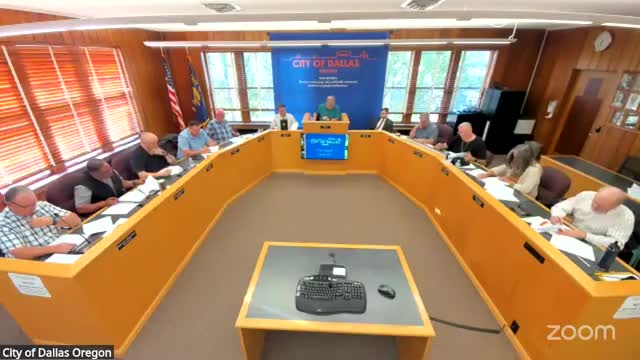
Summary
The Dallas City Council unanimously adopted a master concept plan on June 16 to guide redevelopment of the 66-acre former mill site in South Dallas, emphasizing Ash Creek relocation, mixed uses, large industrial parcels and grant-dependent funding steps.
The Dallas City Council unanimously adopted the Dallas Mill Site Area Redevelopment Plan on June 16, 2025, asking staff to pursue next steps including grant funding and coordination with the Oregon Department of Transportation and state agencies to support an Ash Creek relocation and related infrastructure work.
The plan is meant to guide redevelopment of a 66-acre former mill site in South Dallas by preserving large parcels usable for industry, creating mixed-use frontage along a proposed East–West street and relocating Ash Creek to reduce flooding and unlock developable land. Charlie Mitchell, economic and community development director, told the council the plan is "a kind of a culmination of several years of work," and that the planning commission had unanimously recommended adoption.
The consultant team, led by David Evans and Associates, set five project goals for the plan: land use and transportation guidance, a balanced transportation system, land uses to meet housing and employment needs, enhancement of community character while respecting natural features, and honoring the site's historical context. Jim Henke, project manager with David Evans and Associates, summarized community input and the planning work, saying the project team was "calling it go big with Ash Creek the Ash Creek relocation because number 1, it's gonna unlock the redevelopment potential of the area that floods." He also described tradeoffs: preserving large blocks to keep industrial opportunities while leaving flexibility for smaller-block, mixed-use development if market demand changes.
The plan shows the proposed Ash Creek relocation on the flatter portion of the site to maximize large developable parcels to the north, a multi-use path and commercial frontages along the relocated creek, and an extension of Central Business District zoning along Main Street to strengthen the corridor between downtown and the mill site. The consultant presented four scenario diagrams to illustrate flexible redevelopment approaches rather than a single prescriptive layout.
Estimate ranges for the creek work were discussed during the presentation. Henke said a property owner study had put Ash Creek relocation in the range of tens of millions of dollars; at one point the figure cited in the meeting was about $40,000,000 to $48,000,000. Councilors and staff discussed funding options including stormwater fees, system development charges (SDCs), urban renewal funds, revenue bonds, and grants. Henke noted pursuing grants and public–private partnerships would be key to moving the project forward.
Councilors asked procedural and financial questions during deliberations. Councilor Briggs asked, "Are we expecting too much? Is this something that is actually achievable? Is there grant money out there that can cover this?" Staff responded that multiple local and external funding sources would likely need to be layered to cover the work.
Councilor Shane moved to accept the updated Dallas Mill Site Area Redevelopment Plan as proposed; Councilor Schilling seconded. The motion passed unanimously.
Next steps identified in the plan include updating the Transportation System Plan (TSP) where applicable, coordinating with ODOT and the Department of Land Conservation and Development for required reviews, continuing engagement with the property owner and community, and pursuing grant funding and potential bonding or other financing mechanisms to advance the creek relocation and related infrastructure work.
The council adoption is a policy-level master concept; it does not change zoning or the comprehensive plan at this time and does not authorize construction. Staff and consultants said more technical studies, grant applications and regulatory reviews will follow as implementation steps.