
Peculiar aldermen begin review of sidewalk, ditch and culvert maintenance rules
Get AI-powered insights, summaries, and transcripts
Subscribe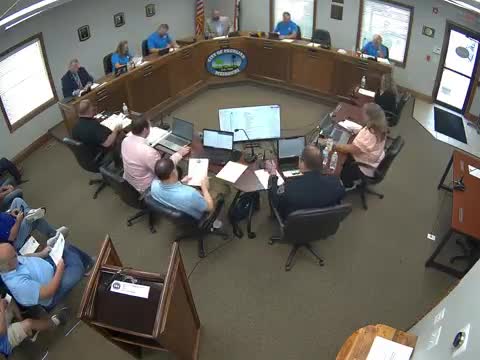
Summary
City staff presented a packet of local code excerpts and sample ordinances from nearby cities as the Board of Aldermen discussed whether the city, homeowners or homeowners associations should be responsible for maintaining sidewalk strips, open ditches and culvert pipes.
Peculiar aldermen opened a policy review July 21 into who must maintain the grassy strip, sidewalks and culvert pipes between private property lines and the street after city staff told the board that existing city code leaves a “gray area.” The discussion was informational only; no ordinance was proposed or adopted at the meeting.
Why it matters: The board must choose whether to clarify the city code to make the city responsible for maintenance, to explicitly assign responsibility to homeowners, or to leave the current ambiguous practice in place. Several aldermen said that whichever path the board chooses will have budget and liability consequences.
City staff member Don Shepherd handed the board a packet that included excerpts of the city code, the International Property Maintenance Code, tree-maintenance language and examples from Harrisonville, Smithville and Belton. Shepherd said the property boundary lines on the city’s GIS maps typically do not extend to the roadway, leaving an unaddressed strip between a lot line and the curb or pavement. “There’s always some gap…that maintenance from that area that’s in that gap has been a gray area forever,” Shepherd told the board.
In presenting the packet, a staff speaker (identified in the packet as Mr. Johnson) said the International Property Maintenance Code language calls on owners or tenants to “mow the private lot to equal maintain the tree, lawn, and grassy area within the abutting right of way or easement.” Johnson also noted the city’s ordinance does not explicitly mention ownership of culvert pipe underneath driveways and that, in the city’s practice to date, private culvert pipes have been treated as homeowners’ responsibility.
Aldermen raised practical concerns. Alderman Paul (Ward 1) asked how many subdivisions are governed by homeowners associations (HOAs) and was told by staff there are 12 active HOAs; staff said most newly proposed subdivisions are triggered to have common-area tracks and HOAs. Several aldermen said HOAs typically maintain sidewalks and trees as part of dues, which complicates adopting a single citywide rule. One alderman noted a potential financial burden on non‑HOA homeowners if the board made property owners responsible for sidewalks that may require full replacement to meet current standards.
Technical implications were discussed: repairs that trigger permits could require bringing an entire property’s sidewalk to current width standards (for example, from four feet to five feet), which can substantially increase cost and scope. Shepherd warned that if the board declares sidewalks to be city property he would request additional funds for maintenance and that the decision “will not be minimal” for the budget.
Next steps: Staff suggested aldermen send questions to staff for follow-up, and that staff will return with draft options or an ordinance if the board directs them to do so. Shepherd said the city is also seeking a new evaluation from Stantec—who produced a streets grading report in 2019—to include curb and sidewalk condition and a possible inventory program. Aldermen discussed the option of creating a multi-year sidewalk replacement program tied to the capital budget if the board elects to assume maintenance.
The discussion included references to the city’s MS4 stormwater responsibilities when private pipes affect public drainage and to the International Property Maintenance Code; no change to code was made at the meeting.