Get Full Government Meeting Transcripts, Videos, & Alerts Forever!
Get email alerts on the Ethics Schoolboard topic
No spam. Unsubscribe anytime.
Rochester ethics panel censures school board member Sandra Keans; requires training and signing of ethics policy
Summary
An ethics investigator found Sandra Keans disclosed nonpublic information and a privileged legal letter; the panel voted by voice to censure her and require training and signing of the city ethics policy.
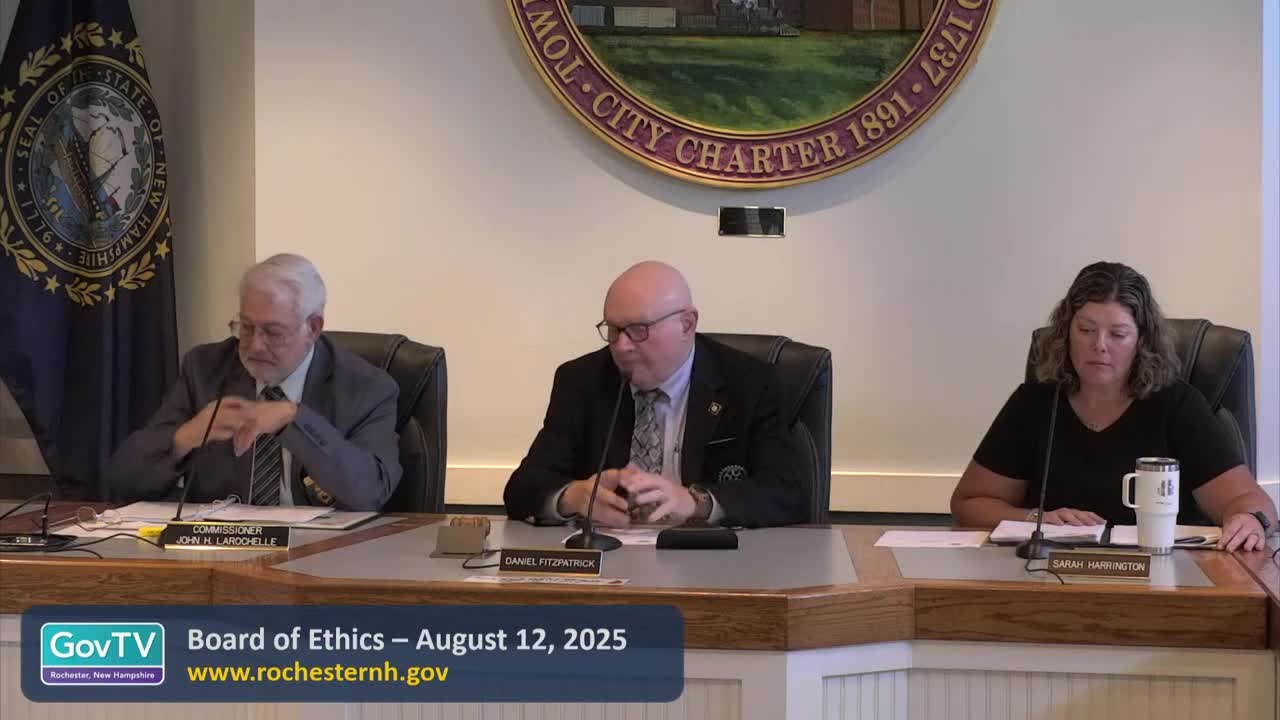
Rochester — The Rochester Ethics Investigation Panel voted on July 22 to censure Sandra Keans, a member of the Rochester School Board, and require her to complete ethics training and sign the city ethics policy after an investigator concluded she disclosed nonpublic information and shared a privileged legal letter.
Andrew, the panel’s appointed ethics investigator, told the panel he "confirmed the initial allegations as true" and said his investigation also found what he described as additional violations of the city ethics policy, including Republican board member Keans distributing a privileged legal letter in the council chamber and participating in a vote that directly affected her.
The investigator said the disclosures prompted inaccurate public reporting and a social-media “explosion” that eroded trust and inhibited candid discussion in nonpublic school-board sessions. "Miss Keene's repeated disclosures of non public information and documents has created an irreparable erosion of trust in the community," he read from his report.
Keans addressed the panel and acknowledged confirming information to a reporter and distributing the attorney’s letter; she told the panel she had been surprised by the reporter’s call, ‘‘I should not have confirmed the information, and I apologize for that,’’ she said. Keans also said she did not believe the letter contained identifying details and said several others outside the board had already seen the material before the board had it.
Panel members debated whether removal from office was warranted. Several members said removal for an elected official would be extreme and noted an upcoming public election; others said the breach could expose the city to legal liability. One panelist cited RSA 91-A (the state Right-to-Know law) and the city charter as part of the context for confidentiality and voting rules.
Panel discussion also covered whether Keans’ April vote on referring the ethics complaint should have been handled differently. Keans told the panel she had not signed the city ethics policy when sworn in and cited city charter section 72, which includes an exception process such as filing a declaration with the city clerk or a board vote on whether a member may participate. Panel members disagreed on whether that vote or a chair disqualification should have occurred at the time.
After discussion the panel proposed a motion requiring a censure, mandatory ethics training for Keans (and recommending broader training for elected and appointed officials), and that Keans sign the city ethics policy she said she did not previously sign. The motion was adopted by voice vote. The panel chair asked the city attorney’s office to clarify how the city handles an elected official’s refusal to sign an ethics policy.
The panel’s action did not remove Keans from office. Keans said she is running for reelection this November and told the panel she hoped voters would decide her future.
The investigator and the panel repeatedly referenced the city’s ethics policy (sections the report labels A10 and A8) and city charter section 72; the panel also noted potential exposure to litigation related to personnel matters.
The panel adjourned after asking the city attorney to provide clarification on enforcement and on whether the city can require an elected official to sign the ethics policy.