
McPherson County adopts temporary moratorium on commercial battery storage projects
Get AI-powered insights, summaries, and transcripts
Subscribe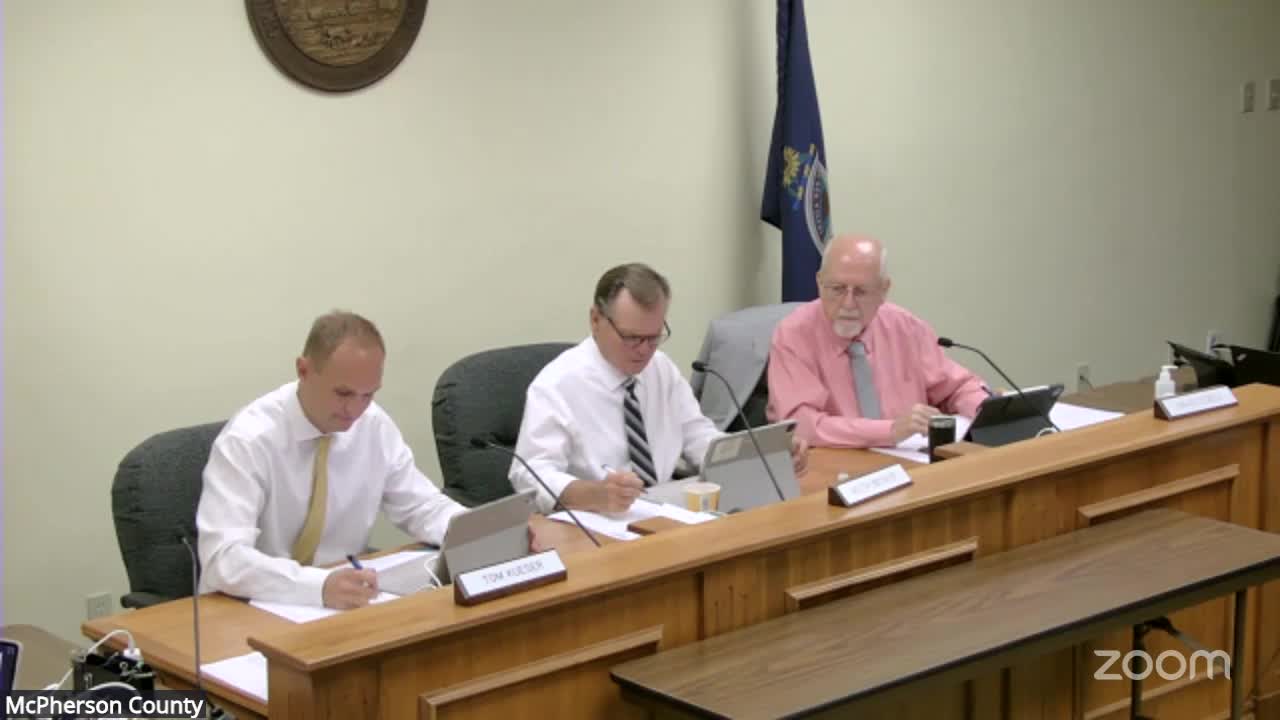
Summary
The Board of County Commissioners approved a temporary moratorium on commercial battery energy storage systems to allow staff and the planning board to review zoning and comprehensive-plan rules; the moratorium runs through Jan. 1, 2028, and commissioners directed a months-long review of regulations.
The McPherson County Board of Commissioners voted unanimously to adopt Resolution 2025-13, imposing a temporary moratorium on commercial battery energy storage systems in the county’s unincorporated areas. The resolution, approved by Chairman Becker and Commissioners Keizer and Adele, directs staff and the planning board to review the county comprehensive plan and zoning regulations for possible changes to regulate commercial battery projects.
County planning and zoning administrator John Kinsey framed the moratorium as a short-term measure to give staff time to study the technology and potential local impacts. “This is similar to the one that is in play with Harvey County, and it is also modeled after what we did for our solar and wind regulations. It is a temporary one in nature. It will last through 01/01/2028,” Kinsey said.
The moratorium covers commercial battery energy storage systems — commonly large lithium battery installations — and related storage, production, generation and distribution activities in unincorporated McPherson County. Kinsey told commissioners the county currently has no pending applications for such facilities but cited examples from other jurisdictions and described how some systems are configured as containerized units that require water cooling and substantial infrastructure.
Commissioners discussed open questions raised in the presentation, including taxation and where similar facilities already operate in the state. Kinsey said he believed the state legislature considered tax treatment for some systems in 2024. He also noted data centers are a related concern that county planning has not yet studied. Commissioners directed staff to return with more detailed recommendations; Kinsey estimated a 4- to 5-month formal review period that he would likely begin in January and present to the planning board.
The resolution states the moratorium is intended to protect public health, safety and welfare while the county updates its regulatory framework. It will remain in effect through Jan. 1, 2028, unless the board acts sooner.