
Miami County approves expansion of 1880 Enterprises quarry, removes ownership restriction
Get AI-powered insights, summaries, and transcripts
Subscribe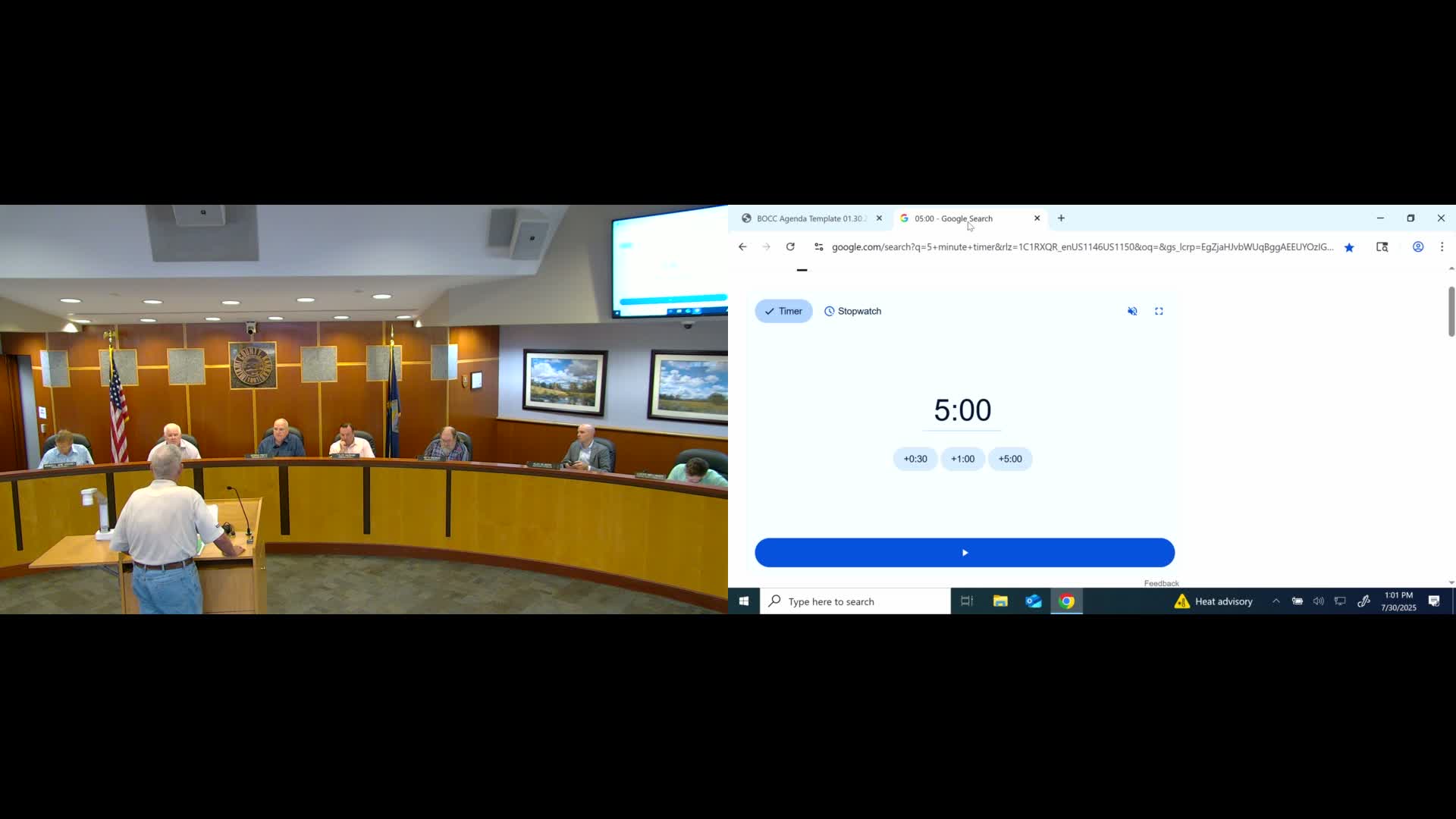
Summary
The Board of County Commissioners approved a conditional use permit allowing 1880 Enterprises to expand an existing quarry north of Fontana, removing a planning-commission-imposed ownership restriction and adding a paving and debris-control condition for Hedge Lane.
The Miami County Board of County Commissioners unanimously approved a conditional use permit (CUP) on a motion by Commissioner Vaughn, seconded by Commissioner Vickrey, allowing 1880 Enterprises to expand quarry operations onto adjoining property north of Fontana.
Residents raised environmental and traffic concerns during public comment before the commission considered the CUP. "My concerns ... were primarily around the environment impacts ... traffic," said Hal Smith, a local farmer, noting he had submitted letters and a protest petition.
The CUP will add conditions on hours of operation, setbacks, screening and dust control, and it modifies a staff-recommended condition to require the applicant to pave the quarry entrance from Hedge Lane to county commercial standards and to "implement measures such as regular sweeping or water trucks and proper use of calcium chloride at least twice per year from the quarry entrance to the scale, to keep debris from being dragged or tracked onto Hedge Lane," as read by Kenny Cook, Miami County Planning Director.
The Planning Commission had recommended approval 6–1. Planning staff reported protest petitions from six property owners covering 55% of the land area within 1,000 feet of the quarry, which would ordinarily trigger a supermajority vote for a CUP. Kenny Cook told the commission that a Kansas statute specific to quarry operations means a simple majority vote is sufficient in this instance.
Attorney David Waters, representing 1880 Enterprises and Clarkson Construction, said the company supplied mining plans, stormwater plans and reclamation plans and had provided a traffic study that, using KDOT standards, concluded no off-site road improvements were required. "We have submitted … everything I think they've asked for," Waters told commissioners, and he asked that condition 3 — which would have tied the CUP strictly to the present owner — be removed or revised.
Commissioners debated condition 3 during the meeting. Planning staff said their standard practice is for CUPs to follow the land rather than the owner but that some circumstances can justify owner-specific conditions. The board ultimately removed the ownership-restriction language and approved the CUP tied to the property, not to an individual owner, while also approving the revised condition about paving and debris control.
Representatives for the company said state permits remain necessary. Gabe Dinar, who identified himself as working for 1880 Enterprises and Clarkson Construction, told the commission he had prepared state permit applications and was ready to submit them once local approval was obtained. He and other speakers noted that state and federal agencies — including KDHE, the Kansas Department of Agriculture and MSHA — govern mining, water and air permits.
Commissioners and county staff noted other enforcement channels remain available for issues such as truck parking and speeding, such as sheriff's office enforcement.
No new blasting notification requirement remained in the final CUP; staff and consultants had previously inspected blasting and reported little apparent off-site effect, and blasting limits in the CUP were tied to monitoring and regulatory limits.
The commission chair asked staff to finalize the amended resolution immediately following the meeting so the board could sign it.
Why it matters: The decision allows continued and expanded extraction of rock used for construction and county needs while adding new operational conditions intended to reduce roadway debris and dust. Nearby residents had submitted formal protests and voiced concerns about traffic, dust and environmental compliance.