Get Full Government Meeting Transcripts, Videos, & Alerts Forever!
Get email alerts on the Dhs Overview topic
No spam. Unsubscribe anytime.
Garfield County Department of Human Services outlines programs, staffing and budget pressures
Summary
Department leaders detailed program responsibilities, staffing levels, state and federal funding mechanisms, service demands (child welfare, APS, Medicaid/SNAP, TANF, CCAP), and said legislative and funding changes are increasing workload and costs.
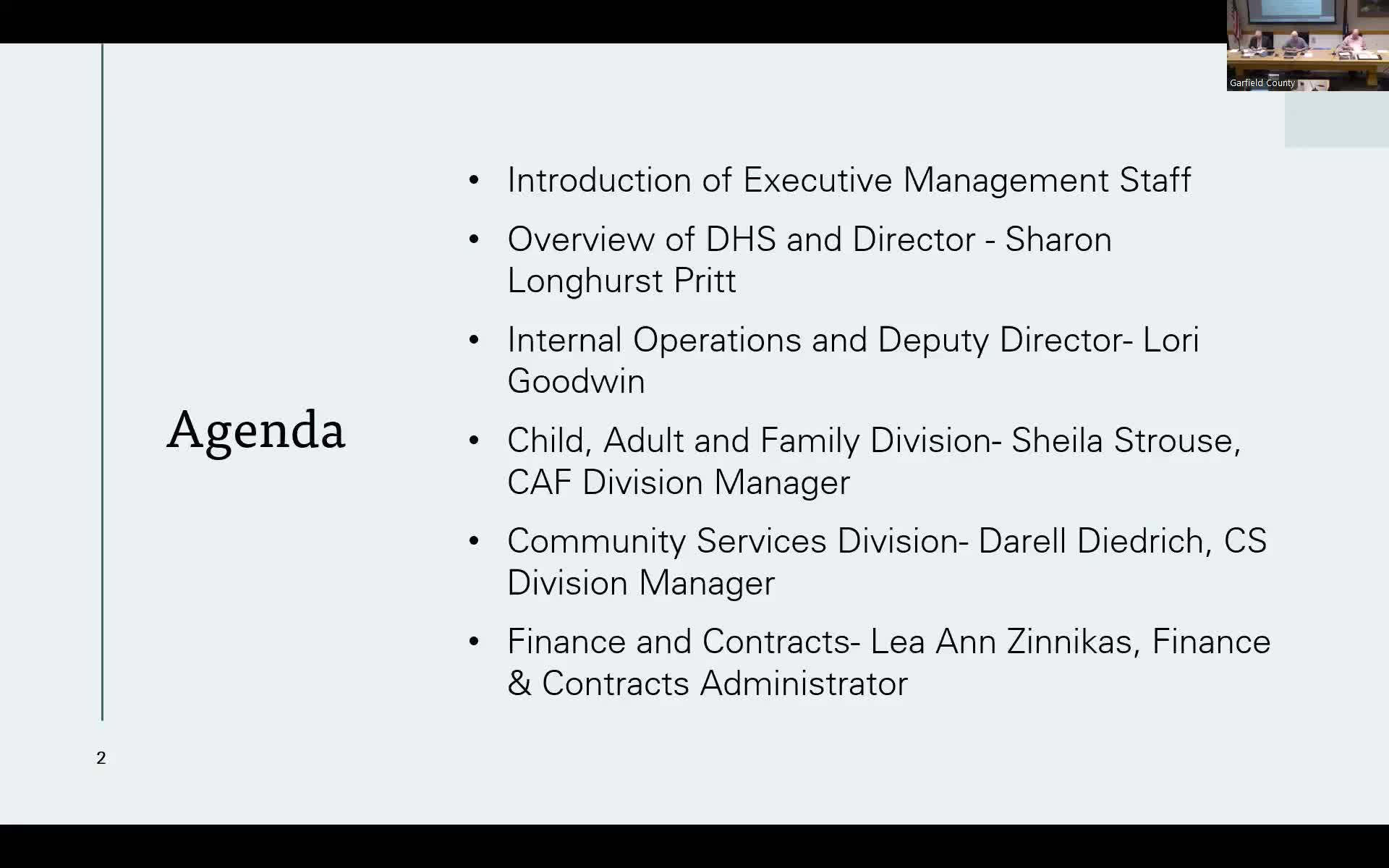
Sharon Longhurst Pritt, director of the Garfield County Department of Human Services (DHS), and her senior managers briefed the commissioners on July 16 on DHS functions, staffing and budget pressures, with a particular focus on anticipated changes from federal and state policy and on program demand drivers.
Sharon said the department employs about 116 staff with typical vacancy levels of 5–10 positions, chiefly in eligibility (Medicaid/SNAP) and child welfare. She described mandated and discretionary program areas: child welfare (investigations, foster care, kinship, out-of-home placements), adult protective services (APS), emergency social services in large incidents (ESF 6 sheltering/response), eligibility programs that determine Medicaid and SNAP, TANF (Temporary Assistance for Needy Families), child care assistance (CCAP), child-support enforcement and older-adult services such as congregate meals and transportation. "The timing is good," she said of presenting the overview because of expected legislative changes (referred to as "HR 1") that DHS staff are tracking.
Key numbers and program notes provided by DHS managers: - DHS annual payroll and program budget is substantial; eligibility caseloads include roughly 12,000 Medicaid clients and more than 4,000 SNAP households (exact counts may vary by month). - The department administers TANF cash assistance for about 50 families currently and CCAP for roughly 198 children (181 classified as low-income through May), with an average current cost per CCAP child around $10,225 and staff warning costs could increase to roughly $18,000 per child-year on new rate structures. - Child welfare out-of-home placements have declined 64% over six years; the county’s out-of-home rate is about 1.5 per 1,000, below the state target of 3.5. However, placements for high-acuity youth present major fiscal and operational strain; White-collar examples included a teenager who required in-office care for 30 days and costly residential treatment placement later out of state.
DHS managers warned of multiple budget pressures: statutory or rule-driven increases to benefit rates, state-mandated COLAs for certain programs, and the end of pandemic-related or temporary funding streams that had masked demand. Finance staff (Leanne) summarized that DHS manages a complex mix of federal, state and county funding with many different reimbursement rates and maintenance-of-effort obligations; TANF and CCAP include county maintenance-of-effort rules and do not behave like simple percentage reimbursements.
The department outlined ongoing operational shifts: contracting out congregate meals in Glenwood Springs and Carbondale, stepping up workforce-center partnerships for TANF clients, and transitioning in-house foster-care administration to a child-placement agency (Hope and Home) to increase recruit/retention of foster families and manage intensive placement needs. DHS said it will present HR 1 impacts and budget implications in a forthcoming board report.
Why this matters: DHS programs provide health, safety and basic needs support to thousands of county residents and operate under a complex funding regime; program demand and state/federal policy changes have direct budgetary implications for the county.
Ending: DHS committed to return with a focused budget presentation, the anticipated impacts of HR 1, and proposed changes to program delivery and contracts for the board’s fiscal planning.