Get Full Government Meeting Transcripts, Videos, & Alerts Forever!
Get email alerts on the Owts Regulation 43 topic
No spam. Unsubscribe anytime.
Public health urges opt-in choices, stakeholder process as state amends onsite wastewater rules
Summary
Garfield County Public Health summarized the state’s Regulation 43 revisions and recommended a stakeholder process and several local opt-ins (licensing/registration of installers and inspectors, inspection-ports, contractor licensing) before adopting local rules that must be at least as stringent as the state’s.
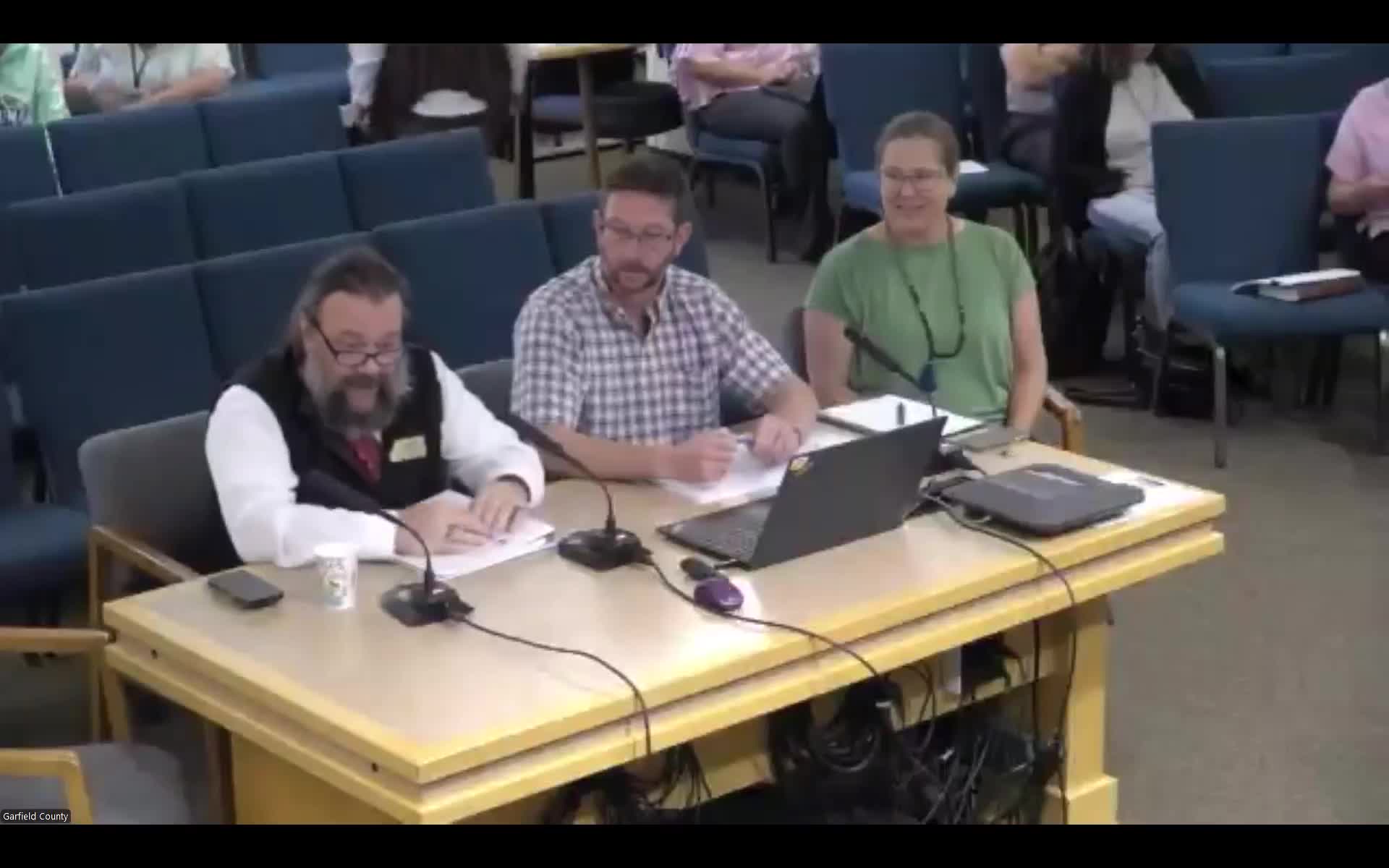
Ted White, Garfield County Public Health environmental health specialist and on-site wastewater treatment system (OWTS) program lead, told the county board that Colorado’s updated Regulation 43 (5 CCR 1002-43) took effect June 15, 2025, and that local boards of health have one year to adopt local regulations that are at least as strict as the state rule.
White said the state changes include clearer designer documentation requirements (for example, reporting “squirt height” test results for pressurized distribution), new soil/bedrock classifications, requirements for tank access risers and interior safety grates, and prohibitions on certain serial-distribution designs. "Septic tanks are confined spaces and not a fun place to be," White said, underscoring a new safety requirement that tanks include a secondary grate below the lid.
Public Health recommended that the board instruct staff to open a stakeholder process and return with recommended local choices (opt-ins) on several matters where the statute allows local tailoring. Among the options staff recommended the board consider are: licensing or registering OWTS contractors and system cleaners (annual license with an open-book exam and fee), registering qualified OWTS inspectors/professionals (to provide an approved list for homeowners), and requiring inspection ports at both ends of each distribution trench for easier field inspections.
White said surrounding counties already license contractors and that licensing reduces installation errors and downstream repair costs for homeowners. Public Health also proposed refining a local definition of a “qualified OWTS professional,” accepting National Association of Wastewater Technicians certifications, Colorado-licensed professional engineers with OWTS experience, or individuals who can demonstrate experience and recordkeeping to support their inspections.
Staff noted the county’s 2014 and 2018 local regulation adoptions included a range of opt-ins already (e.g., allowing continued use of vault privies and continued-use permits, reductions in soil treatment area with higher-level treatment systems, and a variance procedure). The updated state rule requires adoption of base requirements but leaves many local choices for the board to select.
White presented a recommended timeline and asked the board to authorize bringing proposed opt-in choices to stakeholders and returning to the board with a draft local regulation. Commissioners voiced frustration with “unfunded mandates” from the state but agreed the county should pursue a stakeholder-driven approach. No formal vote was recorded; the board asked staff to proceed to stakeholder outreach and return with recommended local options and proposed regulatory language.
Why this matters: Adopting Regulation 43 at the local level affects developers, designers, installers, and homeowners across Garfield County and has implications for groundwater protection, public health, construction costs, and permitting timelines. Several proposed local opt-ins — contractor licensing, inspector registration, additional inspection ports — are designed to reduce installation errors and long-term maintenance costs but could add upfront compliance costs.
Staff follow-up: Public Health will draft proposed opt-in language, conduct stakeholder outreach (designers, installers, pumpers, county departments), and return with a recommended local Regulation 43 adopting base state requirements plus recommended local selections. The board’s immediate direction was to start stakeholder outreach; final local adoption will return to the board for formal action.