Get Full Government Meeting Transcripts, Videos, & Alerts Forever!
Get email alerts on the Behavioral Health Tax topic
No spam. Unsubscribe anytime.
County holds public hearing on proposed 0.15% behavioral‑health sales tax; decision tabled to Aug. 19
Summary
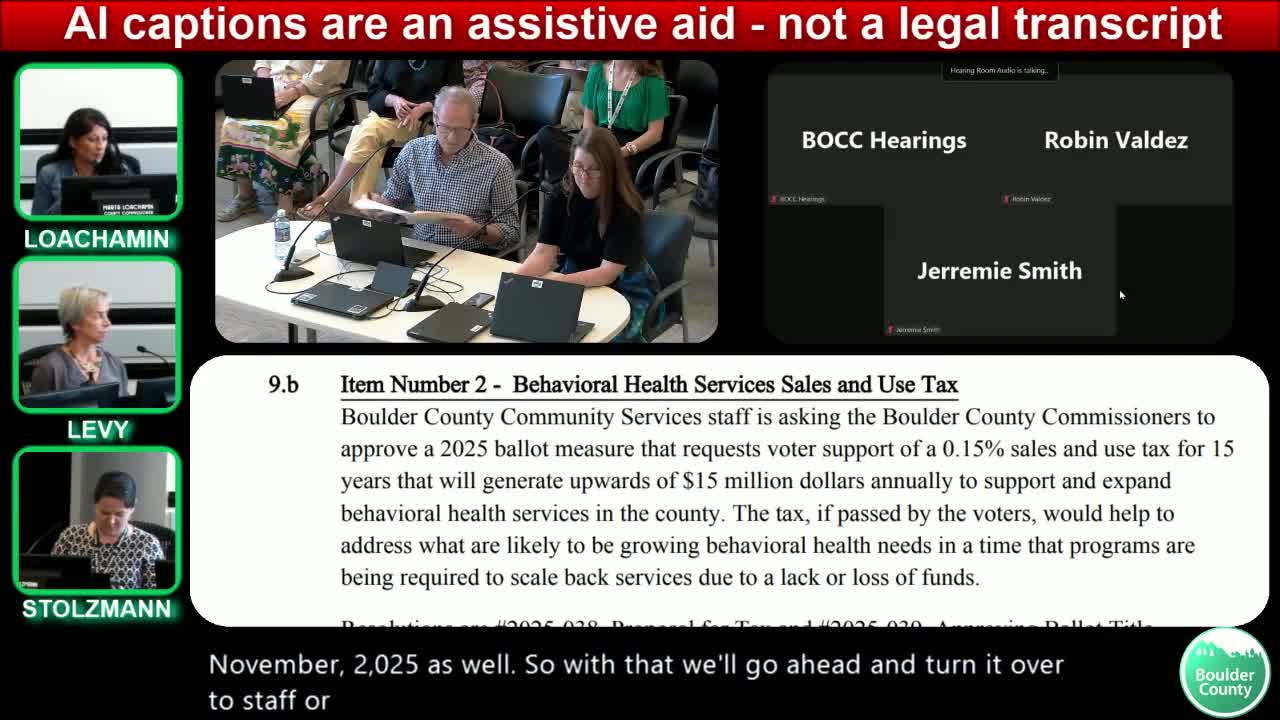
Staff recommended placing a 0.15% behavioral‑health sales tax on the Nov. 2025 ballot to fund navigation, prevention, crisis response, treatment and recovery supports, but after extensive public testimony commissioners tabled action to Aug. 19 to allow more outreach and follow‑up information.
Boulder County staff recommended Aug. 12 that commissioners place a proposed 0.15% behavioral‑health sales and use tax on the Nov. 4, 2025 ballot to generate an estimated $15 million a year and fund a continuum of mental‑health and substance‑use services. After a lengthy public hearing with dozens of speakers, commissioners voted to table final board action until a special meeting on Aug. 19 to allow more targeted outreach and to gather additional financial and program details.
Staff recommendation: Michelle Webb, behavioral‑health system manager, and Jim Adamsburger from Community Services presented a funding model allocating revenue across a service continuum: navigation (5%), prevention (10%), crisis response and stabilization (20%), treatment (40%) and recovery supports (25%). Staff said the funding would be distributed primarily to community providers and that the proposed revenue would sustain navigation services and the community assistance and treatment (CAT) crisis response team and replace expiring federal, state and ARPA grants.
Case for new local revenue: Staff outlined service gaps — long waits, shortages of providers who accept Medicaid or offer culturally responsive care, limited residential and intensive programs — and warned that recent federal and state grants are ending, Medicaid funding faces downward pressure, and ARPA grants supporting navigation and crisis services will expire. Staff argued local revenue is needed to sustain and expand services and guard against a shrinking safety net.
Public comment: More than 50 people spoke. Providers, safety‑net health centers and unionized frontline staff urged voters be given the chance to fund services, citing long wait lists, the county’s only 24/7 walk‑in crisis center and rising suicide and overdose rates. Several providers said federal and state funding cuts would cause closures without a local revenue source.
Other commenters — including some mental‑health advocates and local residents — urged caution, saying the county should present clearer programmatic priorities, measurable targets, and a transparent allocation and oversight structure before asking voters to approve a long‑term tax. Families and advocacy groups pressed the county to include residential psychiatric capacity and step‑down housing in any plan for people with severe, persistent mental illness.
Board action: After public comment commissioners agreed additional information and community engagement were necessary. The board voted to table the item and reconvene Aug. 19 at 9:30 a.m. (a business meeting) for further staff briefing and deliberation. Commissioners asked staff to provide a clearer accounting of current behavioral‑health spending, the ARPA investments that have supported recent services, and options for oversight, evaluation and workforce investment.
Why it matters: Staff said the proposed tax would allow the county to sustain crisis navigation and treatment services in the face of disappearing grants and Medicaid pressures. Commissioners’ decision to delay reflects competing pressures: urgent service needs and a community demand for clearer, more specific commitments and measurable outcomes.
Sources: Community Services staff presentation and public testimony at the Aug. 12 Board of County Commissioners meeting.