
Officials warn Medicaid, SNAP changes in recent federal bill could affect county services; county plans delegation outreach
Get AI-powered insights, summaries, and transcripts
Subscribe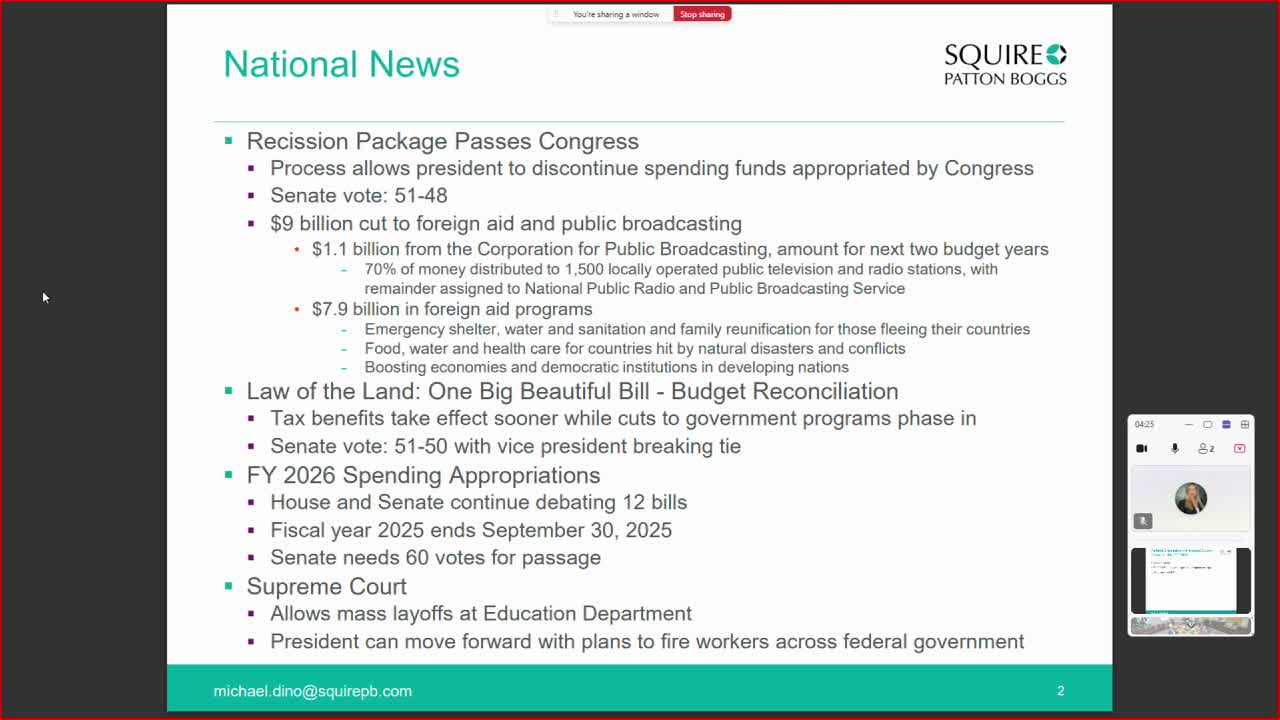
Summary
Federal policy changes passed in the recent reconciliation package prompted Arapahoe County officials on Tuesday to begin planning outreach and advocacy with the county's federal delegation and state leaders.
Federal policy changes passed in the recent reconciliation package prompted Arapahoe County officials on Tuesday to begin planning outreach and advocacy with the county's federal delegation and state leaders.
Mike Dino, an outside federal-affairs speaker participating in the meeting, described the legislation's mechanics and possible downstream effects for counties. "The rescission, again, is where the White House decides, hey, congress. I either don't want you spending this money or you're not spending it, so I want it back to go back to the federal treasury," Dino said. He explained the package reclaimed roughly $9 billion in unspent funds and that the measure removed or reduced several foreign‑aid and public‑broadcasting items earlier in the process.
Dino summarized the parts of the reconciliation package that most directly affect states and counties: a roughly $1.1 trillion reduction tied to Medicaid over the 10‑year window as presented to attendees, a substantial SNAP (food‑assistance) reduction and other program changes. He also cited a new Congressional Budget Office projection that the federal deficit will rise by about $3.4 trillion over 10 years as a result of enacted measures discussed in the session.
County leaders said the changes could increase administrative burdens for county social‑service programs and require state or local backfills for affected services. Commissioners pressed staff about how to respond. Commissioner Fields voiced concern about people who rely on long‑term services: she warned the group that the changes could create new administrative barriers for households and service providers, particularly people with disabilities, older residents and other vulnerable populations.
Staff and the consultants on the call discussed immediate next steps. They proposed intensified outreach to Colorado's federal delegation, a review of county programs that depend on federal funding and an October advocacy trip to Washington, D.C., to press specific project and program requests. Dino and county staff also outlined how appropriations and continuing resolutions could change implementation timelines: several cost‑sharing and provider‑fee reductions in the legislation are scheduled to start Oct. 1, 2025 (fiscal year 2026), though staff noted that continuing resolutions or other congressional actions could alter those start dates.
County staff said they will prepare more granular estimates of local fiscal exposure and ask departments that receive federal funds to produce program‑level impact assessments. Commissioners directed staff to bring information on potential county budget implications to a scheduled August study session so the board can consider whether state‑level action or local mitigation is needed.
What to watch: county staff will track implementation guidance from federal agencies (for example, USDA on SNAP and the Centers for Medicare & Medicaid Services on Medicaid rules), coordinate advocacy with the county's federal delegation and present a set of recommended responses to the board in the coming weeks.