
Arapahoe County to adopt state model standards for electric vehicle charging sites, staff to draft code
Get AI-powered insights, summaries, and transcripts
Subscribe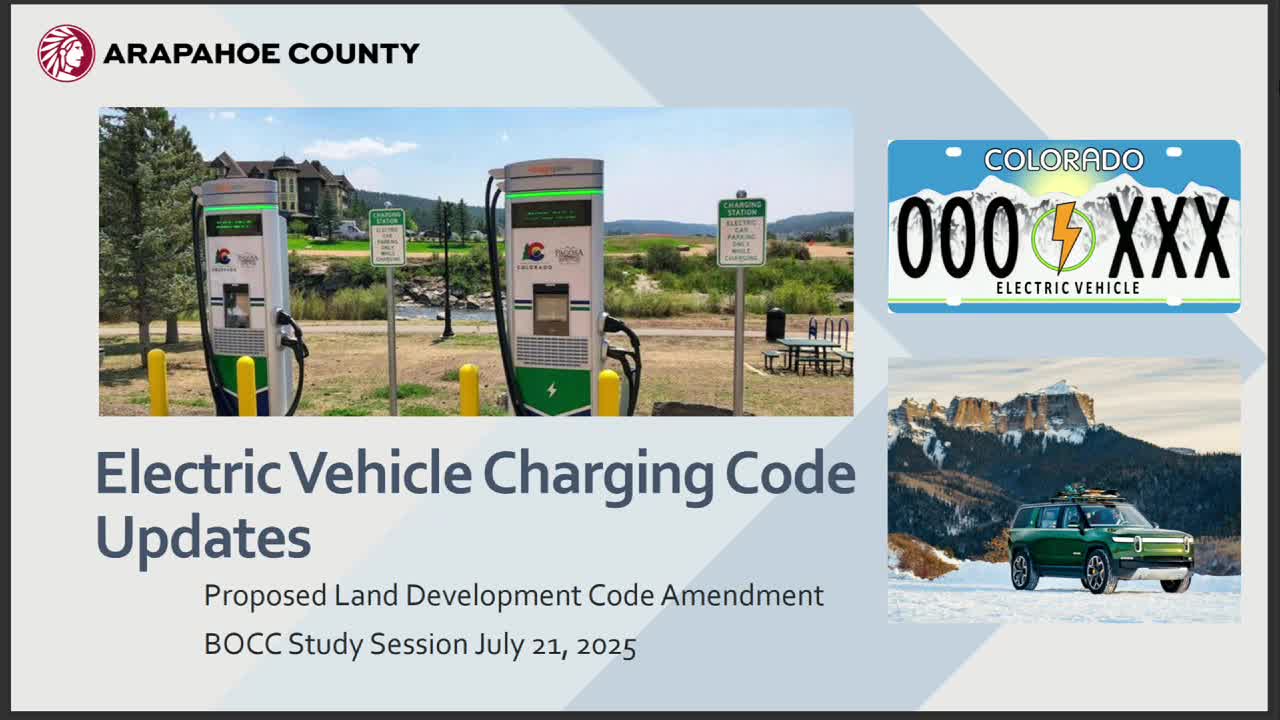
Summary
County staff recommended adopting the Colorado Energy Office model code to comply with a 2024 state EV charging law; commissioners agreed and staff outlined a timeline for drafting code, public review and hearings through December.
Arapahoe County staff recommended, and commissioners agreed, July 15 to adopt the Colorado Energy Offices model code for electric vehicle charging sites to meet requirements of recently enacted state legislation.
Brian Wymer, director of Public Works and Development, summarized the countys need to comply with a 2024 statute referenced in the meeting as House Bill 24 11 73, which requires local jurisdictions to adopt standards for electric vehicle (EV) charging infrastructure and related permitting processes. Molly Rakel Larsen, principal planner, said the Colorado Energy Office produced a model code and the county examined three compliance options: adopt the state model code (staff recommended), draft a wholly county code (staff did not recommend because of timing), or retain existing permitting practice (not applicable).
Larsen said adopting the state model code would be the most straightforward compliance path and that the state has offered staff support. She outlined the model codes elements: new definitions, required site and equipment standards, optional design elements (lighting, pavement marking, weather canopies) and permitting process elements. Larsen said the states model would allow the county to avoid requiring applicants to appear in person for permitting steps and urged staff to ask the state about notary/remote notarization questions.
Planner Ray Fields reviewed the project timeline staff proposed: draft code in the next two weeks, a planning commission study session Aug. 19, a return to the commissioners for feedback Sept. 23, planning commission hearing Nov. 4 and a Board of County Commissioners hearing Dec. 9. Director Wymer flagged opportunities to tie this code work to ongoing county EV outreach, education materials for developers and the countys existing EV strategy.
Commissioners discussed specific elements such as optional landscaping and weather canopy requirements and the tradeoff between design expectations and cost that may affect station deployment. Commissioner Jessica Campbell asked whether the code would allow remote online notarizations to avoid in‑person notarization costs for applicants; staff said they will clarify that point with the state.
The board indicated support for the staff recommendation. The chair recorded “5 thumbs up” to proceed with the staff‑recommended option to adopt the state model code and to begin drafting amendments for public review and hearings.
Next steps: staff will draft code language, consult with the Colorado Energy Office on permitting/process details, post materials for public comment, present at the Aug. 19 planning commission study session and follow the published hearing timeline through Dec. 9.