Get Full Government Meeting Transcripts, Videos, & Alerts Forever!
Get email alerts on the Hydrogen Infrastructure topic
No spam. Unsubscribe anytime.
Depoe Bay committee to pursue two state grants for hydrogen fuel‑cell backup at city facilities
Summary
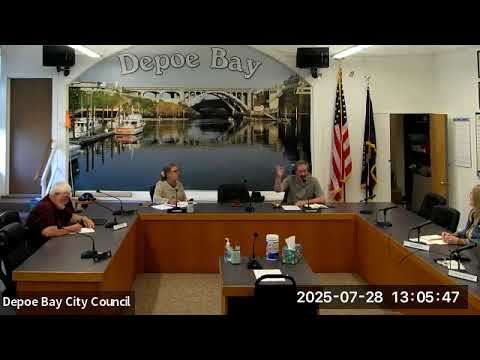
Members of the city’s resilience committee discussed applying for two state grants to add hydrogen fuel‑cell backup power to City Hall and other municipal facilities and to plan a larger hydrogen‑generation site, members said.
Members of the city’s resilience committee discussed applying for two state grants to add hydrogen fuel‑cell backup power to City Hall and other municipal facilities and to plan a larger hydrogen‑generation site, members said.
The committee focused on two near‑term steps: pursue a construction grant to install a fuel‑cell and storage container at City Hall and a separate construction request to equip the community center with fuel cells, and submit a planning grant to design a larger, centralized hydrogen‑generation facility that could supply multiple sites. The Oregon Department of Energy (ODEQ) application window was reported to open Aug. 11, and committee members said the state extended the application deadline by about six weeks into October.
Why it matters: committee members said hydrogen fuel cells would provide longer‑term, storable backup power for critical services — including City Hall, the community center and wastewater systems — and that a centralized generation site could scale to serve multiple city facilities and potentially private customers in the future.
What the committee discussed and decided One committee member proposed "submitting two planning grants at the million‑dollar level" to cover engineering and construction for the City Hall and community center projects and to fund design of a separate generation site. The group agreed it had time to prepare applications, but that the committee should coordinate with city staff and the engineering contractor before formally asking the city council to authorize an application.
Members described several candidate municipal sites for backup fuel cells or generation planning, including City Hall, the community center, the city’s water‑ and wastewater‑treatment facilities (including a cistern near Otter Rock), and locations north and south of the bridge that separates parts of the city. One committee member said the City Hall design under review envisions a 20‑foot container housing electrolyzer equipment, fuel‑cell modules and tanks, with three active tanks and three spares for storage.
Technical and siting points raised in the discussion included: an electrolyzer would allow on‑site hydrogen generation; wind and wave resources on the coast could supply renewable electricity to make hydrogen; solar alone was described as less reliable in foggy stretches; and generation siting should minimize visual impacts. A committee member described the possibility of sizing a single generation facility larger than City Hall needs so that it could supply additional municipal buildings with only smaller local fuel‑cell installations.
Roles and next steps Committee members said Appium’s (engineering integrator) engineers would prepare detailed engineering; the committee’s role is to set project scope and recommend actions to the city council, and the council would make any funding or policy decisions. The committee agreed to work with staff (identified in discussion as Kim) and the engineering contractor to prepare draft materials and to return to the council to request formal authorization to apply at an upcoming meeting (committee members cited Aug. 13 as the next council meeting date for consideration). The committee set its regular meeting time as the fourth Monday at 1 p.m. and planned follow‑up work to size generation and storage and to identify priority facilities.
Funding and business model questions remained unresolved. Members discussed whether generation would be city‑owned or privately operated, whether excess hydrogen could be sold, and what permitting and maintenance obligations a generation facility would create. Those issues were raised for future study rather than decided.
Committee outreach and coordination Members agreed to reach out to local homeowners associations and the emergency preparedness committee for volunteers and for local input on siting. The group also said it would contact developer Chris Vanderbilt, identified in the meeting as the managing partner for recent local subdivisions, about potential siting on common property near Highway 101.
The committee asked staff to circulate the Phase 1 final report and the planning‑grant application materials the group had used previously. Committee members said they would prepare rough sizing calculations for how many fuel‑cell modules and how much hydrogen storage would be required to hold a three‑week backup supply for each prioritized site and bring those numbers to the next meeting.
Ending The committee did not take a formal binding vote in the meeting to submit applications; members agreed to prepare applications through staff and engineering partners and to ask the city council to authorize submission. The group set follow‑up work and a next meeting date to refine sizing, costs and site selections.