
Butler County leaders discuss mill-levy history and consider sales-tax option to lower property tax burden
Get AI-powered insights, summaries, and transcripts
Subscribe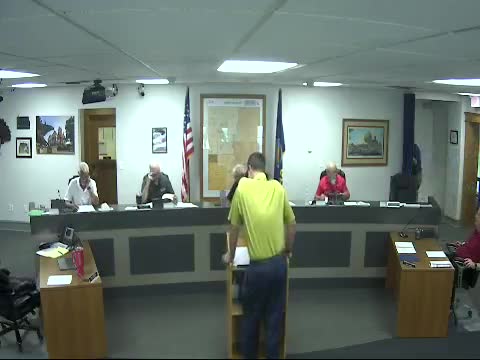
Summary
County staff reviewed mill-levy and assessed-valuation data and presented a proposal framework for a possible half-cent county sales tax; commissioners discussed smaller near-term mill-levy targets and the budget trade-offs for a proposed salary-study and other priorities.
Will (staff member) told the Butler County Commission on July 29 that a county review of mill-levy and assessed-valuation data shows Butler County’s levy fell from about 35.72 mills in 2007 to 29.88 mills for the 2024 tax year, placing the county among the state’s lowest levies. "We thought it would be helpful to review our mill levy information," Will said as he opened the budget presentation.
The review included comparisons to Johnson and Sedgwick counties and a calculation of how a county sales tax would translate into reduced property tax. Staff said a 1¢ (one-cent) county sales tax would generate roughly $13 million and that the county’s share under the distribution approach the county has requested from the Legislature would be about $6.5 million. "With the half cent sales tax, we would be easily the second lowest mill levy in the state of Kansas without any any effort," Will said.
Why it matters: Commissioners and staff framed the discussion as a choice between continuing to trim levy reliance versus pursuing a county sales tax to shift revenue away from property taxes. Commissioners discussed near-term levy goals and staffing, and staff cautioned the county relies today on elevated interest income to smooth budgets.
Key details and debate: Staff presented a large set of comparative metrics — assessed valuation, mill-levy change since 2007, taxes levied and per-capita tax burdens — and said Butler County is now among the lower levies in Kansas because of deliberate reductions over time. The presentation noted sales-tax revenue can vary with economic cycles, and that counties with sales taxes often use some portion for capital or dedicated projects rather than direct residential property tax relief.
Commissioners and staff discussed possible targets. One suggestion from staff and commissioners was to aim for a modest near-term levy reduction target (a quarter-mill was discussed as a realistic immediate objective); commissioners also discussed smoothing one-time costs and the proposed pay study across reserves if needed. "At some point in time, you've got to fund operations," one commissioner observed, noting recruitment and compensation pressures in public safety and other departments.
Staff cautioned that interest income has been an important budget cushion recently and that lower interest rates in the future would reduce that buffer. "We made $4,000,000 last year, which is the equivalent of 4 mills. I'm budgeting 2 and a half to be conservative," Will said. Commissioners discussed staging any new revenue option and sunset provisions for sales tax measures so voters review them periodically.
Next steps: Staff said it will continue to refine numbers for the salary study and incorporate more precise estimates of any proposed personnel items; the commission flagged a target to identify roughly $250,000 of recurring budget adjustments to accompany a modest levy target and to continue pursuing the legislative language needed for a county sales-tax distribution that would return approximately half of a one-cent tax to the county.
Ending: Commissioners set an August 26 public budget hearing on the tentative budget and asked staff to return with more granular scenarios for a quarter-mill and for the effects of a half-cent sales-tax proposal if legislative language is available.