
Columbia council accepts 2025 Renewable Energy Plan, urges further study of future contracts
Get AI-powered insights, summaries, and transcripts
Subscribe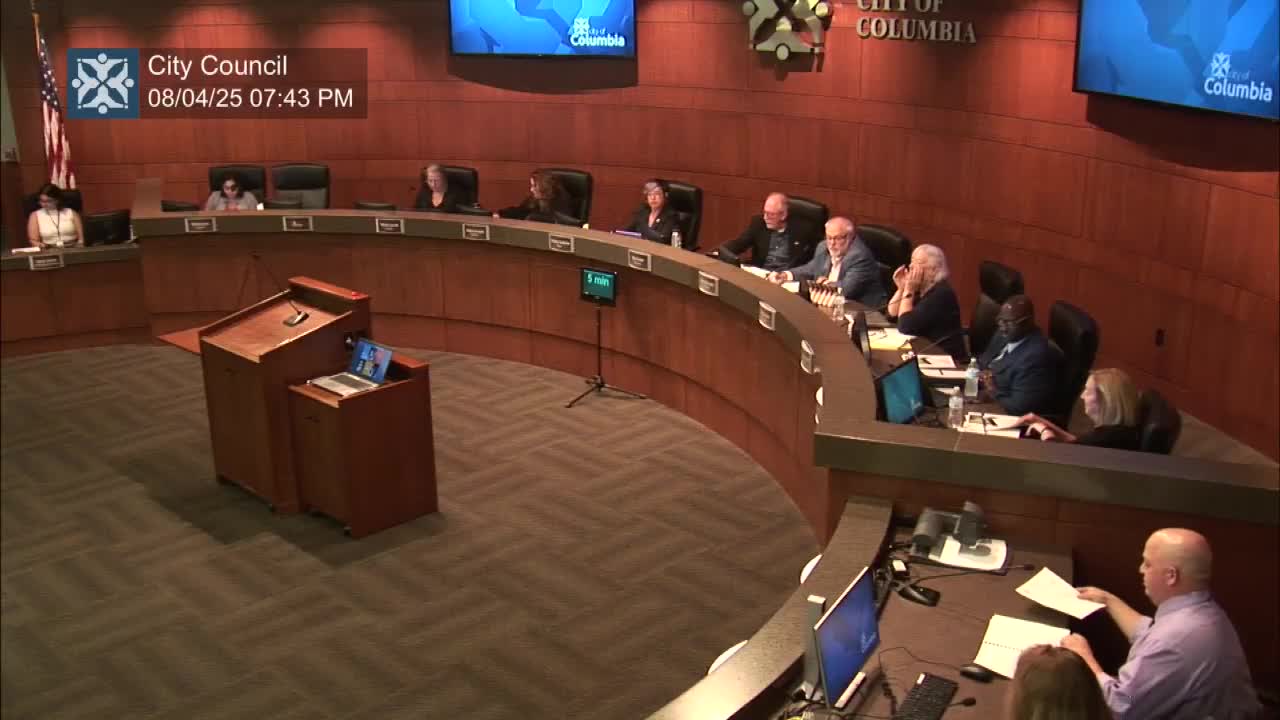
Summary
The City Council voted to accept the Columbia Water & Light 2025 Renewable Energy Plan after staff described current renewable purchases, projected shortfalls and the financial trade-offs of future power purchase agreements. Council and public speakers urged faster renewable procurement while staff warned of transmission and market risks.
Columbia accepted its 2025 Renewable Energy Plan on Aug. 4, 2025, after a staff presentation detailing last year’s renewable generation, the costs of renewables versus nonrenewables and the constraints posed by transmission and existing long‑term contracts. The Water & Light Advisory Board recommended adoption and staff said the city will continue to evaluate solar offers and refine the ordinance that governs future renewable purchases.
The plan shows the utility supplied about 22.82% of its 2024 electricity from renewable sources, below the city’s 25% target for that year, with landfill‑gas upgrades contributing to the increase from 2023. Erin Keyes, Utilities Director, told the council that under current contracts Columbia expects roughly 23.9% renewable supply in 2025, and that the city holds an agreement for about 35 megawatts from a wind facility contingent on a transmission buildout.
The nut graf: council accepted the report as the annual accounting of renewable supply and costs, but the hearing underscored a split between advocates pressing for more aggressive procurement to meet climate targets and staff urging caution because of transmission limits, uncertainty about when coal plants will retire and the price and market‑risk implications of buying contracted renewable capacity.
City staff emphasized three practical constraints: (1) some long‑term coal and capacity contracts remain in force and may not expire at a fixed date; (2) adding renewable capacity today can create situations in which the utility must sell unneeded energy into volatile wholesale markets at a loss; and (3) transmission availability — notably the Grain Belt Express/Grain Belt corridor — affects whether wind contracts will actually deliver energy into Columbia’s service area. "As we evaluate future renewables contracts, costs and financial risk will be a significant consideration," Keyes said. "Until life‑of‑plant coal contracts or PPAs expire, if we enter into a renewable energy contract we will likely purchase more energy than what we need to serve our load."
Public commenters at the hearing urged a faster transition. Carolyn Omparan, chair of the Sierra Club Mid‑Missouri Group, speaking for the Columbia 100% Renewable Energy Coalition, said the council’s draft 40% by 2035 goal is insufficient and argued Columbia could achieve a much higher share if it replaces retiring coal contracts with renewables. "When Sikeston closes, if the energy is replaced with renewable energy, Columbia Water & Light can achieve 65% of our energy from renewable sources if we choose to do so," Omparan said. Other speakers urged local solar, microgrids and battery storage as alternatives to relying on distant transmission projects.
Councilmembers asked staff about timeline questions and transmission dependencies, and staff said they are evaluating two solar offers within the Midcontinent Independent System Operator (MISO) zone that would limit transmission costs and are preparing an RFP if those offers are not favorable. The council also heard that staff will bring proposed ordinance revisions back to city council later this year following recommendations from the Water & Light Advisory Board.
The council voted to accept the 2025 Renewable Energy Plan. The motion was made from the dais and seconded by Councilmember Betsy Peters; roll call was unanimous in favor. Staff said the acceptance is an annual formal step and does not by itself authorize new power purchase agreements. "Any future additional renewable purchases will put us in a situation where we will sell excess energy some hours and lose money in others," Keyes said, adding that the utility is surveying customers about willingness to pay for higher renewable shares.
Looking ahead, staff said they will present ordinance revisions and an evaluation mechanism for future renewable PPAs, continue residential and business solar incentives, and pursue battery‑storage and local projects to improve reliability. The Water & Light Advisory Board and the Climate & Environment Commission previously reviewed the plan and will continue involvement as contract offers are evaluated.
Ending: The accepted plan documents last year’s renewable performance and frames near‑term priorities — evaluating two solar offers, refining the ordinance, and studying storage — while leaving the politically sensitive choice about how quickly to buy large renewable blocks to future council deliberations and contract‑level decisions.