Planning staff and consultants update commission on three North City neighborhood plans; pop‑ups and implementation emphasis
Loading...
Summary
Consultants presented mid‑process neighborhood plans for Planning Areas 1 (The Ville/Greater Ville/Kingsway East), 2 (Walnut Park East/West and Mark Twain) and 3 (Baden and Northpointe). Presentations emphasized robust engagement, development scenarios, vacancy strategies and upcoming placemaking pop‑ups Aug. 23 and Sept. 6.
City planning staff and consultant teams updated the Planning Commission on ongoing neighborhood planning efforts in three north‑side planning areas and described outreach, findings and next steps.
Jonathan Roper of the Planning and Urban Design Agency introduced the work and said neighborhood planning is intended to be co‑authored with residents and city departments. He described phase schedules, noted the planning process is integrated with continuous public engagement, and flagged upcoming pop‑up events August 23 and a community “build day” and the Trap Run on Sept. 6.
Leslie Roth and Hallie Nolan of Lamar Johnson Collaborative presented planning area 1 (The Ville, Greater Ville, Kingsway East). Their existing‑conditions review found that residents in the area are more cost‑burdened by housing than other parts of the city and that the area has a tight block structure but relatively low public‑gathering space. The team said it has convened neighborhood planning committees, topic working groups and 15 neighborhood ambassadors, distributed about $10,000 in stipends, held three public workshops (about 200 participants total), and contacted roughly 3,000 residents in a planning area with an estimated population of about 8,000. Draft subarea development scenarios include four typologies residents prioritized: commercial corridor, resilience/innovation (urban agriculture/eco‑blocks), neighborhood nodes (mixed‑use, placemaking) and institutional campus projects tied to cultural assets and schools. The team said pop‑up demonstrations for placemaking will test design ideas on Euclid & St. Louis Ave and Cottage Ave & Sumner.
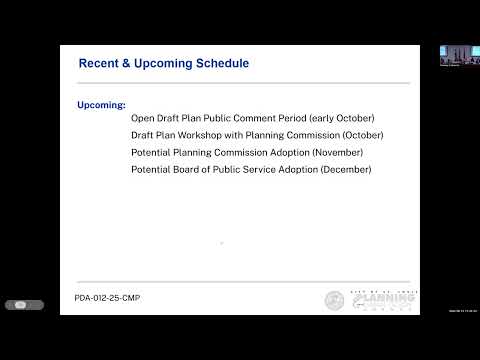
Catherine Hamaker of PGAV briefed commissioners on Planning Area 2 (Walnut Park West/East and Mark Twain). Her team focused on flooding and stormwater impacts (including notable 2022 events), a largely residential land use pattern, vacancy, and resident desire to activate empty buildings and public spaces. Engagement included topic focus groups, pop‑ups, surveys, neighborhood ambassadors and a developer/implementation bus tour. The team said the draft plan will be circulated to city departments before a final open house and a tentative December presentation to the commission.
Interborough’s Dan Dioka and Justin Paul Ware presented Planning Area 3 (Baden and Northpointe) and summarized market analysis and existing‑conditions work. Jessica Payne (Key Strategic Group) summarized findings showing strong historic identity, pockets of high homeownership alongside areas of deep vacancy, some rising home sale values (a reported high of $185,000 and reported low sales reflecting severely distressed properties), and opportunities tied to nearby regional assets. The team described a range of engagement tactics — public workshops, ambassadors, sign campaigns on vacant lots, pop‑up traffic‑calming demonstrations (including a successful painted crosswalk and activation at Hickey Park) — and said the plan will identify catalytic projects and an implementation matrix.
Commissioners asked about how tornado recovery (May event) affected engagement and plan priorities; teams said Planning Area 1 was the most directly affected and that recovery staff and cultural corridor partners have coordinated with planning efforts. Multiple commissioners raised stormwater and flooding as recurring issues; staff and consultants said topography, combined sewers and historical development patterns help explain why some North City areas experience more surface flooding and that some MSD relief is done with surface detention where land costs are lower. Commissioners also pushed for clear implementation commitments, targeted strategies to support the most stable blocks, and additional time where warranted for review before adoption.
Next steps: teams will continue drafting neighborhood plans, refine implementation matrices, hold additional public workshops and pop‑ups (notably Aug. 23 and Sept. 6), and circulate drafts to city departments. Staff said phase 2 planning (areas 4–6) is under contract and that timing will accommodate tornado recovery coordination where needed.