Get Full Government Meeting Transcripts, Videos, & Alerts Forever!
Get email alerts on the Personnel Superintendent Search topic
No spam. Unsubscribe anytime.
Bridal Group outlines 16-week superintendent search process for Laconia district
Summary
The Bridal Group presented a multi‑phase superintendent search plan to the Laconia School Board, describing outreach, a community fit survey, guided storytelling interviews and a typical 16‑week timeline; board members asked timing and candidate‑pool questions.
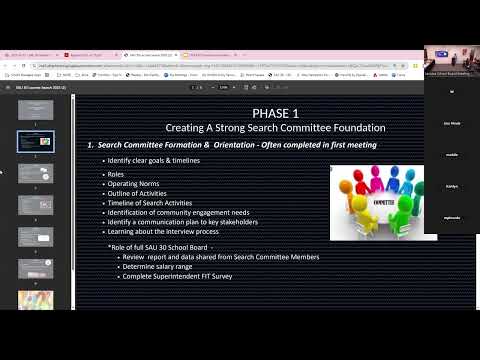
Michelle Munson of the Bridal Group told the Laconia School Board the firm’s superintendent search process typically runs about 16 weeks and emphasizes community outreach and structured interviews. "The whole process takes about 16 weeks, from start to finish," Munson said, describing phases that include forming a search committee, surveying stakeholders and creating a job posting designed to "sell the district."
The firm recommended the board appoint a search committee, run a fit survey of administrators and community stakeholders, and use a guided‑storytelling interview method to reduce bias and probe candidates’ behavioral examples. The Bridal Group’s sequence: organizational meeting to set goals and norms; stakeholder input (surveys and focus groups) to define measurable competencies; a public posting period timed to maximize educator availability; an evidence‑based screening process; semifinalist visits and background checks; and final interviews by the full board. Munson said the firm trains committee members on how to evaluate applications and conducts a community survey before the posting to help prioritize candidate criteria. "We teach people to understand guided storytelling," she said, explaining how candidates are asked to share specific career stories and interviewers drill for details.
Board members asked about timing and candidate supply. Munson said recent searches yield fewer applicants than 15–20 years ago and that it is not unusual to extend the posting window if the applicant pool lacks sufficient strong candidates. The Bridal Group recommended starting the search in the fall so educator‑applicants can consider the move over the school break and holiday period; that often leads to final candidates being identified in January.
The presentation included outreach practices (postings to education associations and local media), expectations for search‑committee workload (committee members should plan for roughly 30 hours), and the firm’s confidentiality approach: applications remain nonpublic through screening and become public only when finalists are presented to the full board. Munson said the firm provides CEUs to participating educators and supports background checks and reference research during finalist vetting.
The board did not take formal action on the engagement during the presentation; board members and staff said they will determine next steps for forming a committee and bringing the Bridal Group back for follow‑up planning.