
Pueblo West board declines to recognize firefighters’ union; union may pursue ballot petition
Get AI-powered insights, summaries, and transcripts
Subscribe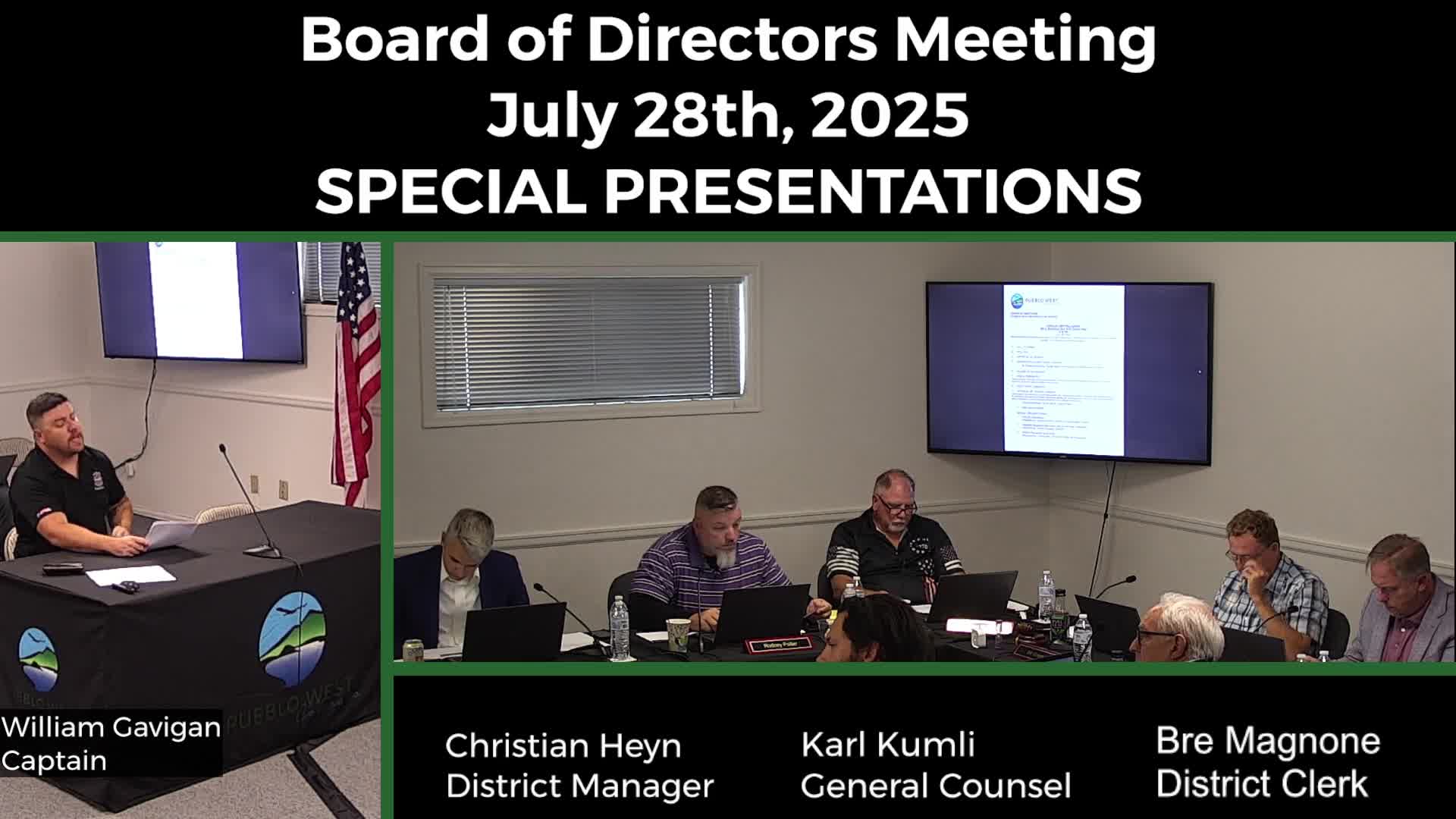
Summary
The Pueblo West Metropolitan District board voted to deny recognition of the Pueblo West Firefighters Local 475’s request to be recognized as a local bargaining unit and moved the petitioners toward a voter-driven option under state law.
The Pueblo West Metropolitan District Board of Directors voted July 22 to deny a request to recognize Pueblo West Firefighters Local 475 as a collective bargaining unit, after more than an hour of public presentation and board questions about costs and long-term obligations.
Union president Will Gavigan told the board the local’s members want a contract that would “establish a framework for employment, protecting the rights of the firefighters, and promoting stability and efficiency within the department.” He said 33 of roughly 35 line-level firefighters had signed a letter of intent supporting recognition and that the union had contributed to prior campaigning for a district sales-tax measure.
The board’s discussion emphasized fiscal uncertainty without a stable, dedicated revenue source. District Manager Christian J. Hynd and board members repeatedly cited the district’s limited budget and said committing to a labor contract with binding staffing minimums could create multi-year obligations the district might not be able to fund if a proposed permanent sales tax provision (referred to in the meeting as the “6A initiative”) did not continue to provide revenue.
Board members also raised alternatives and funding mechanisms the union mentioned, including federal SAFER grants used by some larger fire departments. Gavigan and the union cited neighboring departments that use SAFER grants and other funding tools to offset payroll costs.
After questions, the board first moved the union’s request to an action item and then took the action to deny recognition. The motions were carried by voice vote.
The union’s presentation referenced two statutory routes in the transcript: the Firefighter Safety Act cited as “Senate Bill 25” and a later-referenced ballot process under “Senate Bill 13-025.” Following the board vote, the union indicated its intent to circulate a petition under state law to place a collective-bargaining authorization measure before voters.
Why it matters: Recognition would have allowed the union and district to negotiate a binding collective bargaining agreement that could include minimum staffing levels and other terms; denial means the union will likely pursue a voter-driven route, which would shift campaign costs and the final decision to the district’s electorate. The board framed the decision as protecting long-term fiscal stability for the district.
What happened next: Board members and staff said they would provide the union with procedural follow-up, including guidance on next steps if the union pursues a petition under the state statute cited in the meeting. The district manager noted the district paid the election administration costs in 2020 when the sales-tax ballot measure was certified; he reported the most recent general-election cost associated with the district ballot as $23,768.90.