Get Full Government Meeting Transcripts, Videos, & Alerts Forever!
Get email alerts on the Budget Disaster Relief topic
No spam. Unsubscribe anytime.
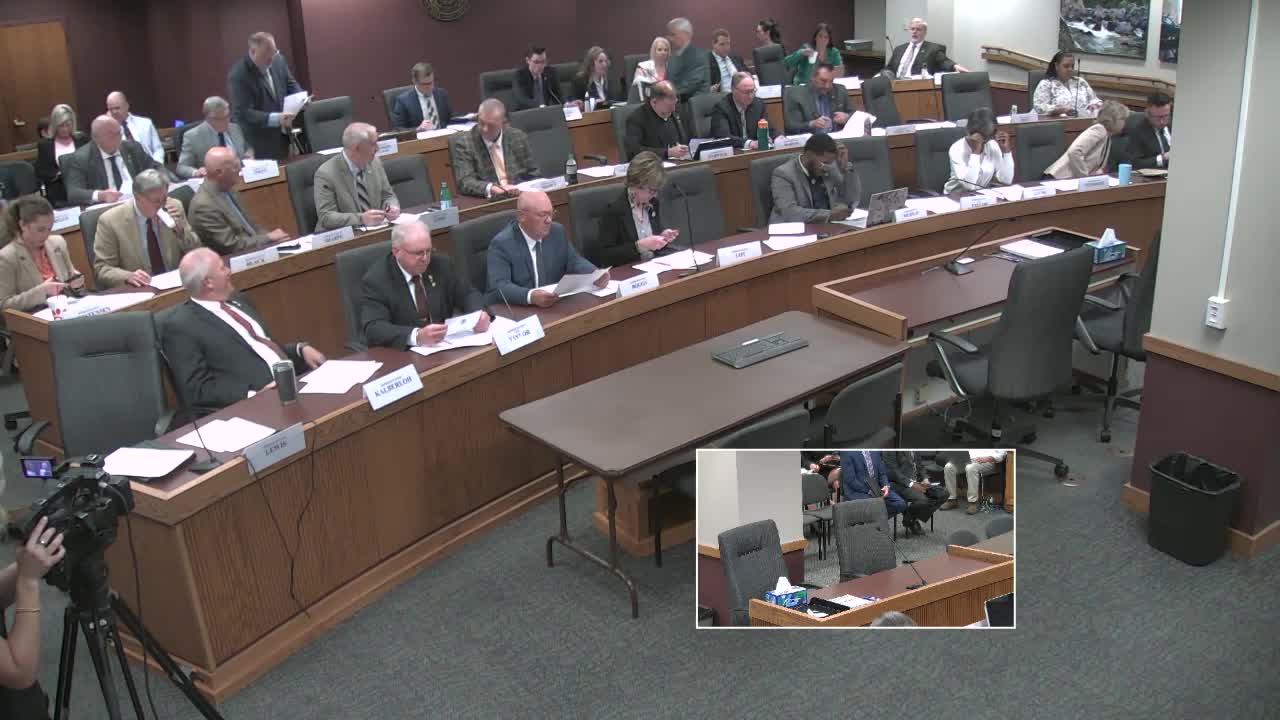
House Budget Committee approves Senate substitute for SB1 to fund St. Louis tornado relief, MU reactor aid
Summary
The House Budget Committee voted 28-0 to report a Senate substitute for Senate Bill 1, a supplemental that directs $100 million in general revenue to St. Louis tornado relief, $25 million to the Missouri Housing Development Commission for housing assistance, and $50 million to the University of Missouri research reactor (MER).
The House Budget Committee voted 28-0 to report a Senate substitute for Senate Bill 1, a supplemental that assembles disaster relief and several capital items including $100 million in general revenue for St. Louis tornado response, $25 million for housing assistance administered through the Missouri Housing Development Commission, and $50 million for the University of Missouri research reactor (MER).
The bill, which the governor placed on an amended call, aims to move cash and spending authority quickly to respond to the May 16 tornado that hit St. Louis. For disaster housing, Kip Stetsler, executive director of the Missouri Housing Development Commission, told the committee that “the 25,000,000 will be run through an existing program, the Missouri Housing Trust Fund.” Stetsler said the trust fund already supports hotel-motel vouchers and a network of local grantees, and that MHDC’s notice of funding availability and application guidance are ready to deploy once the appropriation is final.
Why it matters: State officials said federal help will arrive but not cover all needs, and that fast state action is required to help uninsured and underinsured households, preserve rental assistance and voucher holders, and support neighborhood businesses. Mayor Tara Spencer of the City of Saint Louis described the damage and the human toll: “This tornado was on the ground for 23 miles,” she said, and the city’s initial counts put roughly 48,000 people and 23,000 households in the impacted zone.
Key spending items and mechanics - $25,000,000 — transfer of general revenue to Missouri Housing Development Commission for housing assistance targeted to uninsured and underinsured disaster victims; MHDC to distribute funds through its established grantee network and eligible uses include hotel-motel vouchers and short-term rental assistance. MHDC staff told the committee it will not use the MHDC fee to take an extra administrative percentage from this special $25 million and that it will absorb the administrative effort itself. - $100,000,000 — transfer of general revenue into a new disaster relief fund administered by the Department of Public Safety (through CEMA) with spending authority for relief expenses in the City of St. Louis. The language in the bill is intentionally broad so funds may be used for debris removal, local government match for FEMA public assistance, emergency services, crisis counseling, food banks and other disaster-related needs as they are identified on the ground. - Tax-credit bucket (Senate Bill 3, separate bill) — a $5,000 individual income tax credit for homeowners with storm-related damage tied to deductible amounts. The credit is nonrefundable, carryforward-eligible for 30 years, and structured as a first-come, first-served pool: up to $90,000,000 in credits the first year and $45,000,000 per year thereafter while credits remain available. State budget staff estimated the aggregate exposure could be in the hundreds of millions, “probably to be around all in probably $600,000,000,” depending on how many claims meet the criteria.
Committee questions and implementation concerns Committee members pressed for “guardrails”: who decides eligibility, how quickly funds will reach residents, administrative costs and outreach to low-income and disabled residents who lack internet or transportation. Stetsler and MHDC staff said they will rely on existing community-based grantees — named examples in the hearing included St. Patrick Center and the Salvation Army — and that the NOFA and application guidance are ready and can be distributed to legislators and the grantee network quickly. MHDC said administratively it will not take an additional percentage from this $25 million and that grantees can request modest administrative reimbursements that MHDC will review.
Dan Hogg, the state budget director, said the bill also corrects a funding-source error for a mental health project: about $48,000,000 in the supplemental is a fund-source correction for a larger $300,000,000 program to build a 200‑bed mental health facility; he said the state expects to use roughly 100 beds for state patients and that prior appropriations have been reappropriated to reach the expected total.
University of Missouri research reactor (MER) Matt Sanford, executive director of the research reactor at the University of Missouri, described NextGen MER as a multi‑phase project estimated at about $1.3 billion. He told the committee the early (preliminary) design and licensing phase is roughly $250,000,000 (MER contribution $60,000,000; proposed state contribution $50,000,000; federal NIST grant $20,000,000), followed by construction estimated near $1,000,000,000. Sanford said the design and licensing work will be used to apply to the Nuclear Regulatory Commission and that construction cannot begin until the NRC issues the necessary permits.
Vote and next steps After several hours of questions and testimony — including from Mayor Tara Spencer and regional business and economic-development groups — the committee voted to report the Senate substitute for SB1 by roll call, 28‑0. The committee’s action moves the bill to the next stage; the governor’s signature and program implementation steps (NOFA publication, grantee applications, coordination with HUD, DOR and FEMA) remain ahead.
What the committee did not decide The committee did not decide final program rules or detailed application forms for every fund. Members asked that MHDC, Department of Public Safety/CEMA, Department of Revenue and local housing authorities coordinate outreach and application processes so low‑income, elderly and computer‑limited residents can access assistance. Budget staff said FEMA’s public assistance and federal disaster funding will be important but will not eliminate the need for state funds.
The committee’s passage clears the way for the governor’s amended call items to proceed; implementation details and reporting plans were discussed but will be developed by the administering agencies and returned to the General Assembly as needed.