
House utilities committee hears experts on small modular and microreactor roles in Missouri’s power mix
Get AI-powered insights, summaries, and transcripts
Subscribe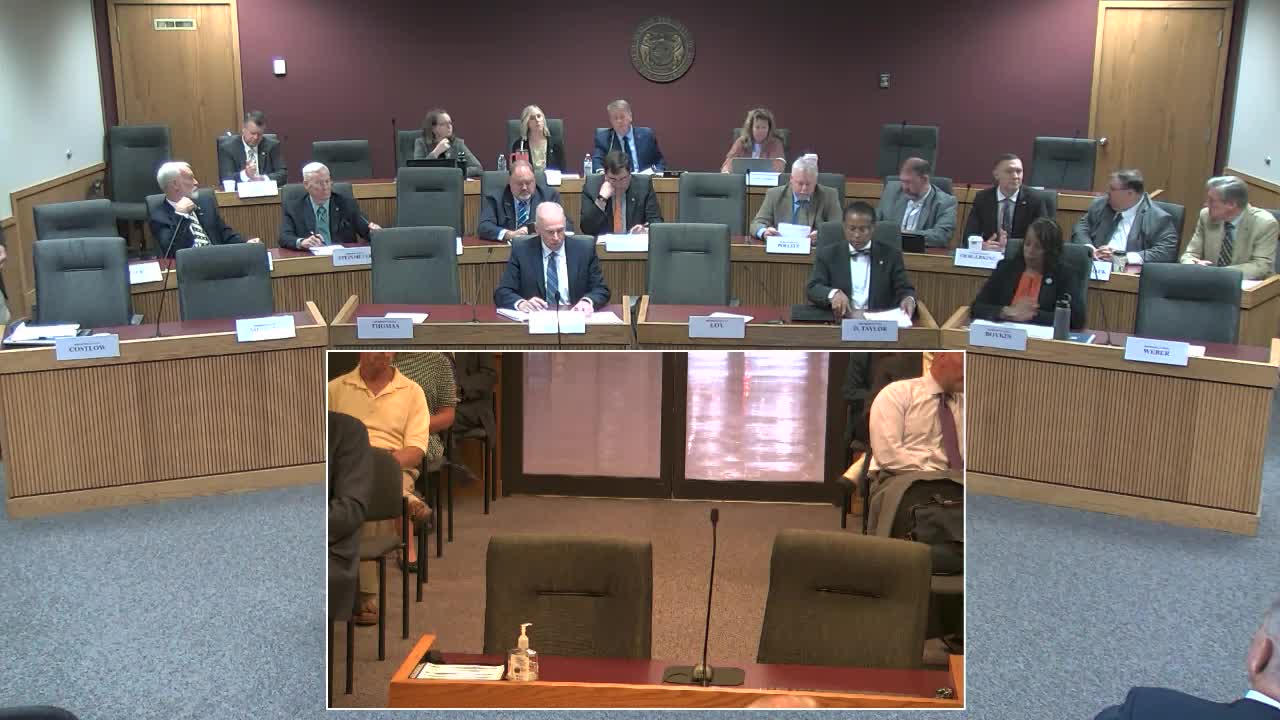
Summary
Missouri House Utilities Committee hosted an informational briefing with Missouri University of Science and Technology and Nuclear Energy Institute experts on small modular reactors, microreactors, workforce needs, waste handling and the rising electricity demand driven by data centers and artificial intelligence.
The Missouri House Utilities Committee convened an informational briefing with academic and industry experts to discuss new nuclear technologies and how the state might support deployment.
Dr. Joseph Newkirk, founding chair of the nuclear engineering and radiation science department at Missouri University of Science and Technology (Missouri S&T), and Doug True, chief nuclear officer and senior vice president for generation and supplies at the Nuclear Energy Institute (NEI), described a fast-moving national shift toward smaller, factory-built reactors and outlined challenges that would affect Missouri.
"It's a very interesting time right now where things are changing at such a rapid rate," Dr. Newkirk told the committee, noting that small modular reactors (SMRs) and microreactors can be sited closer to users than traditional, water‑cooled gigawatt plants. He described those technologies as offering greater energy density and the potential to pair with local generation and storage to create so-called smart-city energy systems.
NEI's Doug True framed the shift in part as a response to new and expanding electricity needs. "The amount of energy it takes for 1 single AI query will keep a light bulb on for 20 minutes, and it consumes about a quart of water," True said, using the example to illustrate why data centers and artificial intelligence workloads are changing demand projections.
Both speakers laid out the principal trade-offs and practical hurdles. Dr. Newkirk emphasized that nuclear's energy density means small amounts of fuel produce large amounts of power but raised workforce and supply-chain questions: he cited a DOE report estimating the nuclear engineering workforce will need to expand substantially in coming decades and described university plans to recruit and train more students. He also told lawmakers Missouri S&T is negotiating with the Missouri Department of Natural Resources (DNR) over a $3,000,000 budget request to support small‑modular‑reactor development, outreach and licensing work on campus.
Committee members pressed speakers on costs, schedules, waste and regulation. Both experts said cost and construction timeline risk are the largest near‑term commercial concerns. True said learning curves and standardized designs reduce time and cost; he pointed to overseas examples of multi-year builds where repeated designs produced faster delivery. Dr. Newkirk and True both described efforts—at Idaho National Laboratory and in other countries—to manage spent fuel and to examine recycling as a way to extract additional energy from used fuel, but they noted a longstanding U.S. federal prohibition on commercial reprocessing dating from the 1970s and said current federal policy and planning remain in flux.
On workforce, committee members were told U.S. programs currently graduate fewer nuclear engineers annually than the number who retire each year; the witnesses described pipelines that include university programs, two‑year technical colleges and Navy training as ways to expand capacity.
Speakers described a range of reactor types and applications. SMRs and microreactors are factory‑built units that vendors say can be shipped to sites and, where appropriate, run in multiples; higher‑temperature non‑water designs can supply industrial heat, hydrogen production and other non‑electrical loads. Dr. Newkirk described experiments to bring a microreactor onto the Missouri S&T campus as a testbed for grid integration, heat co‑generation and hydrogen prototypes.
Both experts stressed this was an informational session rather than a decision meeting. No formal actions, votes or regulatory approvals were taken at the hearing; committee members asked for follow‑up materials on federal permitting timelines, state permitting interactions (water permits, transmission and siting), workforce training and the university's planned use of DNR funds.
The committee was told several first‑of‑a‑kind SMR and microreactor projects are in regulatory review and that some project proponents expect early units to be online near the end of the decade. Missouri S&T and DNR collaboration, as described by Dr. Newkirk, would focus on planning, licensing and public outreach rather than immediate construction.
The hearing concluded with members noting the need to study statutory and permitting changes at the state level—particularly site characterization and streamlining for large capital projects—and with an announcement that committee members would receive additional written materials and that the committee plans further informational sessions on nuclear financing and emerging technologies.