Get Full Government Meeting Transcripts, Videos, & Alerts Forever!
Get email alerts on the Transportation Safety topic
No spam. Unsubscribe anytime.
DOT, consultants present signal-and-median plan for Parks Highway–Sheep Creek Road Extension after crash review
Summary
The Planning Commission heard an Alaska DOT and Kinney Engineering presentation Aug. 12 on a Highway Safety Improvement Program-funded plan to add a traffic signal, medians and pedestrian improvements at the Parks Highway and Sheep Creek Road Extension following analysis of 29 crashes over 10 years.
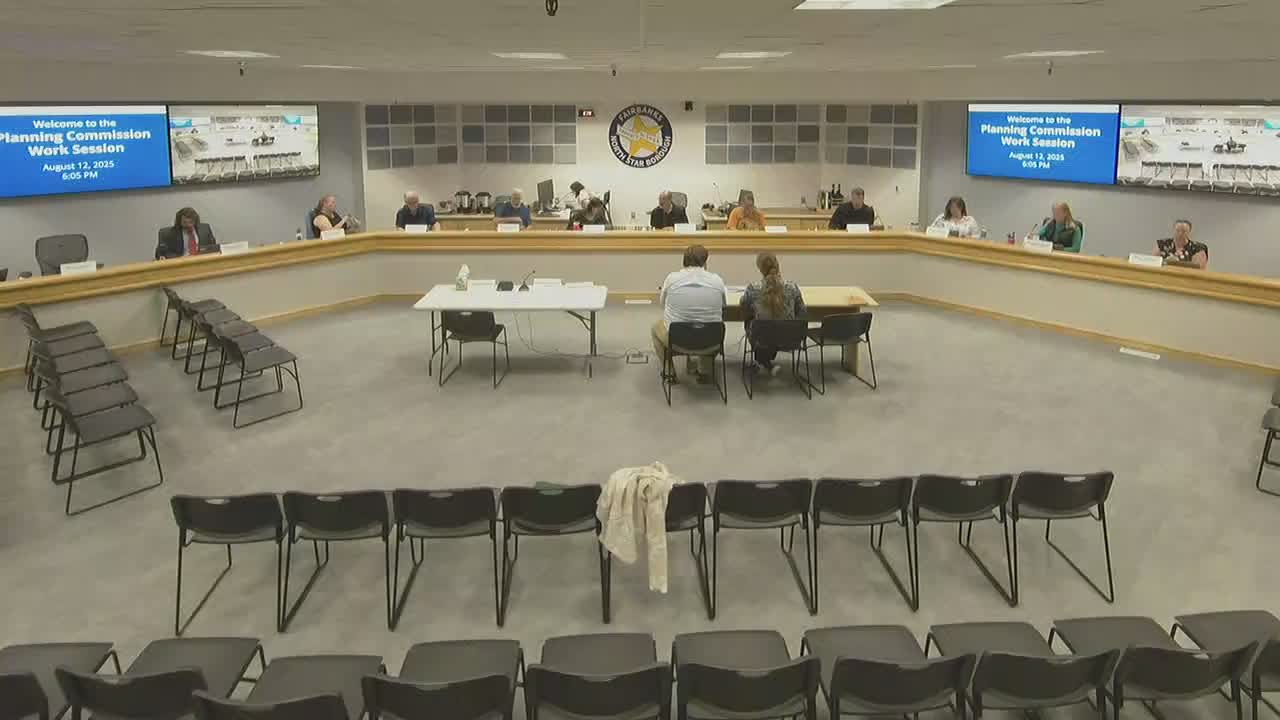
The Planning Commission on Aug. 12 heard a presentation from the Alaska Department of Transportation and Public Facilities and Kinney Engineering on a proposed traffic signal, medians and pedestrian-crossing changes at the Parks Highway and Sheep Creek Road Extension aimed at reducing angle and icy-condition crashes, the agencies said.
The commission was told the project is funded through the Highway Safety Improvement Program (HSIP) and follows an analysis of 29 crashes in the past 10 years in which two crashes caused major injuries, six caused minor injuries and the remainder were property-damage-only, Yvette Hall, design manager for the Alaska Department of Transportation and Public Facilities, said. Hall said the project team revised the design after multiple rounds of public outreach, including an October social-media outreach, a March open house and comments in local media.
DOT and consultant presenters said the project nomination identified contributing factors including blocked sight distance where the intersection sits on the outside of a curve, steep grades and superelevation that allow left-turning vehicles to slide, and difficulty for Sheep Creek drivers finding gaps in Fairbanks-bound traffic. "This project is an HSIP funded project," Hall said, and the signal is the proven countermeasure chosen for the crashes identified. The presentation said a roundabout was not consistent with the corridor and an auxiliary lane alternative was dismissed; an offset median that separates the right-turn lane from the through lane was selected as the preferred option.
Under the proposed design, vehicles traveling straight toward Fairbanks would retain an always-green through signal; left turns from Parks Highway would have a flashing yellow arrow, and left turns from Sheep Creek Road Extension would operate only on a protected green left arrow. Right turns from Sheep Creek would stop on red, be allowed to turn right on red after stopping, and also have a dedicated green right arrow and a right-turn signal that will be prevented from displaying green when a pedestrian push button is active, presenters said. The team also proposed moving and straightening the pedestrian crossing to the start of the channelized turn and installing an overhead Prepare-to-Stop flashing sign similar to those on the Mitchell Expressway.
Presenters told commissioners the design would reduce the vertical slope vehicles traverse when turning from Sheep Creek: the current superelevation and slope in that lane is about 5.5 percent and the plan would reduce key segments to roughly 3.5 percent and as low as 1 percent in some receiving areas to lessen sliding. The planned median would be about 8 feet wide and be an expressway-type mountable curb with a recovery shoulder rather than a vertical curb or a Jersey barrier; a Jersey barrier was ruled out because the route is a major truck route that receives oversized loads.
Commissioners asked about speed, maintenance and winter performance. Presenters said the through lane toward Fairbanks would remain posted at 55 mph and that maintaining a consistent 55-mph segment was preferred for consistency and safety on that corridor. Staff said they spoke with maintenance and operations; road clearing is the highest priority and islands and pedestrian areas would be cleared several times a year when operationally possible. The team declined to add flexible delineators on the median because of expected winter snow-plow impacts. Presenters said existing lighting would be maintained and may be extended to new pavement as needed.
Commissioners expressed support for the iterative outreach and raised remaining concerns: whether keeping the 55-mph through speed adequately reduces collision risk, whether the mountable curb will prevent high-speed encroachments, snow-plow clearance and whether the reduced number of triangular islands would still meet pedestrian needs. There was no formal motion or vote; the session was a work-session presentation and question-and-answer period where staff and consultants responded to commissioner comments and clarified design choices.
The presenters said the design reflects public comments, data analysis and design constraints tied to truck operations and existing corridor speeds; they noted an expected Alaska Traffic Manual update this fall that should allow installation of an orange rapid rectangular flashing beacon for the channelized right-turn crossing. The commission did not take formal action at the session; presenters remained available for follow-up and staff indicated they would continue coordination on maintenance and final design details.