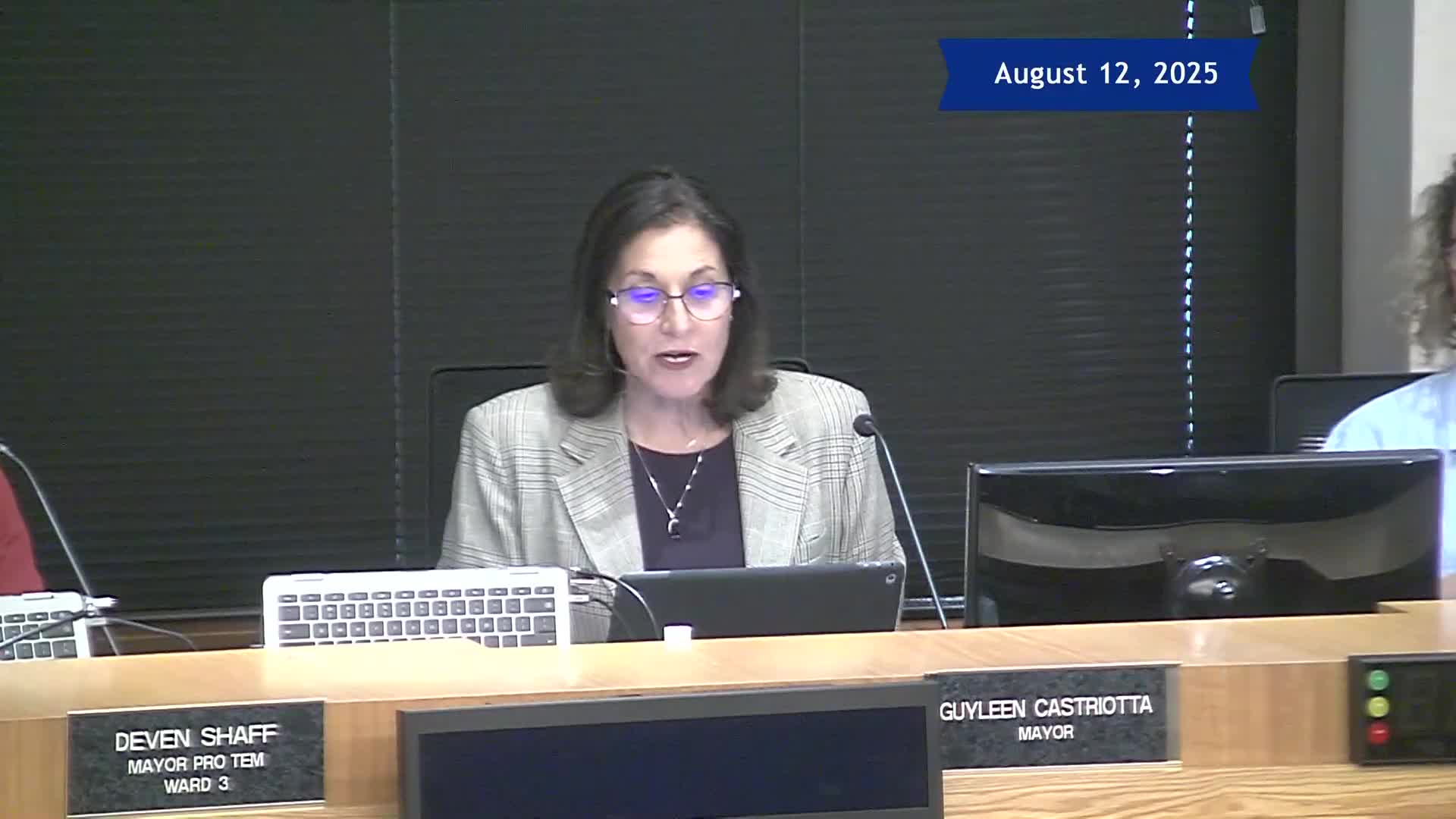
Broomfield council approves placing six charter amendment questions on November ballot
Loading...
Summary
Council voted on six proposed charter amendment ordinances to appear on the Nov. 4 coordinated election ballot, covering clean-up language, dual-office prohibition, vacancy filling, required council code of ethics, emergency ordinance timing, and intergovernmental agreement vote thresholds.
Broomfield City and County Council voted to place six proposed charter amendments before voters at the Nov. 4 coordinated election, approving the ordinances on second reading after staff and council discussion on technical language and implementation details.
City and county attorney Nancy Rogers summarized the package, saying the changes are largely housekeeping and process clarifications following the charter review committee’s recommendations and prior charter updates when Broomfield became a city and county. The measures include a general clean-up and modernization of charter language; a prohibition on elected officials concurrently holding another public office; modification of the timeframe and process for filling elected office vacancies; a requirement that council maintain a code of ethics; a change to make emergency ordinances effective immediately; and a reduction of the charter’s two-thirds approval requirement for intergovernmental agreements to a majority vote.
Why it matters: If approved by voters, these amendments will alter how future councils handle vacancies, enforce ethical rules, approve certain intergovernmental agreements and adopt emergency ordinances. Several measures drew specific questions about costs, clarity of wording and process safeguards during the council discussion.
Key details and council discussion Nancy Rogers (city and county attorney) told council the 1974 charter and later amendments left outdated language and that the committee sought to align language with Broomfield’s status as a consolidated city and county and to modernize references (for example, changing “municipal election” phrasing to the coordinated election process). Rogers and staff emphasized that any charter changes approved tonight would still go to voters for final approval at the November election.
Council considered whether a required code of ethics should be placed in the charter or simply adopted as an ordinance, and whether lowering the IGA approval threshold removed an important check on large or sensitive intergovernmental commitments. Council members also debated wording for the dual-office prohibition to ensure it would prevent holding ‘‘any other publicly elected office’’ concurrently.
Votes at a glance - Ordinance 2276 (charter clean-up and language updates): motion by Councilmember Leslie, second Ward; passed unanimously (10-0). Notes: non-substantive updates to reflect city-and-county status and remove outdated provisions. - Ordinance 2277 (prohibit elected officials from concurrently holding another publicly elected office): motion by Marsh Holsham, second Ward; amendment adopted to clarify wording (“any other publicly elected office”); ordinance passed unanimously as amended (10-0). - Ordinance 2278 (vacancy filling changes; extend appointment period to 60 days and limit appointee service to next coordinated/general election): motion by Wynne, second Ward; passed 9-1. Notes: mayoral vacancy process will change so the mayor pro tem fills the vacancy only until the next coordinated or general election, rather than serving the full remaining term. - Ordinance 2279 (require council to adopt and maintain a local code of ethics): motion by Anderson, second Marsh Holsham; passed 8-2. Notes: council discussed whether an ordinance would suffice or whether the charter mandate better preserves the code across future councils. - Ordinance 2280 (make emergency ordinances effective immediately): motion by Mayor Pro Tem Schaff, second Henkel; passed unanimously (10-0). Notes: maintains the high standards for emergency ordinances (public meeting, notice) but allows them to take immediate effect to respond to public safety threats. - Ordinance 2281 (change IGA approval threshold from two-thirds to majority): motion by Leslie, second Ward; passed 9-1. Notes: does not prevent council from adopting higher thresholds for specific matters in the future and formalizes existing practice of delegating signature authority for routine IGAs.
What council asked and staff responses - Special election cost: staff estimated a standalone special election for the entire city and county at about $120,000; this was cited in support of the mayoral vacancy change (which avoids mandatory special elections for some vacancy timing). - Dual office wording: council corrected a drafting ambiguity and replaced numeric phrasing with text to say an elected official ‘‘cannot concurrently hold any other publicly elected office.’’ Staff treated the phrasing adjustment as a non-substantive scrivener’s clarification and proceeded without a third reading. - Code of ethics vs. ordinance: staff noted the charter requirement would make the code harder for a future council to repeal, while an ordinance could be changed by a subsequent council.
Next steps The ordinances approved by council on second reading will be placed on the Nov. 4, 2025 coordinated election ballot for voters to approve or reject. If voters approve any item, city staff said they will publish explanatory materials (a voter information document) and provide printed copies to election judges and public locations when feasible.
Ending Council and staff said they will finalize a plain-language information booklet for voters and coordinate outreach and publication for the ballot measures ahead of the coordinated election.