
City advances planning for West Greeley general improvement district; council raises questions about scope and property inclusion
Get AI-powered insights, summaries, and transcripts
Subscribe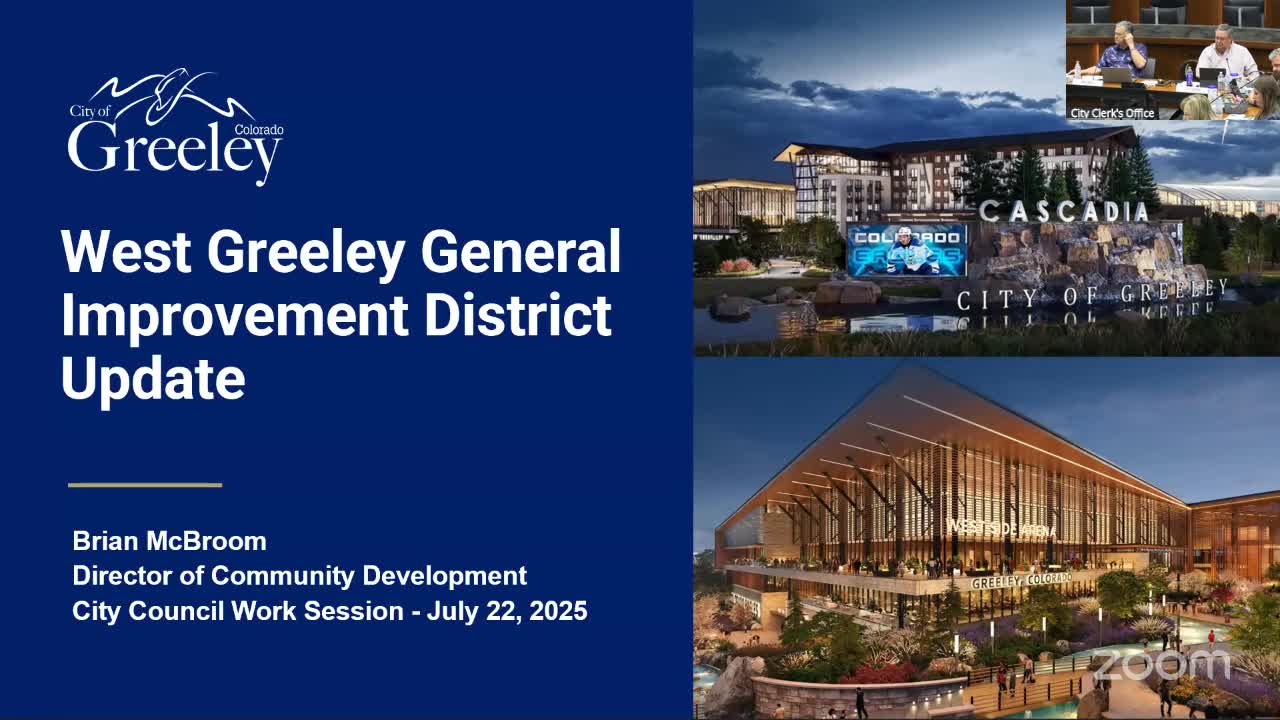
Summary
City staff outlined plans for a potential General Improvement District (GID) in West Greeley, including an anticipated petition, proposed timeline (first reading Aug. 5), possible November TABOR election and financial modeling; council members questioned boundaries, forced inclusion and possible debt levels.
GREELEY, Colo. — City staff updated the City Council on plans to create a General Improvement District (GID) for West Greeley and answered questions about timing, boundaries, financing and the implications for property owners.
Brian McBroom, presenting an informational update, said the city expects a petition from the Water Valley Company to initiate one or two GIDs (a residential GID and a nonresidential GID) that would allow the district to issue debt, levy property taxes and fund regional infrastructure. McBroom said the council is expected to consider first reading of a GID ordinance on Aug. 5 and that the GID board would need to authorize a TABOR election if the district plans to borrow in 2026.
A key feature McBroom described is that an initial TABOR election can be run as a single‑voter ballot (the petitioning property owner) to authorize broad permissions for the GID; additional properties could later petition to join the GID. McBroom emphasized the map included with the ordinance is informational and does not by itself place properties into the district.
Councilors raised concerns about the apparent size of the proposed map and whether already‑developed areas such as Promontory or properties outside city limits would be compelled to join. McBroom and staff explained that forming the GID does not automatically force properties to join; petition and statutory processes determine who becomes part of the district, and the circumstances under which properties could be required to join (for example, if GID‑funded infrastructure is necessary for their development) would be addressed in implementing documents.
Councilor Debuti asked why a developed area already connected to city utilities would appear in the informational boundary; staff replied the map focuses on undeveloped land within the city’s future growth boundary and is intended to support financial modeling and inform property owners.
On financing, city staff said the financial model has considered an initial funding need on the order of $129 million (model‑based estimate for early infrastructure costs), and that the proposed TABOR ballot language is meant to authorize a high maximum mill levy (the presentation suggested up to 20 mills as broad authorization while modeling assumed nearer 12 mills). Staff said the higher ceiling is intended to give flexibility to future GID boards and noted a property‑owner advisory group expressed discomfort with levies above 15 mills.
Councilors pressed what would happen if the GID could not make debt payments. Staff said GID debt is separate from the city’s general obligation; there is no automatic city taxpayer obligation, although the council could decide to assist in extraordinary circumstances and historical examples exist where councils stepped in to address urgent infrastructure gaps.
McBroom said the city is conducting a market study and impact‑fee sensitivity analysis to ensure GID structure and levy assumptions align with market capacity; those studies are expected in late September or early October. The timeline McBroom proposed included expected petition imminent, first reading Aug. 5, an anticipated GID board meeting Sept. 2 and a potential November 4 TABOR election if borrowing authority is sought.
Sources: Presentation and Q&A at the Greeley City Council work session, July 2025; staff presentation by Brian McBroom.