Get Full Government Meeting Transcripts, Videos, & Alerts Forever!
Get email alerts on the West Greeley Gid topic
No spam. Unsubscribe anytime.
Council introduces West Greeley GID ordinances as residents press pause on Cascadia financing
Summary
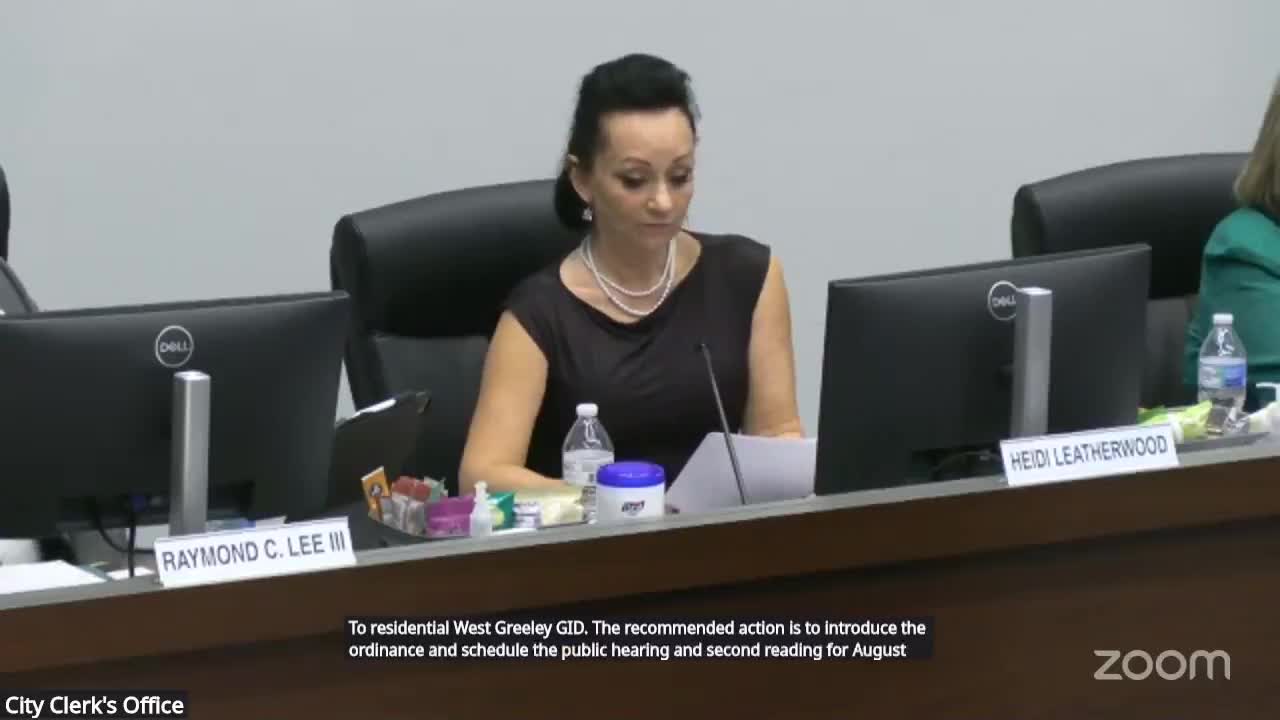
The City of Greeley City Council on Aug. 5 voted 4-2 to introduce ordinances establishing two West Greeley general improvement districts and scheduled second readings for Aug. 19, a procedural step that would allow a future TABOR ballot authorization for bond issuance.
The City of Greeley City Council on Aug. 5 voted 4-2 to introduce ordinances establishing two West Greeley general improvement districts (GIDs) — one residential and one commercial — and scheduled second readings for Aug. 19, a procedural step that would allow the districts to pursue a TABOR ballot authorization for future bond issuance.
The move matters because council members and staff said the TABOR authorization would create the mechanism to issue debt for regional infrastructure in West Greeley; staff presented a model that contemplates about $129 million in GID bonds, though the ordinances do not set a mill levy or obligate the city to immediate borrowing.
Councilman Peyton, Councilmember Olsen and Councilmember McDonald joined Mayor Pro Tem Hall to approve introducing the ordinances; Council member Butler and Council member Debuti voted no. Councilmember Butler objected to the timing and said the council should consider waiting until zoning and sensitivity analyses are complete. Councilmember Debuti asked for clearer answers about whether properties would be forced to join a GID and how metro districts would interact with a GID.
Brian McBroom, director of community development, told council the two ordinances are narrow because state law requires a petition from a property owner to start a GID. "A single property owner submitted petitions asking the city to form two GIDs," McBroom said, and additional property owners would petition to join later if they wanted to use the regional infrastructure the GIDs could fund. He said the ordinances "do little beyond creating two general improvement districts" and that expansion would occur only when other owners request to join.
Elena Portis, deputy city manager, told council the financial model used for planning assumes total GID bonds of about $129 million but added that the model anticipates phased borrowing and does not require all debt to be issued at once. Portis also explained the TABOR process: the ordinances do not establish mills; a TABOR ballot this fall would set broad authorization and the GID board would set annual mill levies within that authorization.
Public comment at the start of the meeting centered overwhelmingly on the proposed Cascadia/Catalyst development for West Greeley. Dozens of residents urged the council to stop spending public money, to let voters decide, and to demand greater developer transparency. Several speakers said the project should be funded by the private developer rather than leverage public assets. Mary Mitsker said, "Stop spending our money. Stop leveraging our city. Let the billionaire pay for his own dream," and referenced what she called city-owned buildings that had been proposed as collateral.
Other commenters raised fiscal and equity concerns. Valerie Lael Whitehead said the most stable revenue from the project — property taxes — would not go to the Greeley school district but to Windsor, and therefore would not benefit Greeley students. Multiple speakers recalled a failed Loveland water park as an example why private entertainment components are risky. Amberley McGregor, speaking from the virtual audience, said, "I am aware that you have already spent roughly $40,000,000 from the certificate of participation," and asked the council to cease signing contracts, creating a GID, or spending more COP money until voters decide.
Supporters of the development also spoke in the virtual public comment. David Sheehy said the project could bring tourism dollars, jobs and hotel demand that would generate sales tax revenues, arguing the city needs those revenues to fund future city services.
During council discussion, staff clarified several process points that residents had raised: joining a GID is by petition of property owners who want the funded infrastructure; metro districts remain an option for developers and can be used in addition to a GID for on-site work; and TABOR authorizations for GID debt must be approved as part of a general election ballot. Council members also noted the timeline is tight if the city wants a TABOR question on the Nov. 4 general election ballot — if not approved this year, a TABOR election would have to wait until November 2026.
The ordinances introduced by motion will return for the required second reading and public hearing on Aug. 19. If council proceeds and the GID boards place TABOR ballot language before property owners, only affected property owners would vote on the GID TABOR measure and the measure would set a maximum mill levy; annual mill levies would then be set by the GID boards within that cap.
A number of commenters urged the council to pause further spending until voters weigh in on financing; council members who supported introduction said creating the GIDs now preserves a financing option while leaving future decisions — including TABOR authorization and bond issuance — to later votes.
The council’s votes on the ordinances were recorded as follows: Item 16 (residential GID ordinance) introduced — Ayes: Mayor Pro Tem Hall; Council member Peyton; Council member Olsen; Council member McDonald. Nays: Council member Butler; Council member Debuti. Item 17 (commercial GID ordinance) introduced — Ayes: Mayor Pro Tem Hall; Council member Peyton; Council member Olsen; Council member McDonald. Nays: Council member Butler; Council member Debuti. The second readings and public hearings are scheduled for Aug. 19.
Council staff said they will return with financial sensitivity analyses, TABOR ballot language if council chooses to move forward, and additional details about the GIDs' boundaries and potential infrastructure projects.
For residents, the near-term schedule includes an Aug. 19 council meeting on the ordinances and the possibility of TABOR-authorizing measures on the Nov. 4 ballot if council and the prospective GID boards pursue that timetable.