Get Full Government Meeting Transcripts, Videos, & Alerts Forever!
Get email alerts on the Infrastructure Development topic
No spam. Unsubscribe anytime.
Greeley staff outlines water, sewer and financing plan for West Greeley Catalyst project
Summary
The Greeley Water and Sewer Board received a detailed update May 21 on the West Greeley Catalyst project and its implications for the city’s water and wastewater infrastructure.
The Greeley Water and Sewer Board received a detailed update May 21 on the West Greeley Catalyst project and its implications for the city’s water and wastewater infrastructure.
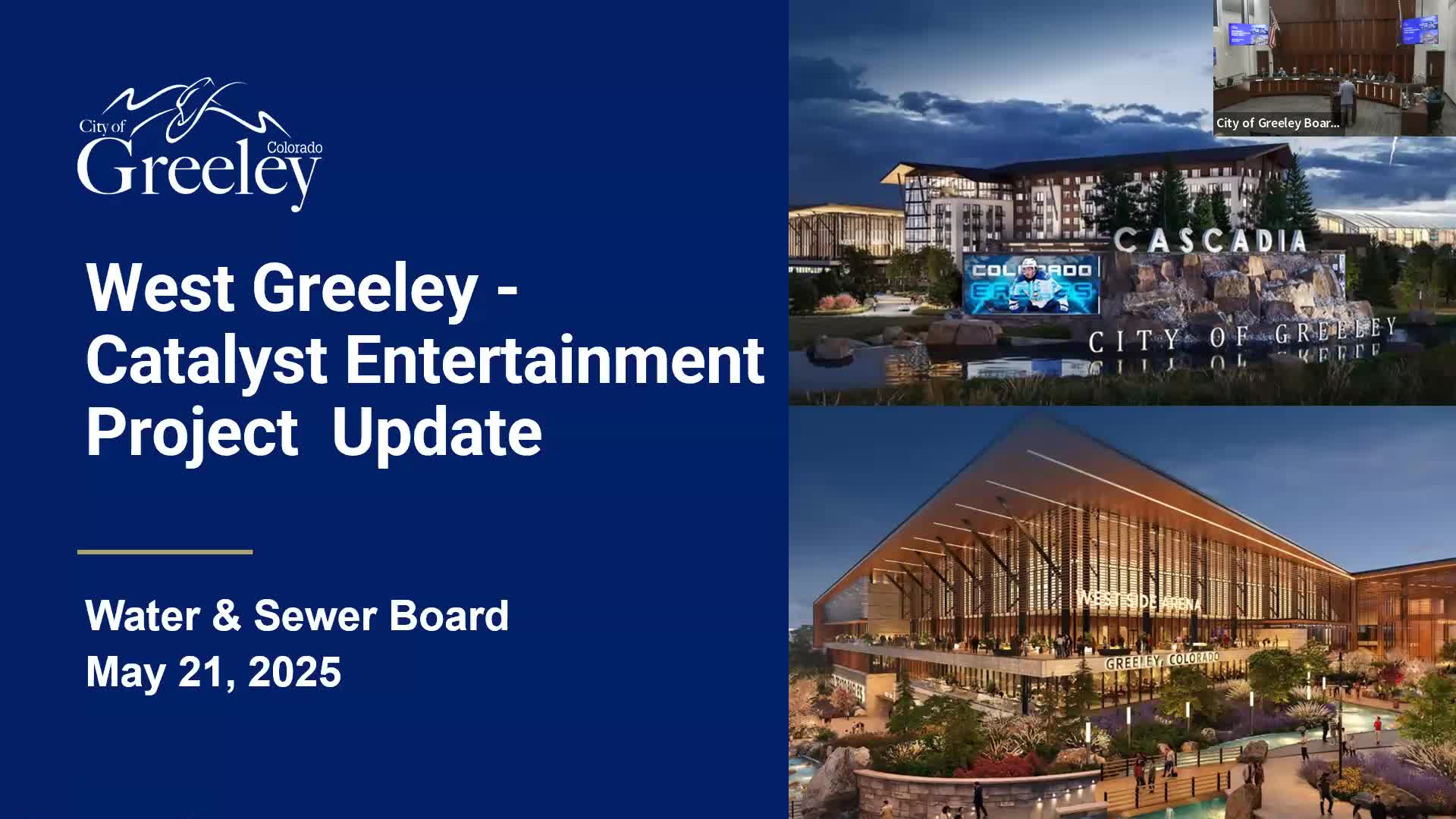
At the meeting, Sean (director), a city water and sewer staff member, told the board the 300‑acre, transit‑oriented development — anchored by an 8,000‑seat arena to house the Colorado Eagles franchise, a hotel/resort and an indoor water park — will require substantial backbone work including relocation of two Boyd Lake welded steel transmission mains and new nonpotable irrigation connections. “The water needs for the project … total 235 acre‑feet a year,” Sean said, adding that the amount is relatively small compared with past redevelopment savings and the city’s overall portfolio.
City staff framed the project financing as a multi‑instrument approach. Council has authorized certificates of participation (COPs) to fund initial design, long‑lead procurement and early construction; a general improvement district (GID) is expected to issue one or more bond issuances for regional backbone infrastructure in 2026–27; and a 501(c)(3) conduit issuance is anticipated to finance entertainment‑asset construction. Sean said that, “the ordinances … and the amount of the debt that’s being offered is strictly for water and wastewater capital projects that were in our capital approved plan,” and reiterated that “there is no Water and Sewer Enterprise debt that’s going toward this” portion of the Catalyst project at this time.
Staff listed infrastructure tasks the developer must address, including relocation of the 27‑inch and 34‑inch Boyd Lake transmission mains that run through the site and creation of a nonpotable supply loop fed from three directions (High Point Business Park, the Greeley‑Loveland Irrigation ditch via a Del Antero pump station, and a transfer from the Oklahoma district) to provide redundancy for irrigation demand. Sewer design will require new backbone collection mains and an interim downstream lift station while negotiations continue over capacity under the city’s intergovernmental agreement (IGA) with Windsor; Sean said Windsor’s treatment plant currently has “less than 5%” available capacity and the city has filed claims seeking declaratory relief.
Board members pressed staff on timing and risk. Chairman Evans noted the Boyd Lake lines must be relocated by April 2026 because Boyd Lake supplies summer peaking capacity once it comes online, and added that relocation is on the project’s critical path. Sean and staff said they have provided the developer and its contractor (PCL) with a list of prequalified design and construction firms and will remain a stakeholder in coordination agreements to ensure infrastructure is designed and inspected to city standards.
Why this matters: the project is large, will cross critical transmission corridors, and requires coordinated financing and construction timing between the city and private developer to avoid interrupting seasonal water service and to meet environmental and permitting obligations.
The board did not take a formal vote on Catalyst financing during the Water and Sewer Board meeting; staff outlined next steps including continued PDSA coordination, GID petitioning and workshops on water and sewer infrastructure coordination.