Get Full Government Meeting Transcripts, Videos, & Alerts Forever!
Get email alerts on the Parking And Traffic topic
No spam. Unsubscribe anytime.
County to consider temporary checkpoints, passes to ease Sauvie Island beach congestion
Summary
Oregon Department of Fish and Wildlife asked Columbia County commissioners for authority to pilot weekend and holiday access controls on Reader Road into Sauvie Island beaches, citing emergency access and severe summertime congestion; commissioners asked staff to bring a draft order for a time-limited trial to the next meeting.
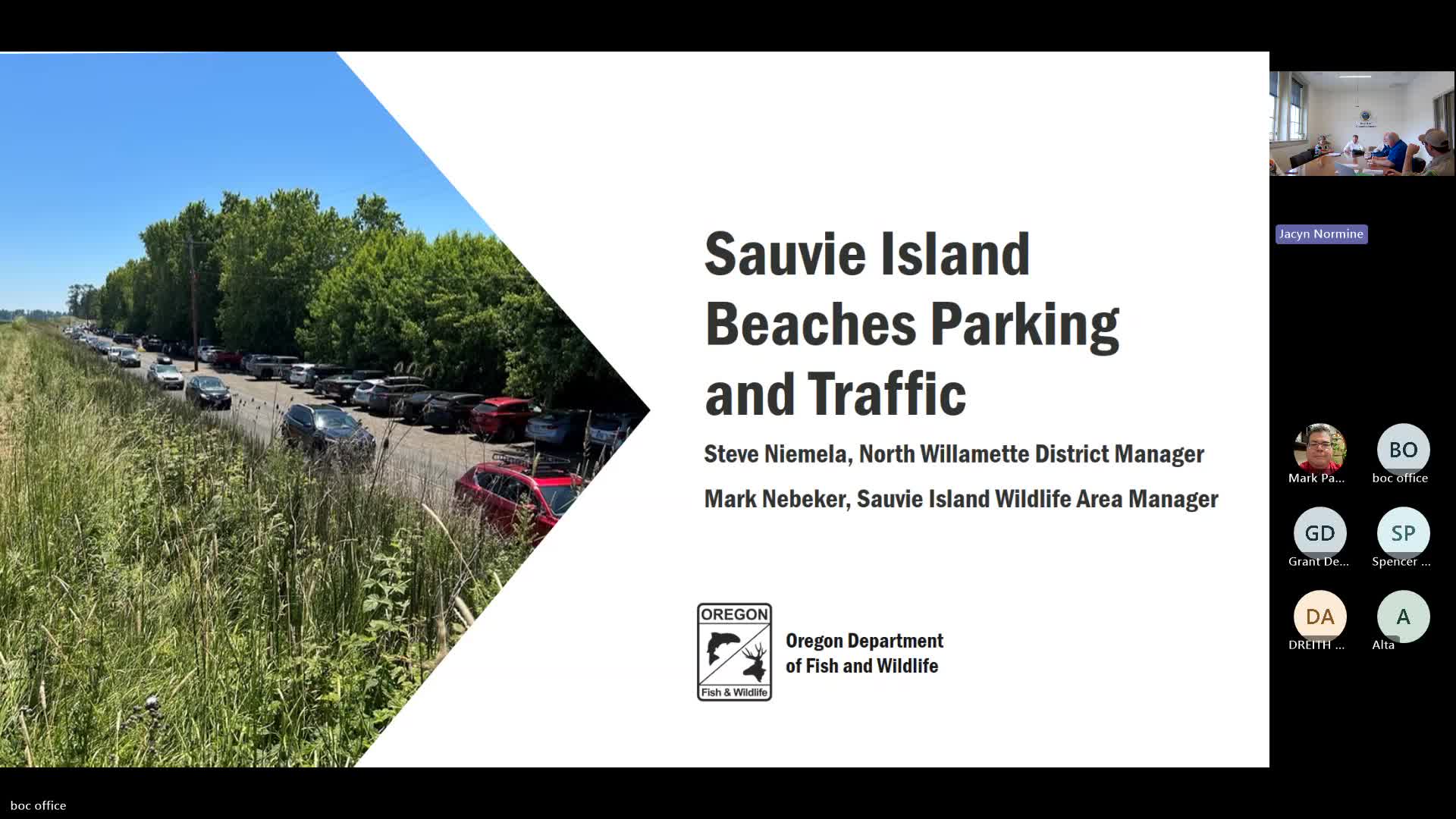
Columbia County commissioners heard a proposal June 18 from the Oregon Department of Fish and Wildlife to limit vehicle access past a checkpoint on Reader Road on busy summer weekends and holidays to reduce congestion, improve emergency access and curb unsafe parking near Sauvie Island beaches.
Steve Namala, watershed manager for ODFW, told the board that on hot, sunny weekends the narrow, mostly single‑lane Reader Road can “saturate with vehicular and pedestrian traffic” and that a recent traffic counter logged about 4,700 events on a single Sunday. He said that day was the highest since 2022 and that consultants estimated peak flows that day reached about 583 vehicles per hour entering around midmorning, with sustained high volumes in the afternoon that produce long queues and block emergency access.
Namala said ODFW proposes a temporary seasonal rule, implemented as a pilot, that would require both the agency’s parking permit and a limited free entry pass for vehicles to proceed past the proposed checkpoint at the intersection of Reader Road and Rednarrow Road on weekends and holidays. ODFW would operate the checkpoint and post signs at the county road intersections; the agency plans to limit the number of passes to just under its estimate of maximum parking capacity and to issue passes through its electronic licensing system.
Why it matters: Commissioners and residents described multiple incidents where heavy beach traffic slowed or obstructed emergency response and created unsafe double‑parking and pedestrian exposure on a narrow route. ODFW and local residents said those safety and trespass problems have increased since 2020 and that enforcement by Oregon State Police (OSP) on busy days diverts troopers from fish‑and‑wildlife enforcement.
Details of the proposal and concerns: Namala said ODFW is contracting a third‑party traffic management vendor and plans signage, outreach (including Spanish language materials) and a traffic management plan. The pilot would be time‑limited (weekends and holidays starting around the July 4 period through Sept. 1 was discussed), with ODFW returning to report midseason or at the end of the season. ODFW noted current enforcement is carried out by OSP; an OSP lieutenant provided a written statement read to the board saying saturation has increased response times and shifted trooper time away from wildlife enforcement.
Residents who addressed the board supported the checkpoint but warned of “growing pains” during an initial soft launch. Keely Nudo, a neighbor, said beachgoers have parked along private driveways and in pastures and that “fire is the biggest thing that scares me about living on the island,” describing vehicles and people pushing into private property on high visitation days.
Commission discussion focused on implementation details and county authority. County staff and counsel told the board that Reader Road is a county‑maintained road and that the board could adopt a board order restricting travel on a section of county road under the vehicle code; once posted under that authority, violations would be enforceable by OSP or the sheriff as class D violations. Commissioners raised technical and liability questions about gates and checkpoints, asked for clearer engineering and enforcement plans, and requested OSP citation data for the area to better understand current enforcement activity.
Outcome and next steps: No ordinance or final order was adopted at the work session. Commissioners directed staff to prepare a draft board order and related materials for consideration at the next board meeting so the board could authorize a time‑limited trial if it chooses. ODFW agreed to provide additional details on contracts, costs, and enforcement statistics; ODFW asked for county cooperation with checkpoint placement, signage and public information. Commissioners emphasized the pilot should be temporary and adjustable based on experience.
Unresolved matters and constraints: The board and ODFW acknowledged several unresolved operational details: how to identify local residents and their visitors at a checkpoint, the precise number of passes to issue, coordination with neighboring jurisdictions (Multnomah County and others) to discourage detours, and indemnity/insurance language for contractor work. ODFW estimated vendor costs in an early range and said contracts were being finalized; commissioners requested more complete contract scopes and citations/enforcement data from OSP before approving a multi‑week launch.
The board scheduled follow‑up: staff will bring a draft order and supporting materials to the next meeting for consideration; ODFW and county staff will continue outreach to residents and law enforcement partners ahead of any trial period.