Get Full Government Meeting Transcripts, Videos, & Alerts Forever!
Get email alerts on the Military Families Education Justice topic
No spam. Unsubscribe anytime.
Panel hears DOD-backed bills to ease school transfers and juvenile cases for military families
Summary
The Joint Committee on Veterans and Federal Affairs received testimony supporting H.3886 and S.2503, a Department of Defense–backed package that would expand school enrollment flexibility for military children, ease special-education transitions, and create a mechanism for concurrent jurisdiction in juvenile cases on military installations.
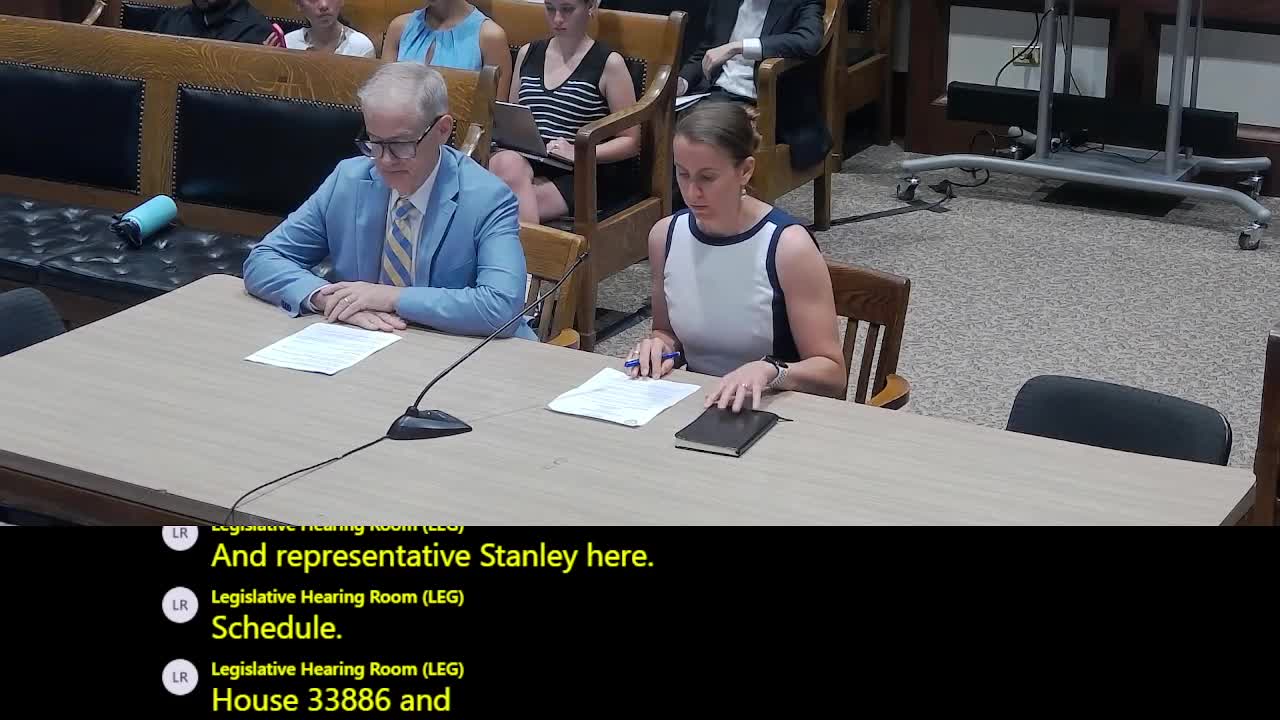
At a public hearing of the Joint Committee on Veterans and Federal Affairs, House Chair Representative Joe McGonigal called witnesses to testify on bills the Department of Defense supports, including S.2503 and H.3886, which the DOD says would reduce barriers for military families moving to Massachusetts.
Melissa Ouellette, New England regional liaison for the Department of Defense State Liaison Office, told the committee the bills would expand district and state open-enrollment flexibility and improve transitions for military-connected students. "Imagine a child, perhaps 10, packing up their bedroom for the third time in 5 years, leaving behind friends, teachers, and a familiar school," Ouellette said. She told the committee about particular challenges for children with disabilities, citing a 2020 study that found 51 percent of active-duty families with a child in special education had trouble transferring an Individualized Education Program to a new school.
The proposals also include a statutory mechanism to permit concurrent jurisdiction for juvenile misconduct that occurs on federal property, so that local family courts could assume cases when appropriate. Ouellette said the approach mirrors changes recently enacted in Connecticut, Maine, New Hampshire and Rhode Island and that it is intended to reduce gaps that can occur when neither federal nor civilian systems assume a juvenile case.
During committee questions, a member asked whether the bills would require the Department of Defense to give up law-enforcement authority on installations. Ouellette replied that the language as drafted would establish a mechanism for concurrent jurisdiction rather than automatically transferring authority; the local family court would decide on a case-by-case basis whether to assume a matter "if they have the bandwidth," and commanders would remain involved in the decision.
Ouellette described other provisions the DOD supports, including recognizing military protective orders as admissible evidence in some civilian temporary protection-from-abuse proceedings and improving information sharing between civilian and military law-enforcement agencies about violations of protective orders.
Committee housekeeping remarks reminded witnesses that written testimony would continue to be accepted until the bills are acted upon; no committee votes were taken at the hearing.