Get Full Government Meeting Transcripts, Videos, & Alerts Forever!
Get email alerts on the Asbestos Contracts topic
No spam. Unsubscribe anytime.
Council committee reviews DDPHE request to extend and add value to asbestos-response contracts
Summary
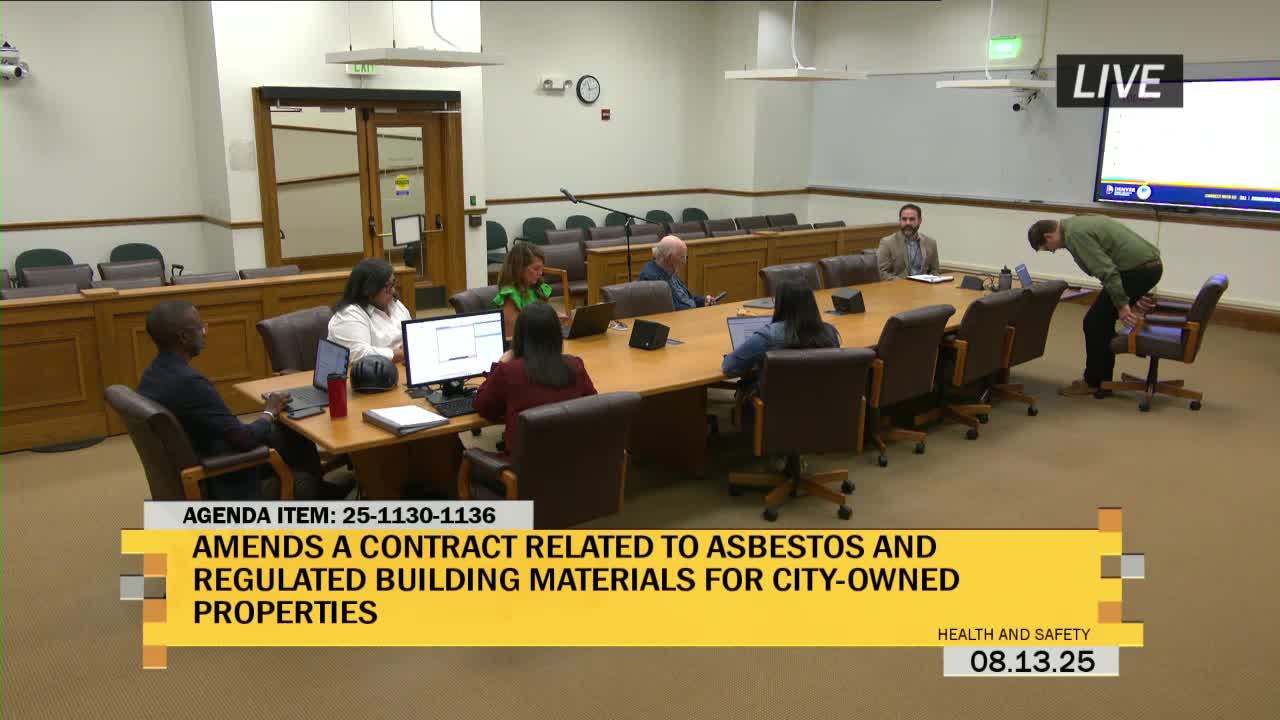
DDPHE asked the Health and Safety Committee to approve amendments extending seven asbestos- and hazardous-materials contracts by six months and adding value to prevent gaps while a new RFP is completed; committee moved the package to the floor as part of a consent block.
Denver Department of Public Health & Environment staff told the City Council Health and Safety Committee they need to extend and add value to on-call contracts for asbestos and other regulated building-material services to avoid gaps while a new competitive procurement is completed. Alex McDonald, liaison for DDPHE, explained the department had launched an RFP for multiyear contracts but said the procurement process can take up to a year. He asked the committee to approve a resolution request to extend existing contracts and add value "out of an abundance of caution to make sure there's no gap in the availability of these services for city agencies," McDonald said. Nick Schroeder, who manages environmental quality work for city-owned properties, described the scope of services covered by the contracts, including asbestos surveys and abatement, lead-based paint, mold, PCBs and regulated-contaminant soil work. He said consultants perform inspections and oversight while abatement contractors perform removals, packaging and disposal to meet state and federal rules. Schroeder said the contracts are used across city agencies for routine maintenance, construction and emergency response. Schroeder told the committee one on-call contractor ceased Colorado operations with about five days' notice, which increased pressure on the remaining vendors. Committee members noted that the existing consultant contracts were structured as $1 million ceiling agreements while abatement contractors had $5 million ceilings. Council Member Kevin Flynn summarized the amendment package as "adding 9 and a quarter million dollars in 6 months" during the committee discussion and asked whether the added capacity would lock up city funds; DDPHE staff responded that the contract ceilings are not appropriations and that project budgets still must provide funding when work is issued under a contract. The department said the RFPs were already posted and said bids were due this month; staff asked for six-month extensions across the seven contracts and modest rate updates from vendors during that extension so the city would remain compliant with environmental and worker-safety regulations while the new procurement completed. The city attorney's office had reviewed and approved a legal justification for the extensions, staff said. The committee moved the item to the City Council floor as part of a block of action items. Council Member Jamon Torres made the motion and Council President Sandoval seconded; the chair said the block would move forward by acclamation. No final contract awards were decided in committee; the extension and added-value requests will move to the full council as part of the consent block. Why it matters: the contracts provide specialized services that state and federal regulations require when regulated materials are disturbed. Department staff said an interruption in on-call access could create exposure risks for workers and the public and increase the city’s environmental liability. Requested follow-ups included: an exact accounting of the capacity remaining on the contractor that ceased operations and a breakdown of how much of the proposed added value would be charged against city projects vs. emergency or derelict-property responses. Committee members said they expected DDPHE to supply those details before the items reach the full council.