Get Full Government Meeting Transcripts, Videos, & Alerts Forever!
Get email alerts on the Green Social Housing topic
No spam. Unsubscribe anytime.
Brendle Group presents CASA study on —green social housing—; committee discusses passive-house and funding windows
Summary
CASA and consulting firm Brendle Group presented a 2024 study on sustainable, affordable social housing. The report analyzed 29 case studies and recommended passive-house design guidance, stacked funding strategies and early nonprofit partnerships. Committee members pressed agencies about applying findings to Denver Housing Authority projects and
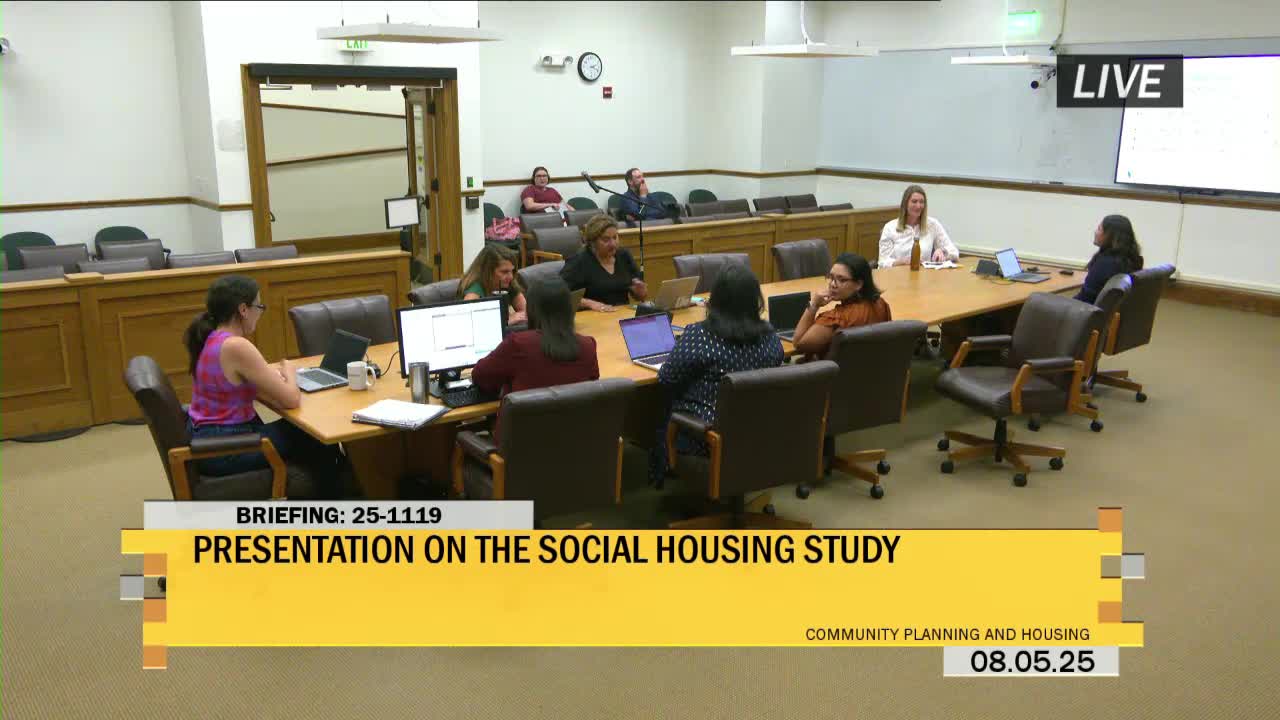
Aug. 5 —1 CASA and consulting partner Brendle Group presented a study of sustainable approaches to affordable and social housing, reviewing 29 global case studies and offering recommendations on design standards, financing and program partnerships.
Shelby Zimmer and Paulina Simosa of Brendle Group told the Community Planning and Housing Committee the study began in mid-2024 and focused on three pillars: energy efficiency and renewables; materials, embodied carbon and water savings; and household- and community-facing support services such as childcare, technology access and food programs. The report included 10 deeper case-study reviews; one example highlighted was a renovated motel in Chula Vista that reused materials, recycled construction debris and added rooftop solar and on-site social services.
Findings presented to the committee included that, among the case studies, 52% of projects were all-electric, 90% incorporated some renewable energy, 79% used high-performance building envelopes and 58% incorporated heat pumps. The consultants also reported an average historical construction cost of about $299 per square foot for projects in their review, noting that cost figures were from 2019—1 and that funding and tax-credit rules have changed since the study was completed.
The report recommended pursuing passive-house design guidelines or standards as a manageable pathway to high-performance affordable housing, stacking incentives and rebates, prioritizing whole-life operational cost analysis, piloting factory-built or modular approaches and engaging nonprofit and social-service partners early in design. Brendle Group and CASA staff also highlighted a window of opportunity for projects that can align with energy tax credits and IRA-related incentives before some of those credits are scheduled to phase down.
Committee members asked whether the Denver Housing Authority uses similar green-building standards. Adam Lyons of HOST said tax-credit-financed projects in Denver generally must meet green-building certifications (for example, Enterprise Green Communities, LEED, or NGBS) as part of tax-credit underwriting, and CPD staff said Denver—s green building code includes related provisions. Committee members asked CASA to share the report with DHA and suggested assembling agency specialists to pursue targeted follow-ups on passive-house guidelines and retrofit opportunities.
The presentation was non-action, but committee members expressed interest in further agency coordination and requested a contact list of city specialists and agency leads who contributed to the study.
Sources: CASA/Brendle Group presentation and Q&A at the Aug. 5 Community Planning and Housing Committee meeting; direct quotes and statistics come from the study presentation on the record.