Get Full Government Meeting Transcripts, Videos, & Alerts Forever!
Get email alerts on the Arts Funding Scfd topic
No spam. Unsubscribe anytime.
Denver committee hears how SCFD will distribute $3.5 million to local arts organizations
Summary
Denver Arts and Venues, the Denver County Cultural Council and the Scientific and Cultural Facilities District (SCFD) told the Parks, Arts and Culture Committee that $3.5 million in 2025 tier‑3 funding will support 87 Denver organizations, with most dollars designated as general operating support amid a 7.3% year‑over‑year drop in revenue.
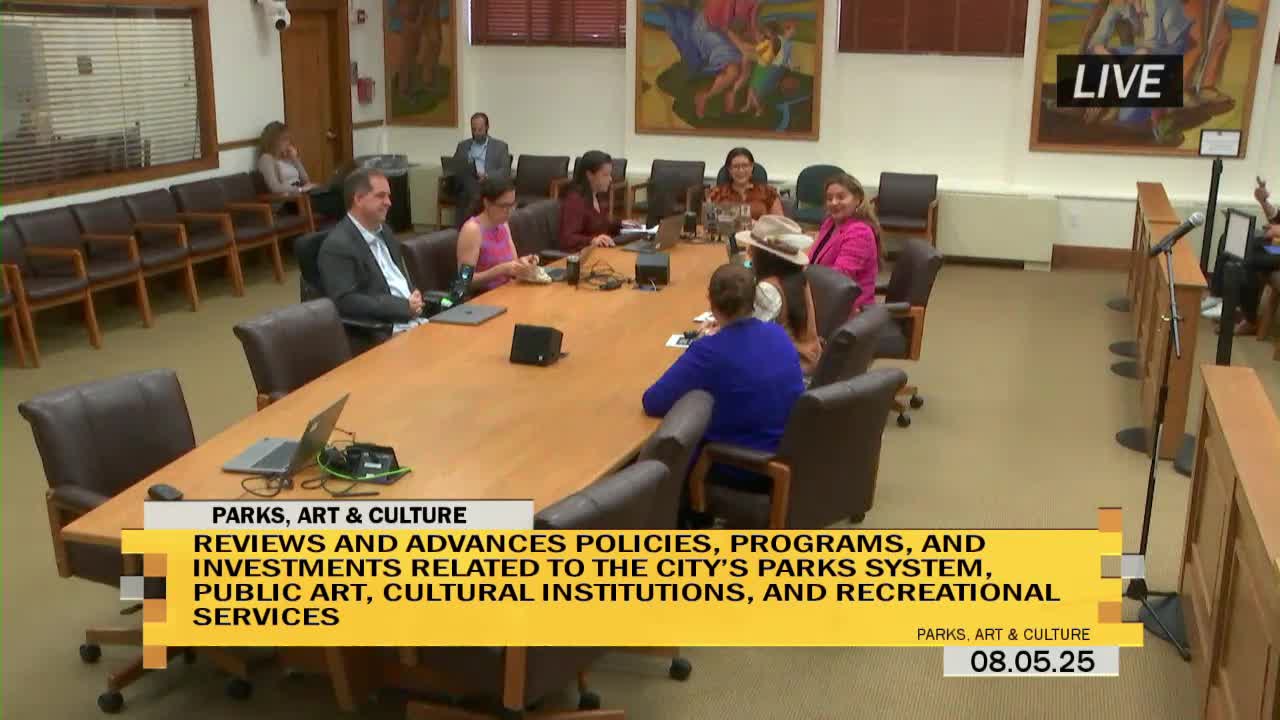
At a monthly meeting of the Parks, Arts and Culture Committee of the Denver City Council, Denver Arts and Venues and the Denver County Cultural Council outlined how $3.5 million in Scientific and Cultural Facilities District (SCFD) tier‑3 funding will be distributed to Denver organizations in 2025. Tatiana Navasnieves, deputy executive director for Denver Arts and Venues, led the presentation alongside Jose Rosales, chair of the Denver County Cultural Council, and Jessica Cato, deputy director at SCFD.
The 2025 allocation to Denver County for tier‑3 organizations totals $3,500,000. The council recommended funding for 87 Denver tier‑3 organizations; the largest individual award this year will be $90,000 and the smallest $2,579. The council reported a 7.3% decrease in available funds compared with 2024 and noted that the program’s revenue is tied to sales and use tax collections.
The funding approach prioritized operating support. Navasnieves said that, historically, about 95% of tier‑3 dollars are directed to general operating support while roughly 5% is reserved for discretionary grants; this year the council moved that 5% into the general operating pool to spread reduced funds more equitably. "Every time you go shopping and spend dollars, know that you are contributing to the health of our arts and cultural sector," Navasnieves said, describing the link between consumer purchases and SCFD revenue.
The council explained eligibility and award limits. Requests may not exceed 25% of an applicant’s prior‑year income or expenses, and the maximum award cap for a single organization this year is $90,000. Rosales said the council uses a standardized evaluation rubric that rates mission and objectives, operations and strategy, equity and accessibility, financial responsibility, and impact on county residents. He described this as the second year the council has used the common rubric, which council members said reduced subjectivity in scoring.
Rosales also described the council’s review process: the Denver County Cultural Council has 11 members (three appointed by named partners and the remainder community members) and, during the April–June review period, members met frequently—sometimes weekly—to read and score nearly 90 applications. The council reported demographic diversity among members and said nine members identify as people of color.
Panelists described how SCFD and county councils interact. Navasnieves said SCFD covers seven counties and that each county’s cultural council recommends tier‑3 awards for organizations whose activities primarily benefit residents of that county. She explained that revenue generated in a county funds tier‑3 awards in that county and that organizations may apply in more than one county if they run programs there, provided the majority of activities for an award are in the county awarding funds.
Council members asked for operational details and district lists. Councilmember Diana Romero Campbell (District 4) asked whether there are application minimums or partial awards; presenters confirmed the 25% limit and the $90,000 cap. Staff said they will provide council offices with lists of funded organizations by council district so members can see which funded groups are located in or serve their districts. Rosales noted a separate eligibility rule: organizations must generally have been a 501(c)(3) for at least five years before applying for SCFD tier‑3 funding.
The presenters named several top‑scoring organizations for 2025, including Su Teatro, Warm Cookies of the Revolution, Colorado Dragon Boat Festival, Cleo Parker Robinson Dance, ACCESS Gallery, Museo Las Americas, Family Theatre Company, Mexican Cultural Center, Latino Cultural Arts Center and City Park Jazz. Presenters said the council considered equity, diversity and inclusion in awarding funds and that the standardized rubric helped surface organizations that consistently scored highest across reviewers.
No motions or formal decisions were taken at the committee meeting; the presentation was informational and staff said there were no action items. The committee adjourned following questions from council members.