
City Council approves Broadway general improvement district; organizers to seek November voter authorization
Get AI-powered insights, summaries, and transcripts
Subscribe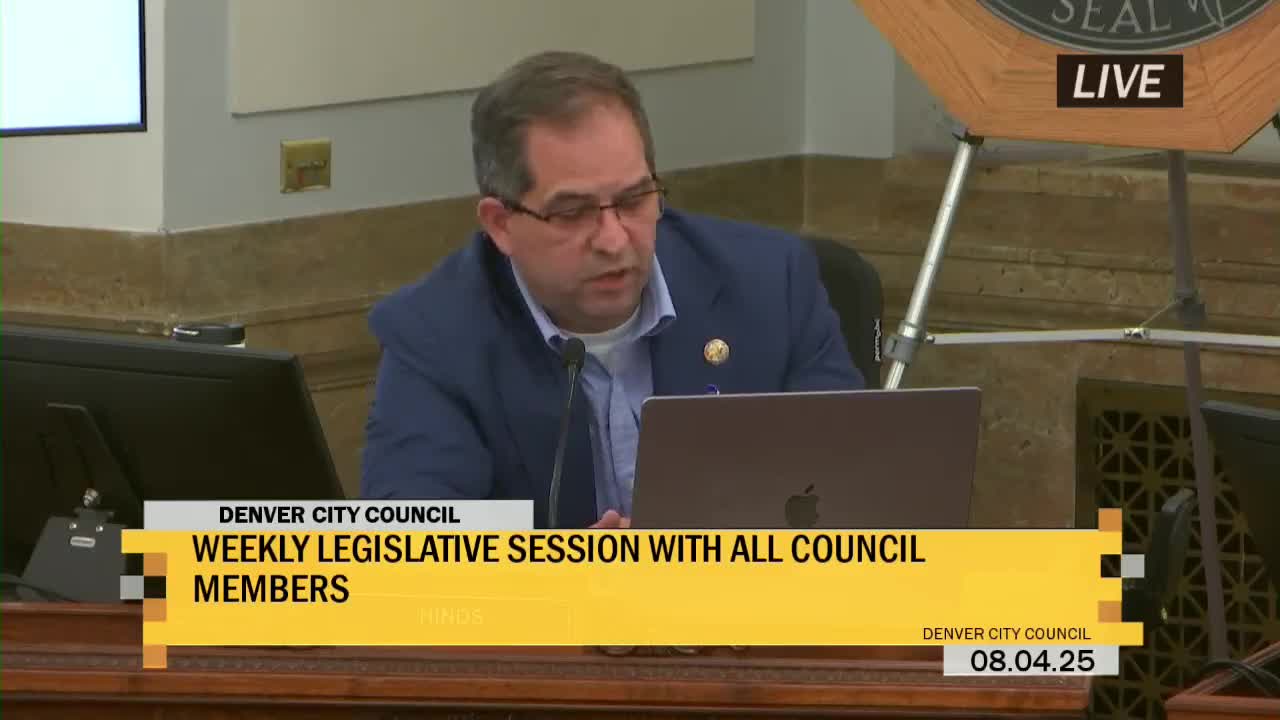
Summary
Council approved creation of a Broadway General Improvement District to fund security, cleaning and marketing; proponents said the district will help small businesses and boost safety, opponents warned about displacement and equity.
Denver City Council on Aug. 4 adopted an ordinance to create the Broadway Denver General Improvement District (GID) and to establish an 11‑member advisory board that will manage the district’s work plan and budget. The council approved the ordinance by roll call vote with 12 ayes; the creation ordinance authorizes the district to pursue voter approval of a mill levy and related matters at the Nov. 4 special election.
Under the ordinance the proposed GID would have authority to levy up to 8.96 mills on taxable property in the district once elector authorization is obtained. Staff estimated the district’s first‑year revenue at roughly $1.1 million beginning in 2026 (the district will not be able to impose the mill levy in 2026 because of timing and would seek collection in 2027). The GID’s initial work plan anticipates spending on safety and security ambassadors, street cleaning, landscape and maintenance, marketing/branding and festival and programming support; some services require intergovernmental agreements (for example, enhanced security services coordinated with the Denver Police Department).
Proponents — including Broadway business owners, the Broadway Merchants Association and neighborhood leaders — said a GID is a locally led, stable funding source to address visible disorder, clean public space and support small independent businesses on South Broadway. “We need more of them to make an impact... Please give us the opportunity to improve our own destiny,” Broadway Merchants president Luke Johnson told council. Multiple business owners and neighborhood representatives described property damage, repeated break‑ins and street conditions that they say deter customers and threaten business viability.
Opponents, including members of community organizations and a few speakers who said they had been involved in other Broadway efforts, urged caution about the role of private security and the potential for displacement and exclusion. During the hearing Councilmember Parady and others pressed for safeguards and for representation on the advisory board; the ordinance requires at least one resident and at least one residential property owner among the advisory board members and allows the councilmember representing the area to serve as an ex‑officio member. City staff said three small existing local maintenance districts (LMDs) in the area would be dissolved if the GID is formed and their functions would fold into the GID; any LMD reserves would transfer to the new district to fund work in those same geographic areas.
What passed: The council adopted the creation ordinance and appointed an initial advisory board in order to allow proponents to proceed to the November ballot asking electors to authorize the mill levy and other matters. The council recorded a 12‑aye vote on the creation ordinance (there was substantial public comment both for and against prior to the vote).
Why it matters: GIDs are locally funded near‑term revenue sources that provide ongoing funding for maintenance, cleaning and place management. If voters approve the levy the Broadway GID would create stable annual revenue to pay for cleaning, safety patrols/ambassadors, planters/trees and marketing — services proponents say are hard to sustain via volunteers and ad‑hoc funding. Opponents cautioned that GID services must be carefully designed to avoid displacement, over‑criminalization of people experiencing homelessness and to ensure accountability.
Next steps: The ordinance authorizes proponents to place the GID question on the Nov. 4 ballot and instructs staff to coordinate procedures for dissolution of the local maintenance districts and for transfer of any reserves. The district advisory board will propose an annual work plan and budget for council approval; some services will require intergovernmental agreements with city agencies.