Get Full Government Meeting Transcripts, Videos, & Alerts Forever!
Get email alerts on the Affordable Housing topic
No spam. Unsubscribe anytime.
Mayor: Federal and state voucher cuts reduced planned housing exits, slowing permanent-housing goals
Summary
City officials told the Denver City Council that cuts to rental vouchers from federal, state and partner agencies have reduced the number of planned housing exits this year, leaving the city behind its midyear target for permanent housing placements even as transitional placements exceed goals.
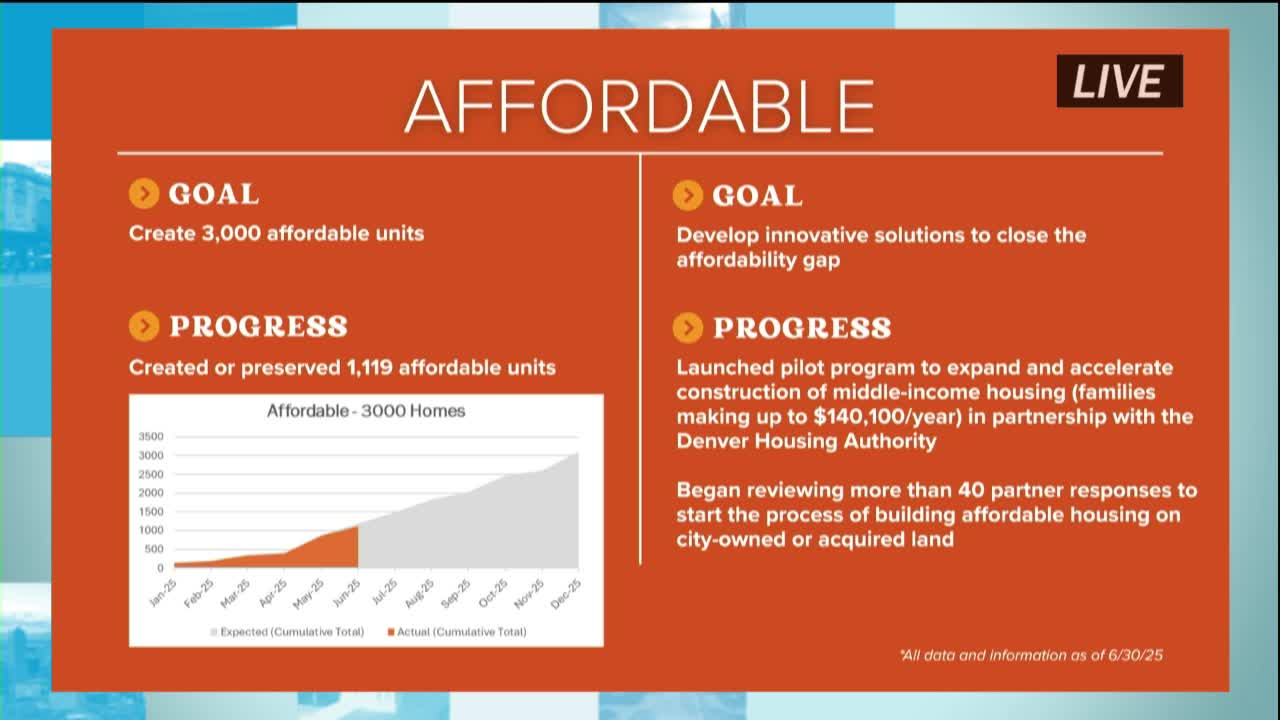
Mayor (name not specified) told the Denver City Council during a midyear goals briefing that cuts to rental vouchers and slower federal processing have trimmed the city’s expected exits into permanent housing. The mayor said the city has so far created about 1,100 affordable units this year, behind a midpoint target of 3,000, and that while the city has moved more than 1,500 people from the street into transitional housing (above a 2,000-year goal’s midpoint) only about 743 people have exited into permanent housing so far — short of the 1,000 target at midyear. The mayor said, “We are seeing right now so far a cut of about a 180 of our vouchers that we use to support people and access to housing.” He added that roughly 100 of those voucher reductions came through partners at the Denver Housing Authority and federal funding decisions, while about 80 were cuts tied to recent state budget reductions. He also said placements tied to U.S. Department of Veterans Affairs vouchers have slowed because of processing and personnel changes at the VA. Why this matters: vouchers and rental subsidies are a primary tool the city uses to move people from transitional settings into permanent housing. The mayor warned that further state or federal cuts could widen the gap between the city’s targets and outcomes. City officials described three distinct strands of activity: acquiring and converting land to expand affordable stock; offering property-tax abatements to developers who commit long-term affordability; and creating partnerships to develop city-owned parcels. The mayor said about 40 development partners have submitted proposals to build on city-owned land. Councilor Kathy Torres asked the administration to consider partnerships beyond city-controlled land — including Denver Housing Authority parcels and community land banks — to accelerate construction of accessory dwelling units and duplexes. The presentation did not propose a formal vote. Council members asked for more detailed data on family homelessness and requested follow-up briefings and dashboards; the mayor said the city maintains a public dashboard with exit and placement details and offered to provide additional breakdowns. Ending: Council members praised progress moving people off the streets but pressed for more detail about family outcomes and the city’s strategy to replace lost voucher capacity. The mayor said the administration will press federal and state partners to restore voucher funding and will work with local housing agencies to find alternatives.